

Calculating ROI on Commercial HVAC Replacement: A 2026 Manager’s Guide
If your commercial cooling system is over a decade old, you aren't just paying for air; you're likely subsidizing a massive, invisible leak in your building's profitability. With the Section 179D tax deduction deadline hitting on June 30, 2026, and a stricter Florida Building Code arriving on December 31, is your current "patch and pray" strategy actually costing you more than a brand-new system? Calculating roi on commercial hvac replacement has never been more critical for Florida managers facing 2026's regulatory shifts and rising energy costs.
We understand the headache of unpredictable repair bills and the constant ping of tenant complaints about stifling humidity. It's exhausting to watch summer energy spikes drain your maintenance budget while an aging unit struggles to maintain a professional environment. You deserve a facility that runs like a sanctuary, not a source of constant stress. Investing in a modern system can restore that peace of mind while protecting your bottom line from future mechanical failures.
This guide will help you master the math behind high-efficiency investments. You'll learn how a strategic replacement can slash operating costs, reduce operational risk, and significantly boost your building's total value. We'll preview the new low-GWP refrigerant standards and provide a clear framework for estimating your payback period before the 2026 code changes take effect.
Key Takeaways
- Identify the critical "tipping point" where cumulative repair costs exceed 50% of your system's value to stop draining your maintenance budget.
- Master the essential math for calculating roi on commercial hvac replacement by using baseline utility logs and specialized load calculations for your facility.
- Discover why Southwest Florida's extreme humidity and non-stop cooling cycles can significantly accelerate your payback period compared to other regions.
- Learn how to leverage Section 179 tax deductions and local energy rebates to offset upfront costs before 2026 regulatory shifts occur.
- Understand the importance of precision right-sizing to ensure your new high-efficiency system delivers the exact performance and comfort your tenants expect.
The Financial Case for Commercial HVAC Replacement in 2026
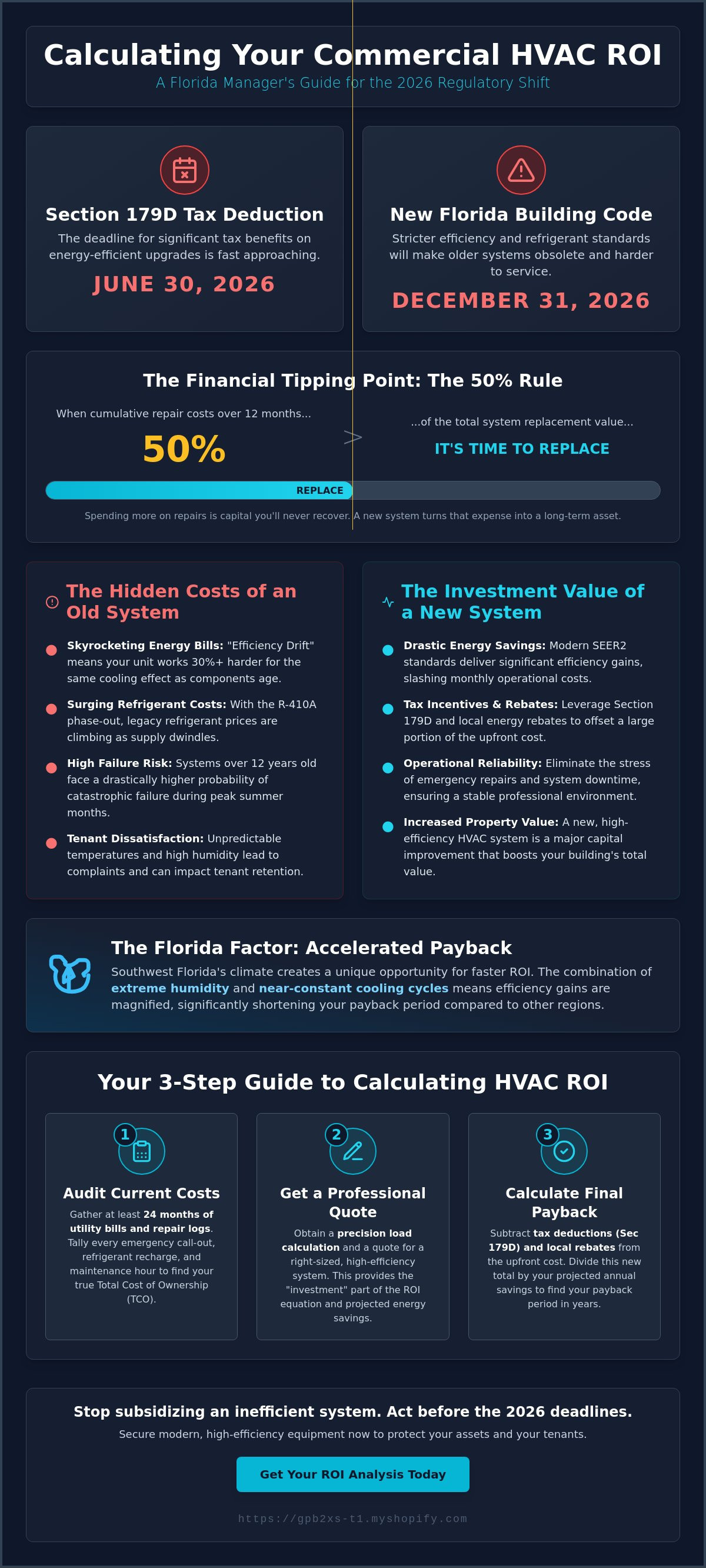
2026 is a definitive turning point for commercial property managers in Florida. Between the looming June 30 deadline for Section 179D tax deductions and the arrival of the 9th Edition of the Florida Building Code on December 31, the window for strategic upgrades is closing fast. If you've been nursing an aging system through another sweltering summer, the math has changed. Calculating roi on commercial hvac replacement is no longer just about energy bills; it is about staying ahead of regulatory shifts that will make older units nearly impossible to maintain affordably.
Many managers use the "50% rule" as their financial compass. If a single repair bill or the cumulative maintenance costs over a 12 month period exceed 50% of the system's total replacement value, you've reached the tipping point. At this stage, every dollar spent on repairs is capital you'll never recover. Modern SEER2 standards have significantly shortened the ROI timeline by offering efficiency gains that older units simply can't match. Furthermore, the 2025 ban on R-410A manufacturing means that the cost of refrigerants for legacy systems will continue to climb as supplies dwindle.
Defining ROI for Commercial Property Owners
True ROI looks beyond the initial price tag. You must evaluate the Total Cost of Ownership (TCO), which includes maintenance, emergency service fees, and energy consumption. Don't overlook the cost of "invisible downtime." When HVAC systems fail, employee productivity drops and tenant satisfaction plummets. In a commercial setting, a building that is too hot or too humid is a building that loses money every hour. HVAC ROI is the intersection of energy savings, tax benefits, and risk mitigation.
The Opportunity Cost of Waiting
Delaying your decision until 2027 could be a multi-thousand dollar mistake. Inflation continues to drive up equipment and labor costs, meaning the same installation will likely cost more next year. When calculating roi on commercial hvac replacement, consider these risks of waiting:
- Legacy Refrigerant Costs: Prices for R-22 and even R-410A are surging as they are phased out of the market.
- Failure Rates: Commercial units over 12 years old face a drastically higher probability of catastrophic failure during peak cooling months.
- Missed Incentives: Waiting past the June 2026 deadline for Section 179D means leaving significant tax deductions on the table.
Your cooling system should be a silent partner in your success, not a source of constant financial stress. Acting now allows you to secure modern, high-efficiency equipment before the next wave of price increases and code restrictions takes effect. It's time to move from a reactive "patch and pray" mindset to a proactive strategy that protects your assets and your tenants.
Step-by-Step Guide to Calculating Your HVAC ROI
Moving from the financial theory of 2026's regulatory shifts to the hard math of your specific building requires a systematic approach. You can't rely on guesswork when your capital budget is on the line. Calculating roi on commercial hvac replacement starts with a clear-eyed look at your past operational data compared against the verified performance of modern technology. By following a structured audit, you can move from "patching and praying" to making a data-driven investment that secures your building's future.
Step 1: Auditing Current Operational Costs
Start by gathering at least 24 months of utility data and repair logs. This window is long enough to capture Florida's seasonal cooling spikes and the true cost of emergency maintenance. Look closely for "Efficiency Drift." This is the gradual, often invisible decline in a unit's cooling capacity as components age and struggle against Southwest Florida's salt air and heat. Don't just track the major repairs; tally up every emergency call-out, refrigerant recharge, and the labor hours your team spends resetting tripped breakers. You should also evaluate your building's envelope. Leaky ductwork or poor insulation can force an old unit to work 30% harder, effectively stealing your ROI before the air even reaches the tenant.
Step 2: Projecting Future Savings with Modern Tech
The leap in technology between a 15-year-old unit and a 2026 model is massive. Modern systems often utilize variable-speed drives (VSD) instead of the old-fashioned "all or nothing" fixed-speed compressors. These units modulate their output to match the exact cooling load, which drastically cuts energy waste during milder mornings. Smart building automation further enhances these savings by adjusting setpoints based on real-time occupancy. To ensure these projections are grounded in reality, consult with reputable commercial HVAC companies that use specialized load calculation software. They can provide a precise estimate of how much less power a new system will draw compared to your current baseline.
Step 3: Calculating Net Present Value (NPV)
Simple payback periods are helpful, but sophisticated managers look at Net Present Value (NPV). This accounts for the time value of money over the expected 15-year lifespan of the equipment. When calculating roi on commercial hvac replacement in 2026, you must factor in current interest rates for equipment financing and the projected inflation of energy costs. A project with a high Internal Rate of Return (IRR) is often a better use of capital than letting that money sit in a low-interest account while your old unit continues to bleed cash. If you are ready to see the numbers for your specific facility, consider scheduling a professional HVAC assessment to get a detailed breakdown of your potential savings.
Finally, don't ignore "soft savings." Improved indoor air quality (IAQ) and consistent humidity control lead to higher tenant retention and fewer sick days for employees. While harder to quantify on a balance sheet, a building that functions as a comfortable sanctuary is always more valuable than one plagued by "hot spots" and musty odors. Use the simple formula of (Total Investment / Annual Operational Savings) to find your baseline payback period, then layer in the tax benefits and risk mitigation to see the full financial picture.
The Florida Factor: How Sarasota’s Climate Accelerates Payback
Non-stop cooling cycles in Southwest Florida change the fundamental math of calculating roi on commercial hvac replacement. While a building in a temperate climate might see its HVAC system rest for months, Sarasota units face a relentless 24/7 workload. This constant operation means that efficiency gains aren't just incremental; they are compounded every single hour. A 20% improvement in energy efficiency pays for itself twice as fast when the compressor never stops. In our region, the sheer volume of run-time turns small efficiency gaps into massive financial leaks.
The "Humidity Penalty" is often the most overlooked factor in commercial cooling budgets. In our region, systems don't just lower the temperature; they must strip gallons of moisture from the air to maintain a safe, professional environment. Latent heat removal is the primary energy drain in Florida commercial spaces. Older units often struggle to balance temperature and humidity, leading to "clammy" offices and over-cooling. Modern systems with dedicated dehumidification cycles solve this problem, reducing the strain on the compressor and slashing utility spikes that occur when a system fights moisture around the clock.
Humidity Control as a Revenue Driver
Beyond electricity savings, precise humidity management is a shield against mold-related liability and structural damage. A musty building isn't just unpleasant; it's a liability that can lead to expensive remediation and tenant departures. Consistent climate control is directly linked to tenant retention. When your facility feels like a protected sanctuary from the outside heat, businesses stay longer and pay higher premiums. High-performance commercial HVAC services in Sarasota are essential for ensuring your system is sized and tuned for these specific moisture loads.
Protecting the Unit from Coastal Elements
In the harsh salt air of Florida, the physical structure of your facility plays a vital role in shielding your HVAC investment. Whether you are maintaining a standard office or a specialized commercial space, the durability of your building's exterior is paramount. For property owners exploring high-performance structural options, Bradberry Steel provides pre-engineered systems that offer the resilience needed to protect sensitive mechanical equipment from environmental degradation.
Maximizing ROI Through Incentives, Tax Credits, and Smart Tech
The upfront cost of a new system often feels like a hurdle, but the 2026 tax landscape provides a rare opportunity to recoup your investment faster than ever. When calculating roi on commercial hvac replacement, you must look beyond the utility bill and focus on the federal and local incentives that expire this year. The Energy Efficient Commercial Buildings Deduction, known as Section 179D, has a firm deadline. Projects must have begun significant physical work or incurred 5% of the total cost by June 30, 2026, to qualify for these substantial deductions. If you miss this window, you are essentially leaving a massive portion of your project's funding on the table.
Local utility providers in Florida, including FPL and Duke Energy, frequently offer rebates for businesses that upgrade to high-efficiency equipment. These programs often target the peak demand periods that plague Southwest Florida during the summer months. By installing a system that draws less power during these critical windows, you can secure immediate cash back. Combining these rebates with federal tax strategies can often cover a significant percentage of your total installation cost before the first cooling season is even over.
Tax Strategies for Commercial Upgrades
Consult with your tax professional to understand how bonus depreciation rules for 2026 can benefit your specific property. Many managers are finding success by structuring a replacement as an operational expense rather than a long-term capital expense. This shift allows for more immediate financial relief on your balance sheet. Utilizing the 179D deduction requires precise documentation of energy savings, which is why working with an expert team is vital. To start documenting your energy needs and potential savings, you should contact our commercial team for a detailed system evaluation.
Technological Force Multipliers
Smart technology acts as a permanent guard for your ROI. HVAC systems account for approximately 39% of the total energy used in commercial buildings; wasting that energy on empty rooms is a common financial drain. Smart thermostats and occupancy sensors prevent this by adjusting cooling loads based on real-time room usage. Integrating your new units with an existing Building Management System (BMS) allows you to catch "ROI Leaks" through remote monitoring before they turn into catastrophic failures.
Finally, the long-term math depends on consistency. A BulletProof Air maintenance plan ensures that your high-efficiency system actually maintains its rated performance. Without regular care, even the most advanced 2026 models will suffer from efficiency drift as coils clog and sensors lose calibration. Calculating roi on commercial hvac replacement requires you to value the extended lifespan and reduced risk that a professional maintenance schedule provides. It turns a one-time purchase into a durable, high-performance asset for your facility.
Why Precision Installation is the Final Piece of the ROI Puzzle
Even the most advanced 2026 cooling technology won't save you a dime if it's installed incorrectly. This "Installation Gap" is the hidden predator of commercial profitability. A high-efficiency unit that is poorly commissioned can lose up to 30% of its rated efficiency on day one. When you are calculating roi on commercial hvac replacement, the skill of the technician is just as vital as the SEER2 rating on the equipment box. Precision installation ensures that the complex variable-speed compressors and sensors actually perform as the manufacturer intended.
Duct sealing is another critical factor in realizing your energy savings. In many Sarasota commercial buildings, leaky or uninsulated ductwork allows cooled air to escape into ceiling plenums before it ever reaches your tenants. This forces your new system to work harder and run longer, effectively erasing the ROI you worked so hard to calculate. Securing expert AC installation in Sarasota is the only way to ensure your building's envelope and delivery system are optimized for the new equipment. It also protects your investment by ensuring the manufacturer's warranty remains valid; many brands will deny claims if they find the system was not installed to their exact specifications.
Right-Sizing vs. Oversizing
Many contractors fall into the trap of "bigger is better" and install oversized units. This is a costly mistake. An oversized system will "short cycle," meaning it turns on and off rapidly. This prevents the unit from running long enough to remove Florida's intense humidity, leaving your workspace feeling clammy and uncomfortable. BulletProof Air utilizes Manual N load calculations to ensure commercial accuracy. We analyze your building's square footage, window orientation, and occupancy levels to find the perfect fit. Right-sizing ensures maximum occupant comfort and prevents the premature wear and tear associated with frequent cycling.
The BulletProof Guarantee
BulletProof Air is committed to total accuracy. We understand that a service failure is a direct threat to your business operations. Our technicians are trained to deliver definitive solutions that eliminate the need for follow-up visits. We treat your commercial workspace as a sanctuary; a peaceful, protected environment where your team can focus on their work without the distraction of "hot spots" or mechanical noise. We act as your dependable partners in restoring and maintaining a safe, productive space. Don't leave your facility's future to chance. Contact BulletProof Air for a comprehensive commercial ROI assessment today. Our team will provide the precision and expertise needed to ensure your 2026 HVAC investment delivers the long-term durability your business deserves.
Secure Your Building's Financial Future
The window of opportunity in 2026 is closing fast. Between the June 30 tax deduction deadline and the arrival of the 9th Edition of the Florida Building Code, property managers must act now to avoid rising repair costs and regulatory penalties. Mastering the process of calculating roi on commercial hvac replacement allows you to move from reactive repairs to proactive asset management. You've seen how Sarasota's unique humidity and salt air accelerate the need for high-durability solutions that protect your tenants and your bottom line.
BulletProof Air specializes in high-durability commercial solutions designed to withstand Southwest Florida's intense environment. Our expert technicians serve Sarasota and Bradenton with a focus on precision installation and fast response times to protect your business continuity. We don't just install equipment; we restore your facility as a reliable sanctuary for your business operations. Don't let an aging unit drain your profitability any longer.
Secure Your Business Comfort with a BulletProof Commercial HVAC Estimate today. It's time to invest in a system that works as hard as you do.
Frequently Asked Questions
What is the average payback period for a commercial HVAC replacement?
The average payback period for a commercial system typically ranges from three to seven years. In Southwest Florida, high electricity rates and non-stop cooling cycles often accelerate this timeline toward the lower end of that range. Factors like the Section 179D tax deduction and energy savings of up to 30% can significantly shorten your window for a full return on investment.
How much can I save on my energy bill with a new SEER2 compliant system?
Upgrading to ENERGY STAR certified light commercial equipment can reduce your energy use by approximately 17% compared to standard models. When you combine high-efficiency hardware with smart building controls and a professional maintenance plan, total HVAC energy reductions often reach 20% to 30%. These savings are a cornerstone when calculating roi on commercial hvac replacement for your facility.
Can I deduct the full cost of a commercial HVAC system in one year?
Yes, Section 179 of the federal tax code allows many businesses to expense the entire cost of commercial equipment in the year it is placed in service. The Section 179D deduction also provides specific incentives for energy-efficient building upgrades. You must act quickly; projects must meet significant physical work requirements by the June 30, 2026, deadline to qualify for these specific 2026 deductions.
How does humidity control impact the ROI of my cooling system?
Effective humidity control directly reduces the latent heat load on your compressor, preventing the system from over-cooling just to reach a comfortable moisture level. In Florida, this prevents "clammy" air and protects your property from mold-related liabilities. A system that manages moisture precisely reduces energy waste and prevents expensive tenant turnover, which protects your long-term profitability.
Should I replace the ductwork when I replace the commercial AC unit?
You should have your ductwork professionally tested for leaks and insulation integrity during the replacement process. Leaky ducts can waste up to 30% of your new system's conditioned air before it ever reaches your tenants. Sealing or replacing damaged ductwork ensures that the high-efficiency performance you are paying for is actually delivered to the workspace.
What happens to my ROI if I don't have a regular maintenance plan?
Your ROI will quickly evaporate through "efficiency drift" if you neglect regular maintenance. Clogged coils and uncalibrated sensors force your new unit to work harder and consume more electricity every month. Routine service extends the lifespan of your equipment and prevents the catastrophic emergency repair bills that can destroy your annual maintenance budget. Calculating roi on commercial hvac replacement requires factoring in these long-term preservation costs.
Is it better to lease or buy a new commercial HVAC system for ROI purposes?
Buying typically offers the highest long-term ROI because you can claim significant tax deductions and bonus depreciation. However, leasing can be a strategic move if you prefer to structure the upgrade as an operational expense rather than a capital one. This approach preserves your liquid capital for other business needs while still allowing you to benefit from lower monthly utility bills.
How do I know if my current commercial unit is 'right-sized' for my building?
Signs of an improperly sized unit include frequent short-cycling or high indoor humidity levels despite the air feeling cold. If your system turns on and off every few minutes, it's likely oversized and wasting energy. The only way to confirm the correct tonnage for your building is through a professional Manual N load calculation that accounts for your specific occupancy and envelope.