

Commercial Kitchen HVAC Requirements: The 2026 Florida Business Guide
Imagine it is a humid Friday night in Bradenton. Your kitchen line is hitting 98 degrees, staff morale is melting, and a surprise fire inspector just walked through the back door. For many Florida restaurateurs, this nightmare is a reality because their ventilation fails to meet the strict 8th Edition Florida Building Code standards. You already know that keeping a kitchen cool while managing grease and smoke feels like a losing battle against the local climate. It is stressful to worry about failing an inspection or watching your energy bills climb because of an inefficient, struggling setup.
The good news is that you can master the complex commercial kitchen hvac requirements to create a safe, compliant, and comfortable workspace. We promise to help you turn your kitchen into a precision-balanced ecosystem that handles everything from the 400 CFM makeup air rule to NFPA 96 cleaning schedules. This guide provides a clear roadmap for Sarasota and Bradenton owners to achieve a BulletProof system that lowers humidity and passes every inspection. We will explore the critical differences between Type I and Type II hoods, current fire suppression mandates, and the smart technology that helps local businesses manage the 10% to 20% cost increase typically associated with code compliance.
Key Takeaways
- Understand how to align your operation with the 8th Edition Florida Building Code and NFPA 96 to eliminate fire risks and pass inspections.
- Learn to balance exhaust and makeup air systems to meet all commercial kitchen hvac requirements while maintaining perfect building pressure.
- Gain clarity on selecting Type I versus Type II hoods to protect your investment and ensure your ventilation matches your specific cooking equipment.
- Discover the secret to managing Florida humidity through precise CFM calculations and high-performance dehumidification strategies.
- Navigate the permitting landscape in Sarasota and Bradenton with a professional design-build approach that ensures your system is reliable from day one.
Why Commercial Kitchen HVAC Requirements Matter in 2026
In the intense heat of a Sarasota summer, your kitchen is more than just a place to prep food. It is a high-pressure environment where heat, moisture, and grease collide. If your ventilation system fails, your entire business grinds to a halt. Meeting current commercial kitchen hvac requirements is not just about checking a box for a local inspector. It is about building a "BulletProof" foundation that protects your staff, your property, and your profit margins. A properly balanced system ensures that smoke and odors stay in the kitchen while fresh, cooled air keeps your dining room comfortable for guests.
Safety remains the primary driver behind these regulations. Grease is fuel. Without a compliant exhaust system, vaporized grease settles inside your ductwork, creating a massive fire hazard. Following the NFPA 96 standards ensures this grease is captured and removed before it can ignite. Beyond fire safety, a balanced system protects the structural integrity of your building. Excessive heat and humidity can lead to mold growth and wood rot in your walls. By investing in a compliant setup, you are essentially buying an insurance policy for your real estate. While meeting these codes can add 10% to 20% to your initial project costs, the long term savings in energy overhead and equipment lifespan are undeniable.
The Governing Bodies: Who Sets the Rules?
The rules for Florida kitchens are clear and uncompromising. The 8th Edition Florida Building Code (2023) serves as the primary legal framework for all new installations and major renovations. This code incorporates the 2021 International Mechanical Code (IMC), which provides the technical blueprint for duct construction and fan sizing. For fire safety, the industry looks to NFPA 96. This standard dictates everything from hood clearance to the frequency of professional cleanings. In our region, you must also account for specific Sarasota and Bradenton municipal amendments. These local rules often focus on noise ordinances for exterior fans and specific permitting paths that can delay your opening if ignored.
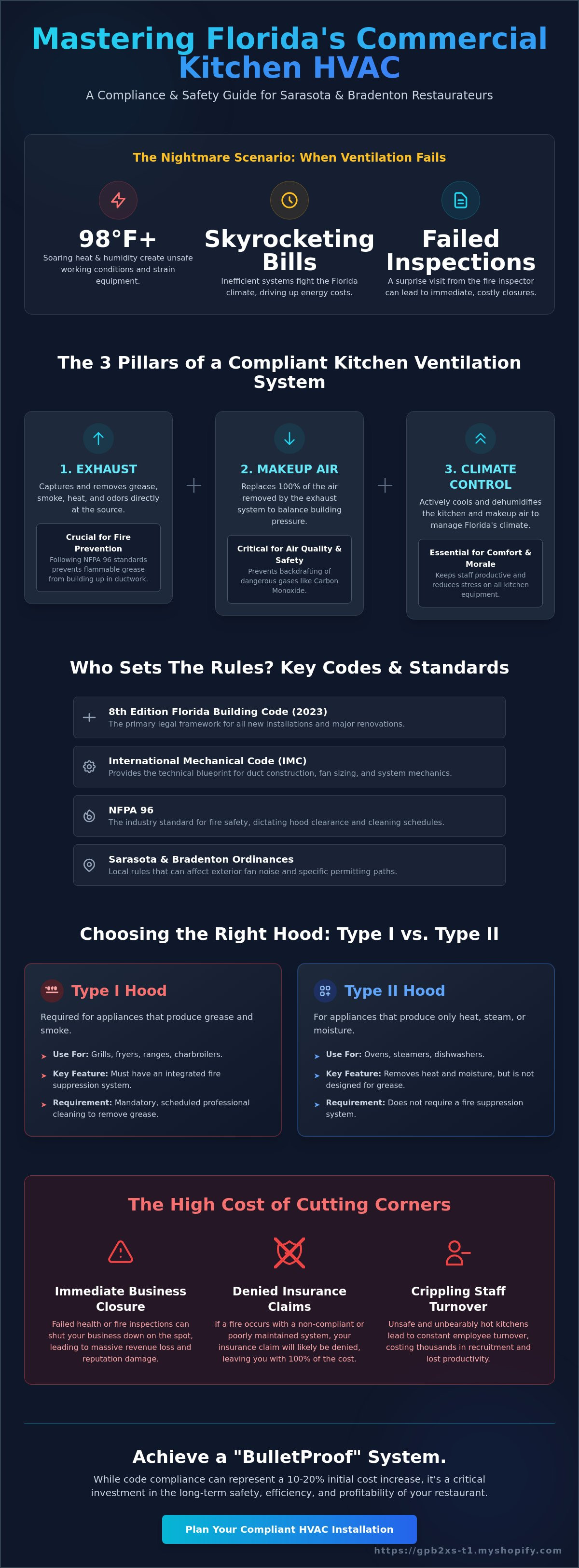
To understand the mechanics of these rules, it helps to look at The Three Pillars of Commercial Kitchen Ventilation. This framework explains how exhaust, makeup air, and climate control must work in perfect harmony to maintain air quality and pressure. If one pillar fails, the entire system collapses, leading to "backdrafting" where dangerous gases like carbon monoxide are pulled back into the building.
Risks of Non-Compliance for Local Businesses
The consequences of ignoring commercial kitchen hvac requirements are swift and expensive. A single failed health inspection due to poor air quality can lead to an immediate business closure. This loses you revenue and damages your reputation in the tight-knit Bradenton food scene. Insurance companies are also becoming stricter. If a kitchen fire occurs and your records show you skipped the semi-annual service for your Type I hood, your claim will likely be denied. This leaves you responsible for 100% of the damages. Finally, consider your team. Kitchen staff facing 100 degree temperatures and high humidity will quit. High turnover costs you thousands in training and lost productivity, making a compliant HVAC system a vital tool for employee retention.
The Three Pillars of Commercial Kitchen Ventilation
A commercial kitchen is a high-speed machine. If you don't balance the airflow, the machine breaks. Many business owners think a hood is just a metal box with a fan, but meeting commercial kitchen hvac requirements requires a three-way harmony between exhaust, makeup air, and climate control. You cannot have one without the others. If you pull air out but don't put it back, your building will struggle to breathe. If you don't cool the air you bring in, your staff will suffer in the Florida humidity. This balance is what creates a BulletProof environment.
The system relies on three distinct functions. First, the exhaust system captures and removes the byproducts of cooking. Second, you must replace that lost volume. Makeup Air is the air brought in from the outside to replace air exhausted by the hood system. Third, you must provide active climate control. In Sarasota, ignoring the cooling pillar is a recipe for disaster. If you only vent the heat but don't actively dehumidify and cool the space, your kitchen can easily reach 100 degrees by lunch rush. This puts immense strain on your refrigeration and your people.
The Role of the Exhaust Hood
Your hood is your first line of defense against fire and filth. Type I hoods are mandatory for any equipment that creates grease or smoke, such as fryers, griddles, or charbroilers. These units include baffle filters designed to trap grease before it enters the ductwork. Type II hoods are reserved for appliances that produce only heat and steam, like dishwashers or some ovens. To pass inspection in Bradenton, your hood must have at least a 6-inch overhang on all open sides of the cooking equipment. Mounting height is equally critical; if the hood is too high, smoke escapes into the dining room. If it's too low, it creates a safety hazard for your chefs.
Makeup Air (MUA) and Building Pressure
When your exhaust fan pulls 2,000 CFM (Cubic Feet per Minute) out of the building, that air has to come from somewhere. Without a dedicated MUA system, your building falls into negative pressure. You'll notice doors that are nearly impossible to pull open or a loud "whistling" sound through the windows. In our humid climate, bringing in raw, 90-degree air from outside can ruin your indoor air quality and lead to mold. This is why we prioritize conditioned makeup air systems. These units pre-cool the air before it enters your kitchen sanctuary.
To keep your team safe and maintain compliance with OSHA ventilation standards, your MUA must be interlocked with the exhaust fan. This ensures both systems activate simultaneously. If you are struggling with a kitchen that feels like a sauna, you may need to upgrade to a BulletProof ventilation setup. We ensure your system is balanced correctly the first time, preventing the suction issues that plague so many local restaurants.
Type I vs. Type II Hoods: Selecting the Right System
Choosing the wrong ventilation hood is a mistake that can cost you thousands in fines and lost productivity. In the Sarasota and Bradenton area, your choice determines not only your fire safety profile but also how your kitchen handles the relentless local humidity. The commercial kitchen hvac requirements for a burger joint with three fryers are vastly different from those of a bakery or a high-volume coffee shop. You must match the hood to the specific effluent your appliances produce to maintain a safe, BulletProof operation.
Material choice is a critical factor often overlooked by national guides. While galvanized steel might work in drier climates, Florida's salt air is corrosive. We prioritize stainless steel construction for all local installations. Stainless steel resists the pitting and rusting that occurs when salty coastal air meets kitchen grease and steam. Ensuring your system is built with high-grade materials from the start means you won't be replacing rusted-out components in three years.
Type I: Grease-Laden Vapors
If your menu involves frying, grilling, or charbroiling, a Type I hood is mandatory. These systems are designed to capture grease-laden vapors before they settle on your walls or inside your ceiling. Because grease is highly flammable, Type I hoods must include an integrated fire suppression system. Florida law requires these fire systems to be inspected every six months to remain compliant.
The ductwork for these hoods is also specialized. It must be constructed of 16-gauge steel or 18-gauge stainless steel with liquid-tight, continuous external welds. To ensure your design meets professional benchmarks, our technicians follow the ASHRAE Standard 154. This standard provides the technical foundation for proper airflow and capture velocities, preventing smoke from spilling into your dining sanctuary.
Type II: Heat, Steam, and Odors
Type II hoods are your solution for "clean" heat. You'll typically find these over dishwashers, pasta cookers, and some light-duty ovens. Their primary job is moisture and odor control. In a Florida kitchen, steam is a silent enemy. Without a Type II hood, that moisture settles on cold surfaces, leading to rapid mold growth and structural damage.
While Type II hoods don't require the same heavy-duty fire suppression as grease hoods, they are still vital for staff comfort. Managing the latent heat from a commercial dishwasher keeps your kitchen from feeling like a swamp. Some small appliances, such as certain microwave ovens or small convection units, may be exempt from hood requirements under the 8th Edition Florida Building Code. However, we always recommend a professional evaluation to ensure your specific equipment layout doesn't create a "heat pocket" that overworks your main AC system.
Calculating HVAC Sizing and Florida Humidity Control
Sizing a system for a Sarasota restaurant is a high-stakes math problem. You cannot simply guess the capacity based on square footage. To meet modern commercial kitchen hvac requirements, you must calculate the required Cubic Feet per Minute (CFM) based on the total BTU ratings of your cooking line. A heavy-duty charbroiler generates significantly more radiant heat than a sandwich press, requiring a more aggressive airflow to keep the line safe. If you undersize the system, heat will build up until your staff physically cannot work. Standard residential AC sizing fails in kitchens because it cannot handle the extreme sensible heat load.
In Florida, the "latent heat" factor is your biggest challenge. This refers to the energy required to remove moisture from the air. Because our local humidity often sits above 80%, your HVAC system must work twice as hard to keep the kitchen dry. If your system only cools the air without removing moisture, you end up with a "cold swamp" effect. This leads to slippery floors, rapid food spoilage, and massive mold risks behind your stainless steel prep tables. A BulletProof system is designed to balance the sensible heat from the stoves with the latent moisture load from the Gulf air.
Managing the Florida Humidity Load
Many owners try to solve heat issues by installing a massive, oversized AC unit. This is a dangerous mistake. An oversized unit cools the room so fast that it shuts off before it can finish the dehumidification cycle. This leaves your kitchen damp and prone to structural damage. We solve this by using Dedicated Outdoor Air Systems (DOAS). These units focus specifically on pre-cooling and drying the makeup air before it ever reaches your hood. It is a critical component of our indoor air quality solutions, ensuring your kitchen remains a comfortable sanctuary rather than a breeding ground for bacteria.
Energy Recovery and Demand Control
Running a full-power exhaust fan 24/7 is a drain on your profits. Smart restaurateurs in Bradenton are shifting to Demand-Controlled Ventilation (DCV). These systems use sensors to detect heat and smoke levels, automatically adjusting fan speeds to match your cooking intensity. During the 3:00 PM prep lull, your fans might drop to 50% capacity, which can reduce your monthly energy overhead by up to 30%. While meeting the 8th Edition Florida Building Code can add 10% to 20% to your initial project cost, these high-efficiency systems typically pay for themselves within 24 months through lower utility bills.
Don't let an imbalanced system burn through your profits. If your kitchen is currently a humid, high-cost nightmare, schedule a BulletProof system audit today to restore efficiency and comfort to your business.
Planning Your Commercial HVAC Installation in Sarasota
Opening a restaurant in Southwest Florida involves a mountain of paperwork, but your mechanical permits shouldn't be the thing that stops your grand opening. Meeting the commercial kitchen hvac requirements in Sarasota County or the City of Bradenton requires a design-build partner who understands the local landscape. We don't just drop a unit on the roof and walk away. We coordinate with engineers, architects, and fire marshals to ensure your system is compliant from the first sketch. Investing in a professional commercial HVAC installation saves you thousands by avoiding the failed inspection loop that plagues DIY or cut-rate projects.
Our coastal location means we don't just worry about heat. We worry about hurricanes. Every roof penetration and equipment curb must be engineered to withstand wind speeds of at least 150 mph according to the 8th Edition Florida Building Code. If your contractor uses standard residential flashing, the first tropical storm will send water straight into your fryers. We use heavy-duty, wind-rated curbs and liquid-tight seals that protect your building's integrity. This attention to detail ensures your kitchen remains a sanctuary, even when the weather turns.
The BulletProof Air Installation Checklist
A successful launch depends on the final 5% of the build. Before we hand over the keys, we perform a rigorous series of tests. We verify that your fire suppression system is perfectly interlocked with the fuel shut-off and exhaust fans. We test fan rotation because a fan spinning backward is a common mistake that kills airflow. Finally, we perform a total air balance. This ensures that the 2,000 CFM you are exhausting is being replaced by 2,000 CFM of fresh, cooled air. Once the system is live, we help you establish a commercial maintenance plan to protect your investment and keep your warranty valid.
Why Choose a Local Sarasota Expert?
Sarasota sits right on the Gulf. This means your exterior equipment faces constant salt-air corrosion. We specify 316-grade stainless steel or specialized coastal coatings for all outdoor components to prevent premature rust. A national contractor might not realize that salt air can eat through a standard condenser coil in less than five years. We also maintain strong relationships with local building inspectors in Bradenton and Sarasota. We know exactly what they look for during a final walk-through, which often leads to faster approvals and fewer delays. When an emergency happens on a Friday night, you need a local team that can be on-site in an hour to keep your kitchen open and your staff safe.
Build Your BulletProof Kitchen Sanctuary Today
Your restaurant is a significant investment, and your HVAC system is its heartbeat. Managing the 8th Edition Florida Building Code and NFPA 96 standards doesn't have to be a source of constant stress. By mastering the balance between Type I grease capture and conditioned makeup air, you protect your staff and your bottom line. We have explored how proper sizing and dehumidification prevent the humid "cold swamp" effect that ruins so many local businesses. Now, it is time to turn these commercial kitchen hvac requirements into a competitive advantage for your Sarasota or Bradenton establishment.
Don't let a failed inspection or a broken exhaust fan during a 95 degree July lunch rush shut your doors. Our expert technicians are trained in the latest NFPA 96 safety standards and provide 24/7 emergency commercial support to keep your kitchen running perfectly. We are here to ensure your workspace remains a cool, compliant, and efficient sanctuary for your team. BulletProof Air delivers the reliability you need to focus on what you do best: serving your customers.
Schedule Your Free Commercial HVAC Consultation with BulletProof Air Today and get the reliable, expert guidance your business deserves. We look forward to helping you build a system that lasts.
Frequently Asked Questions
What is the difference between a Type I and Type II kitchen hood?
A Type I hood is designed specifically for appliances that produce grease and smoke, such as fryers, griddles, and charbroilers. These systems must include a built-in fire suppression system and liquid-tight welded ductwork. A Type II hood handles only "clean" heat, steam, and odors from equipment like dishwashers or pasta cookers. While Type II hoods don't require fire suppression, they are vital for managing moisture levels in the Florida climate.
How much makeup air is required for a commercial kitchen in Florida?
Florida law mandates a makeup air system for any commercial kitchen exhaust exceeding 400 CFM. You must replace approximately 90% of the air you exhaust to prevent dangerous pressure imbalances. In Sarasota, we recommend using conditioned makeup air to avoid bringing raw, 90 degree humidity into your workspace. This ensures your commercial kitchen hvac requirements are met while keeping your staff comfortable and your energy bills manageable.
Does my pizza oven require a Type I grease hood?
Most commercial pizza ovens require a Type I hood if they produce grease-laden vapors or use solid fuels like wood or charcoal. If you operate a wood-fired hearth, NFPA 96 standards mandate a Type I system with monthly professional cleaning. Some electric conveyor ovens may qualify for a Type II hood, but you must verify this with your local Sarasota or Bradenton building department before installation to avoid costly fines.
How often do I need to have my commercial kitchen exhaust system cleaned?
Cleaning frequency is dictated by your cooking volume under NFPA 96 standards. High-volume operations, such as 24-hour fast-food restaurants, must have their systems cleaned quarterly. Moderate-volume kitchens typically require semi-annual service, while low-volume operations like seasonal snack bars may only need an annual cleaning. If you use solid-fuel cooking equipment, you are legally required to have the system cleaned every month to prevent grease fires.
Can I use my existing rooftop AC unit for a kitchen expansion?
You likely cannot use a standard rooftop unit for a kitchen expansion because the sensible heat load is too high. Kitchens generate intense radiant heat that standard commercial units aren't designed to neutralize. Adding more cooking equipment usually pushes your system beyond its capacity, leading to rapid compressor failure and high humidity. A professional load calculation is necessary to determine if your current equipment can handle the increased demand.
What happens if my kitchen has negative air pressure?
Negative pressure occurs when your exhaust fans pull out more air than your makeup air system replaces. You'll notice exterior doors that are nearly impossible to open or a "whistling" sound through window seals. More dangerously, negative pressure can cause backdrafting. This pulls carbon monoxide from gas water heaters or ovens back into the kitchen sanctuary, creating a life-threatening health risk for your employees and guests.
Are there energy-saving requirements for commercial kitchen ventilation in 2026?
The 8th Edition Florida Building Code (2023) emphasizes energy-efficient designs like Demand-Controlled Ventilation (DCV). These systems use heat and smoke sensors to adjust fan speeds automatically, which can reduce your monthly energy overhead by up to 30%. While not always mandatory for small repairs, these efficiency measures are often required for new construction or major renovations in the Sarasota area to meet modern performance standards.
What fire suppression system is required for a commercial range?
A UL 300 compliant wet chemical fire suppression system is mandatory for all commercial ranges located under a Type I hood. This system must be interlocked to automatically shut off the gas or electric power to the appliances when the system triggers. Florida law requires these fire systems to be inspected and certified every six months by a licensed contractor to ensure they remain functional and compliant with local safety codes.
If you would like maintenance or repair assistance with your Florida Air Conditioner, contact BulletProof Air Or call: 941.599.9999 for more information about how we can help.