
Ductless Mini Split vs. Window AC: Which is Best for Your Florida Home?
That window AC unit propped in your bedroom might be the most expensive "cheap" decision you ever make for your Florida home. When you're weighing a ductless mini split vs window ac, the upfront price tag tells only half the story, and in Southwest Florida's relentless heat and humidity, the other half shows up on your monthly energy bill.
You already know the frustration. The rattling hum that drowns out conversation. The gap around the unit that lets in warm, humid air, and the nagging feeling that anyone could push it right out of the frame. Worst of all, that one room that never quite cools down no matter how low you set the dial.
Your instinct to look for something better is exactly right. In this guide, you'll discover the critical differences in efficiency, installation, security, and long-term cost between these two cooling solutions, so you can make a confident, informed decision for your home. We'll break down what each system actually delivers in Florida's climate, where each one makes sense, and why the right choice could turn your home into the quiet, cool sanctuary it's supposed to be.
Key Takeaways
- When comparing a ductless mini split vs window ac, the upfront cost difference is far less significant than the long-term efficiency gap — especially under Florida's relentless cooling demands.
- Mini-splits deliver whisper-quiet operation and superior humidity control, making them the stronger choice for bedrooms, sunrooms, and any space where comfort truly matters.
- Window units have a legitimate role in specific situations, but understanding exactly when each system makes sense can save you from a costly, uncomfortable mistake.
- SEER2 ratings directly impact your monthly utility bill — and the right system choice for your Sarasota home could mean significant savings over a five-year period.
- Professional installation is the deciding factor between a cooling system that performs and one that fails — learn what precision installation actually involves and why it matters.
Cooling Without Ducts: The Window AC vs. Ductless Mini-Split Showdown
Before you can make a smart decision, you need to understand what these two systems actually are, not just what they look like, but how they work and why that matters in a Florida home. The ductless mini split vs window ac debate isn't really about size or price. It's about two fundamentally different engineering philosophies: one built for temporary convenience, the other engineered for permanent, precision climate control.
How Window Units Work
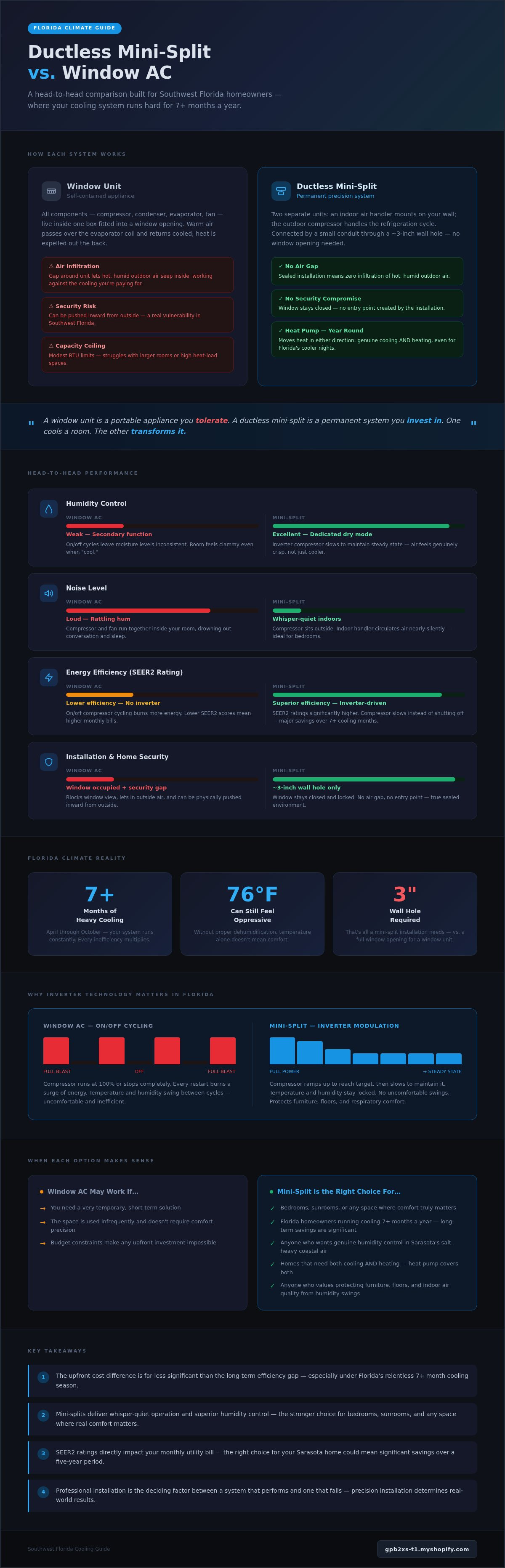
A window AC is a self-contained appliance. Every component, the compressor, condenser, evaporator, and fan, lives inside a single rectangular box. Warm room air passes over the evaporator coil, loses its heat, and returns to the room cooled. The heat itself gets expelled through the back of the unit, outside your window.
That design creates three unavoidable problems for Florida homeowners:
- Air infiltration: The gap between the unit and the window frame is a direct pathway for hot, humid outdoor air to seep inside, working against the very cooling you're paying for.
- Security vulnerability: A window unit can be pushed inward from outside. It's not a theoretical risk; it's a real one that homeowners in Southwest Florida should take seriously.
- Capacity ceiling: Most residential window units top out at relatively modest BTU ratings, which limits how effectively they can handle larger rooms or spaces with high heat loads.
How Ductless Mini-Splits Work
A ductless mini-split divides the work between two separate components. The indoor air handler mounts on a wall inside your room and circulates conditioned air quietly and efficiently. The outdoor compressor unit handles the heavy mechanical work of the refrigeration cycle, and it does that work outside, away from your living space.
These two units connect through a small conduit carrying refrigerant lines, a power cable, and a condensate drain. That conduit requires only a small hole through the wall, roughly three inches in diameter. No window opening. No air gap. No security compromise.
Critically, mini-splits operate as heat pumps. They don't just cool; they move heat energy in either direction, making them a genuine year-round comfort solution. That distinction matters even in Florida, where winter nights can drop enough to make a heating mode genuinely useful.
This is the core difference worth understanding: a window unit is a portable appliance you tolerate, while a ductless mini-split is a permanent system you invest in. One cools a room. The other transforms it.
Efficiency and Comfort: Why Florida Homeowners are Moving Away from Window Units
Performance is where the ductless mini split vs window ac debate stops being theoretical and starts hitting your daily life. Florida's climate doesn't give you a grace period. From April through October, your cooling system runs hard, and every weakness in that system becomes impossible to ignore. The homeowners making the switch to mini-splits aren't doing it for the aesthetics. They're doing it because the difference in real-world comfort is impossible to argue with once you've experienced it.
The Battle Against Florida Humidity
Humidity is the enemy that temperature alone can't defeat. Sarasota's air carries serious moisture year-round, and a room that reads 76°F but feels clammy and oppressive isn't comfortable. It's just less miserable. Window units are designed primarily to reduce temperature; dehumidification is secondary, and it shows. They cycle on and off in broad, inefficient swings that leave moisture levels inconsistent at best.
Mini-splits handle this fundamentally differently. Most modern units include a dedicated dry mode that prioritizes moisture removal independently of temperature, so your indoor air feels genuinely crisp rather than just cooler. The real advantage, though, is inverter technology: instead of shutting off entirely when the target temperature is reached, an inverter-driven compressor slows down and maintains a steady state, keeping both temperature and humidity locked at your chosen level without the uncomfortable swings a window unit produces.
In Southwest Florida's salt-heavy coastal air, that consistency isn't a luxury. It protects your furniture, your floors, and your respiratory comfort.
Restoring Your Home Sanctuary
Think about what a window unit actually does to a room beyond cooling it. The mechanical rattle of a compressor running inches from your head disrupts sleep. The unit itself blocks natural light and eliminates any view you had. And the gap around the frame, no matter how carefully you seal it, remains a vulnerability that no homeowner in Southwest Florida should accept.
Mini-splits eliminate all three problems at once:
- Whisper-quiet operation: Indoor air handlers typically operate at noise levels comparable to a library. The compressor noise stays outside where it belongs.
- Advanced filtration: Multi-stage filter systems capture dust, allergens, and mold spores, a genuine benefit in Florida's humid, high-pollen environment.
- Windows stay locked: No opening, no gap, no entry point. Your home's security perimeter stays intact.
- Zoned comfort: Cool the rooms you're actually using without conditioning empty spaces, which translates directly to lower monthly energy costs.
That combination of quiet, clean, secure, and efficient cooling is what transforms a house into the sanctuary it's supposed to be. If you're ready to move beyond the limitations of window-mounted appliances, explore professional mini-split installation options designed specifically for Florida's demanding climate.
The Real Cost of Cooling: Upfront Investment vs. Long-Term Savings
The sticker price on a window unit looks appealing right up until you do the math. A $300 appliance that runs inefficiently for five years in Florida's climate doesn't save you money. It costs you more of it, quietly, month after month, on your FPL bill.
Here's the honest comparison most articles skip: total cost of ownership. That means purchase price, installation, energy consumption, maintenance, and replacement frequency, all added together over a realistic ownership window. When you run those numbers for a Southwest Florida home, the gap between a window unit and a ductless mini split vs window ac setup tells a very different story than the price tags suggest.
Energy Bills: The SEER2 Advantage
SEER2 is the current federal efficiency rating for cooling equipment, and the difference between a typical window unit and a modern mini-split is substantial. Most residential window units carry efficiency ratings in the range of 10 to 12 SEER. Quality ductless systems routinely achieve 20 SEER2 or higher. In practical terms, a higher-rated system can use significantly less electricity to produce the same cooling output.
For a Sarasota homeowner running a cooling system through a seven-month cooling season, that efficiency gap compounds quickly. Florida's residential electricity rates and the sheer number of hours your system runs mean that even a modest improvement in efficiency translates to real monthly savings. Energy Star certified mini-splits meet strict federal efficiency thresholds and may also qualify for federal tax credits under current clean energy incentive programs, improving your return on investment further. Check the current IRS guidelines or consult a tax professional to confirm eligibility for your specific situation.
Lifespan and Long-Term Value
Window units are, by design, disposable appliances. A well-maintained unit might last five to seven years before the compressor fails or the unit simply becomes too inefficient to justify running. At that point, you replace it entirely, absorbing the full purchase cost again.
A properly installed and maintained mini-split is a different category of investment. These are serviceable HVAC systems with manufacturer-rated lifespans that can extend to fifteen or twenty years. Professional maintenance makes a measurable difference in reaching that ceiling. Routine service, including coil cleaning, refrigerant checks, and filter maintenance, keeps the system operating at peak efficiency and catches small issues before they become expensive failures. A good HVAC maintenance plan is the single most effective way to protect that investment.
There's one more factor worth considering: resale value. Buyers in Sarasota and Bradenton increasingly recognize ductless systems as premium upgrades, not afterthoughts. A window unit signals temporary. A mini-split signals permanence, quality, and a home that's been cared for. That perception has real weight in a competitive real estate market.
The upfront cost difference is real. But over a realistic ownership period, it's the window unit that costs more.
Choosing the Right Solution for Your Sarasota Sanctuary
Knowing the technical differences between systems is one thing. Knowing which system belongs in your home is another. The honest answer isn't always a mini-split, and it isn't always a window unit. It depends on how you use the space, what your electrical panel can support, and how long you plan to stay in the property.
Start with a simple question: is this a permanent solution or a stopgap? If you're renting a property and your landlord won't approve a wall penetration, a window unit is a reasonable temporary measure. If you're cooling a storage closet you access twice a week, a window unit makes sense. But for any space where you spend real time, sleep, work, or entertain, the ductless mini split vs window ac comparison isn't close. The mini-split wins on every metric that affects daily comfort.
Common Use Cases in Southwest Florida
Southwest Florida's housing stock creates some cooling challenges you won't find in other regions. Here's where each solution fits:
- Garage conversions: A garage workshop or home gym in Sarasota can reach dangerous temperatures by mid-morning in July. Window units can't keep pace with the heat load, and most garage windows aren't sized for them anyway. A wall-mounted mini-split handles the BTU demand, runs quietly while you work, and doesn't require you to sacrifice a window or a parking space.
- Older homes without ductwork: Many of Sarasota's older properties weren't built with central air in mind. Retrofitting ductwork is invasive and expensive. A ductless system is the practical path to whole-home comfort without tearing into walls and ceilings. If you're exploring that option, our guide to AC installation in Sarasota, FL walks through what that process actually involves.
- Master bedroom hot spots: When one room never reaches the temperature the thermostat promises, independent zoning solves the problem permanently. No more thermostat wars. No more running the whole-house system harder just to cool one room.
- Sunrooms and additions: These spaces are notoriously difficult to condition through existing ductwork. A dedicated mini-split handles the job precisely, without overloading your central system.
Professional Assessment Matters
Sizing a system correctly requires a proper load calculation, not a rough guess based on square footage. Florida's humidity levels, ceiling heights, window exposure, and insulation quality all affect how much cooling capacity a room actually needs. An undersized unit runs constantly and never catches up. An oversized unit short-cycles, leaving humidity levels high and your energy bill higher than it should be.
DIY mini-split kits exist, but they carry serious risks: voided manufacturer warranties, improper refrigerant handling, and electrical connections that don't meet code. None of those outcomes protect your investment. For a full picture of what professional service covers in this region, the HVAC services near me guide for Sarasota and Bradenton is worth reading before you make any decisions.
One more practical check before you commit: verify your electrical panel has capacity for a dedicated circuit. Most mini-splits require their own breaker, and older Florida homes sometimes need a panel assessment before installation can proceed. A qualified technician will catch this before it becomes a surprise.
Ready to match the right system to your specific space? Connect with BulletProof Air for a professional cooling assessment built around your home's actual needs.
Professional Mini-Split Installation: Building a BulletProof Home Environment
The best mini-split system in the world underperforms when it's installed incorrectly. That's the reality most homeowners only discover after the fact, when efficiency numbers don't match expectations, when refrigerant leaks quietly reduce cooling capacity, or when an outdoor unit positioned in the wrong location corrodes faster than it should. In the ductless mini split vs window ac debate, the mini-split wins decisively on paper. Professional installation is what makes it win in practice.
BulletProof Air approaches every installation with the same standard: precision that eliminates callbacks. Our technicians are trained on Daikin and Lennox systems, and they bring that manufacturer-level expertise to every job in Sarasota and Bradenton. Nothing is guessed. Nothing is approximate.
The Installation Process
A BulletProof Air installation follows a deliberate sequence built around your home's specific layout and cooling demands:
- Indoor air handler placement: Positioning matters more than most homeowners realize. We mount each unit at the correct height and orientation to maximize airflow distribution across the entire room, not just the area directly below it. We also account for aesthetics, keeping the installation clean, unobtrusive, and appropriate for the space.
- Outdoor condenser placement: Southwest Florida's salt air, storm debris, and summer flooding risk all factor into where and how we secure the outdoor unit. Proper elevation, clearance, and mounting protect your investment from the environmental conditions that shorten equipment life in coastal climates.
- System testing before we leave: Every installation concludes with a full performance verification. We check refrigerant charge, confirm there are no leaks in the line set, test electrical connections, and run the system through its operating modes. You see the results before we pack up our tools.
Restoring Your Comfort Today
Your home is supposed to be a sanctuary. Not a room you tolerate because the window unit is running. Not a space where you sleep lighter because of a rattling compressor three feet from your head. A genuine sanctuary: quiet, cool, secure, and exactly the temperature you chose.
BulletProof Air treats that standard as non-negotiable. We respond with urgency because we understand that Florida's heat doesn't wait, and neither should you. Every job gets the same level of care regardless of scope, because your comfort is the measure of our work, not just the completion of a task.
Don't settle for the temporary fix when a permanent solution is within reach. Contact BulletProof Air today for a professional estimate and take the first step toward a home that's built to handle whatever Florida's climate delivers.
Your Florida Home Deserves Better Than a Temporary Fix
The ductless mini split vs window ac decision comes down to one honest question: are you cooling a room, or are you protecting a home? Window units offer short-term convenience at a long-term cost. Mini-splits deliver the efficiency, quiet operation, and humidity control that Southwest Florida's climate actually demands.
Three things to carry forward from this guide: efficiency ratings have a direct, compounding impact on your monthly energy bill across Florida's long cooling season; proper sizing and professional installation determine whether a system performs or disappoints; and a well-installed mini-split is a home improvement, not just an appliance purchase.
BulletProof Air's expert technicians serve Sarasota and Bradenton as authorized Daikin and Lennox installers, and 24/7 emergency AC services are available when Florida's heat doesn't wait. Every installation is built to the same standard: precision that protects your investment for years to come.
You're one decision away from the cool, quiet sanctuary your home is supposed to be. Upgrade your comfort with a professional mini-split installation from BulletProof Air today!
Frequently Asked Questions About Ductless Mini Splits vs. Window AC
Is it cheaper to run a mini-split or a window AC?
A mini-split is cheaper to run over time, even though it costs more upfront. Modern ductless systems routinely achieve 20 SEER2 or higher, while most residential window units fall in the 10 to 12 SEER range. That efficiency gap means a window unit can consume significantly more electricity to deliver the same cooling output. In Florida's seven-month cooling season, that difference compounds into real monthly savings on your utility bill.
Can I install a ductless mini-split myself to save money?
DIY installation isn't worth the risk. Refrigerant handling requires EPA certification, and improper line set connections can introduce leaks that quietly degrade performance without triggering an obvious failure. Beyond that, most manufacturers void the warranty on systems not installed by a licensed technician. The money you save on labor upfront can disappear quickly in repair costs, reduced efficiency, or a replacement unit you shouldn't have needed.
Do ductless mini-splits provide heat as well as cooling?
Yes. Mini-splits operate as heat pumps, moving heat energy in either direction depending on the season. In cooling mode, heat moves from inside your home to outside. In heating mode, the process reverses. Florida winters are mild, but nighttime temperatures in Sarasota and Bradenton do drop enough to make that heating capability genuinely useful, and running a heat pump is typically more energy-efficient than electric resistance heating.
How long does it take to install a mini-split system?
A single-zone mini-split installation typically takes a professional technician four to six hours to complete. That includes mounting the indoor air handler, securing the outdoor condenser, running the conduit through the wall, making electrical connections, and conducting a full system test before the job is considered finished. Multi-zone systems covering several rooms will take longer. Either way, most homeowners have a fully operational system the same day installation begins.
Will a mini-split increase my home's resale value in Florida?
A professionally installed mini-split is recognized by buyers as a permanent upgrade, not a temporary appliance. In Southwest Florida's competitive real estate market, ductless systems signal that a home has been maintained and improved with quality solutions. This is especially true for older properties without central ductwork, where a mini-split directly addresses a gap that would otherwise require buyers to budget for a costly retrofit after purchase.
What happens to the window if I choose a mini-split instead?
Your window stays exactly as it was, fully functional and locked. A ductless mini split vs window ac installation requires only a small hole through an exterior wall, roughly three inches in diameter, for the conduit carrying refrigerant lines and electrical connections. That's it. Your window remains unobstructed, your natural light stays intact, and your home's security perimeter isn't compromised by a gap or an easily dislodged appliance.
Are mini-splits loud enough to disturb my sleep?
No. Indoor air handlers on quality ductless systems operate at noise levels that most people compare to a quiet library. The compressor, which is the loudest component of any cooling system, sits outside with the condenser unit. What you hear inside is a gentle airflow, not a mechanical rattle. If noise from your current window unit is disrupting your sleep, the difference after switching to a mini-split is immediately noticeable.
How often does a ductless mini-split need maintenance?
Most manufacturers and HVAC professionals recommend a professional service visit once a year, ideally before Florida's peak cooling season begins. That service should include coil cleaning, refrigerant level verification, filter inspection, and a check of all electrical connections. Homeowners can also rinse or replace the indoor air handler's filters every few weeks during heavy-use months. Consistent maintenance is what separates a system that reaches its full lifespan from one that fails prematurely.