

How Long Does an AC Unit Last in Florida? The 2026 Homeowner’s Guide
In Southwest Florida, your air conditioner isn't just an appliance; it's a high-performance athlete running a triple marathon 365 days a year. While systems in cooler states might cruise for twenty years, the brutal reality is that the average lifespan of an AC unit in Florida is just 10 to 15 years. If you live along the Gulf Coast, salt air corrosion can slash that number to a mere 7 to 10 years. You're likely wondering if your system is a ticking time bomb or if those rising electric bills are just the new normal.
We understand the stress of facing a potential breakdown during a record-breaking heatwave. You deserve clear, honest advice without the confusing technical jargon often used by contractors. This 2026 guide reveals exactly how long does an ac unit last in florida and introduces the "5,000 Rule" to help you decide between a repair and a full replacement. We'll show you how to protect your home's comfort and share expert strategies to squeeze three more years of life out of your current system, ensuring your home remains a cool sanctuary regardless of the temperature outside.
Key Takeaways
- Understand the real-world lifespan of Southwest Florida systems and why a 10-year-old local unit often performs like a 20-year-old northern model.
- Identify the specific environmental "killers" in Bradenton and Sarasota that cause systems to fail prematurely and how to mitigate them.
- Learn exactly how long does an ac unit last in florida based on your proximity to the coast and the impact of salt air on your system's components.
- Apply the "5,000 Rule" to make a confident, financially sound decision between repairing your current system or investing in a new, high-efficiency installation.
- Implement the "BulletProof Strategy" of daily and monthly habits to protect your home’s comfort and avoid the stress of emergency breakdowns.
The Hard Truth: Average AC Lifespan in the Florida Heat
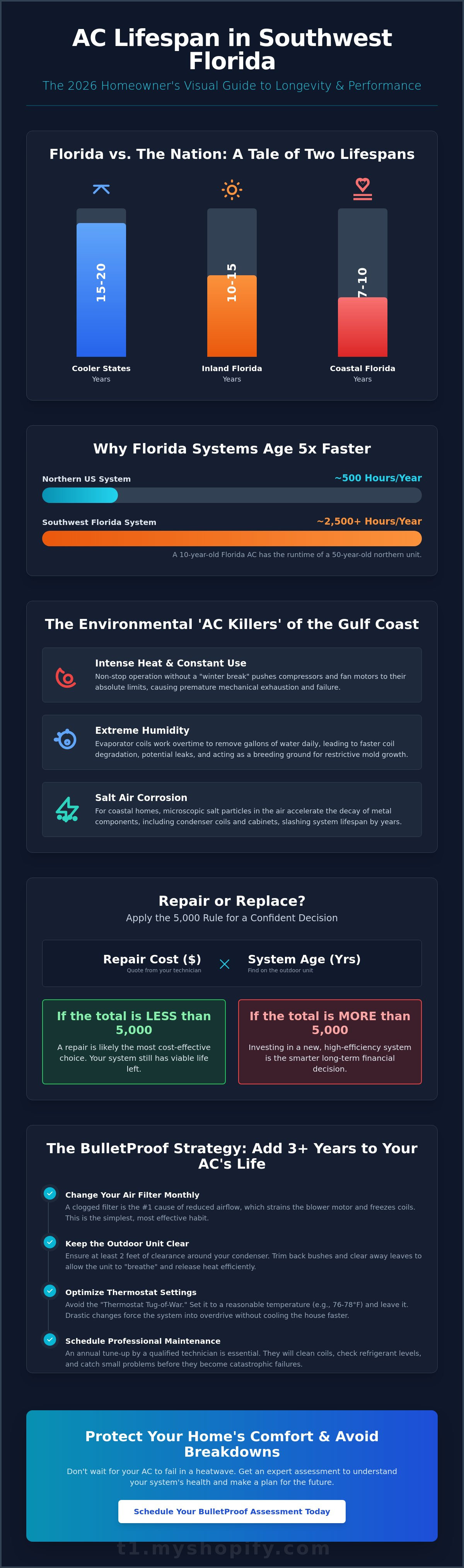
In most parts of the country, a central air conditioner is a seasonal luxury. In Southwest Florida, it's a life-support system. While the national average for a cooling system is often 15 to 20 years, the reality for local homeowners is much harsher. You can typically expect an 8 to 14-year lifespan for a Florida system. This discrepancy isn't because the units are lower quality. It's because they're working under extreme environmental duress every single day. In our climate, the actual definition of "AC lifespan" is a delicate balance of total run-time, consistent maintenance, and constant environmental exposure.
When you ask how long does an ac unit last in florida, you have to look at the odometer. A 10-year-old unit in Sarasota has likely clocked more hours than a 20-year-old unit in Ohio. At BulletProof Air, we see systems that have been "run into the ground" because homeowners treat them like appliances rather than high-performance machinery. True durability matters more than just the brand name on the cabinet. A "BulletProof" system is one that is built to withstand the specific rigors of the Gulf Coast through proactive protection and rapid response when parts begin to wear.
Why Florida Systems Age Twice as Fast
The primary reason for premature failure is the sheer volume of work. Most northern systems run for about 500 hours a year. Down here, your compressor might hum for 2,500 hours or more annually. To understand the mechanical strain, it helps to look at How Air Conditioners Work on a fundamental level. These systems move heat rather than just creating "coolness." Without a winter break to shed thermal stress, internal components like fan motors and capacitors are pushed to their absolute limits. High humidity adds another layer of struggle. Your evaporator coil must work double-time to pull gallons of water out of your indoor air every day, leading to faster coil degradation and potential leaks.
Brand Quality vs. Environment: What Matters More?
Many homeowners ask if buying a premium brand like Daikin or Lennox will guarantee a 20-year life. The short answer is no. While high-end brands offer better efficiency and quieter operation, the Florida sun and salt air are great equalizers. Even the most expensive unit will fail prematurely if it lacks professional ac repair and preventative care. There is no such thing as a "lifetime" unit in a tropical climate. The environment will eventually win, but a trusted local partner can help you delay that victory for as long as possible through honest recommendations and expert service.
The 'AC Killers': Why Florida Systems Fail Faster
Understanding how long does an ac unit last in florida requires looking at the specific environmental threats that call the Gulf Coast home. In Sarasota and Bradenton, your system faces a "triple threat" of intense heat, extreme humidity, and salt air corrosion. These factors don't just cause wear; they act as catalysts for mechanical failure. While a unit in a drier climate might age gracefully, a Florida system is under constant siege from the moment it's installed. This environmental pressure is why proactive protection isn't just a suggestion; it's a requirement for home comfort.
One of the most common stressors we see is the "Thermostat Tug-of-War." Many homeowners crank their settings down to 68 degrees after a long day, hoping to cool the house faster. This doesn't actually speed up the cooling process. Instead, it forces the compressor to run at maximum capacity for hours without a break. This constant strain leads to mechanical exhaustion and shortened component life. When your system can't cycle off, the internal oil that lubricates the compressor begins to break down, leading to a terminal failure that often results in an expensive replacement.
The "Invisible Threat" is another major factor. Microscopic biological growth thrives in the dark, damp environment of a Florida air handler. As mold and mildew accumulate on the evaporator coils, they create a physical barrier that restricts airflow. This forces the blower motor to work harder, consuming more energy and driving up your electric bills. Poor indoor air quality creates a destructive feedback loop where the dirtier your system becomes, the faster its parts degrade. Keeping these coils clean is the only way to ensure your home remains a healthy sanctuary.
Humidity: The Silent Compressor Killer
Excessive moisture is a primary cause of "slugging" in the compressor. Slugging occurs when liquid refrigerant, rather than gas, enters the compressor. Because liquids don't compress, this can shatter internal valves instantly. High humidity levels also lead to moisture accumulation on electrical contacts, causing "pitting" and eventual component failure. Following official maintenance tips can help you manage these moisture levels and prevent liquid backup. In many cases, adding a whole-home dehumidifier can actually extend your AC's mechanical life by reducing the latent heat load on the primary unit.
Power Surges and Florida Storms
Southwest Florida is the "Lightning Capital" of the United States. Frequent strikes cause "micro-shocks" that degrade sensitive inverter boards over time. Even more dangerous are "brownouts" during summer storms. When voltage drops, the motor draws more current to compensate, which can melt the insulation on the motor windings. Installing a dedicated surge protector acts as a "BulletProof" shield for your investment. If you're concerned about how recent storms have affected your system, it's worth having a professional check your residential HVAC services to ensure your electrical components are still within safe operating limits.
Coastal vs. Inland: How Your Sarasota Location Impacts Longevity
Your zip code plays a massive role in answering how long does an ac unit last in florida. While we previously discussed the state average of 8 to 14 years, your proximity to the Gulf of Mexico can shift that window dramatically. A system installed in a Lakewood Ranch home faces a completely different set of environmental stressors than one sitting on the sands of Siesta Key. If your home is within the five mile "Danger Zone" of the coast, salt air isn't just a nuisance; it's a chemical weapon aimed directly at your air conditioner’s sensitive components.
The primary culprit is galvanic corrosion. This process occurs when salt spray acts as a bridge between the aluminum fins and copper tubing of your outdoor condenser. Because these are two different types of metal, the salt air triggers an electrochemical reaction that causes the aluminum to "pitting" and eventually crumble. Once these fins disintegrate, your system can no longer shed heat efficiently. This forces the compressor to run hotter and longer, leading to a total mechanical breakdown years before an inland unit would even show its age. We recommend that coastal homeowners perform a gentle freshwater rinse of their outdoor coils every month to clear away this salt buildup, or consult with Ultra Air Heating and Cooling for professional anti-corrosive maintenance.
The Siesta Key & Longboat Key Challenge
For residents on Siesta Key or Longboat Key, the reality is often harsh. Coastal units without specialized protection can fail in as little as 5 to 7 years. The salt doesn't just eat the coils; it penetrates the outdoor condenser fan motor and eats away at the bearings, leading to a seized motor during the hottest week of July. To make your system truly BulletProof, we often recommend anti-corrosive treatments like "Blygold." These factory grade coatings provide a protective barrier that can help beachside systems reach that elusive 10-year mark, ensuring your home remains a cool sanctuary despite the salty breeze.
Inland Advantages in Lakewood Ranch and Bradenton
Homeowners in Lakewood Ranch and eastern Bradenton typically enjoy an inland advantage, often seeing 2 to 4 more years of life from their systems than their coastal neighbors. However, this doesn't mean you're in the clear. Inland units face different threats like fine dust, lawn debris, and higher ambient temperatures because they don't benefit from the cooling sea breeze. Many inland residents overlook maintenance because they don't see the visible rust common on the coast. This is a mistake. When you wonder how long does an ac unit last in florida, remember that inland longevity is only possible if you keep the condenser clear of grass clippings and dirt that can choke the system and cause it to overheat.
How to Extend Your AC Unit’s Life: The BulletProof Strategy
Extending the life of your air conditioner isn't a matter of luck; it's a result of a disciplined hierarchy of care. At BulletProof Air, we believe in the "Clean Sanctuary" principle. This starts with keeping the area around your outdoor condenser clear. You should maintain at least two feet of clearance from shrubs, weeds, and lawn debris to ensure the system can "breathe" and shed heat effectively. When you consider how long does an ac unit last in florida, the answer depends heavily on whether you treat maintenance as a luxury or a necessity. Investing in a $150 professional tune-up provides a massive return on investment when compared to the $8,000 cost of a total system replacement.
Think of your maintenance plan as an insurance policy for your home’s comfort. Signing up for a comprehensive HVAC maintenance plan ensures that small issues are caught before they turn into midnight emergencies. Our goal is to move your system from the "at-risk" category into a state of reliable performance that lasts for a decade or more. If you want to protect your investment, schedule your service today to lock in your system's reliability for the coming season.
The Homeowner’s Monthly Checklist
In Florida's high-pollen and high-dust environment, 30 days is the hard limit for standard air filters. A clogged filter restricts airflow, which causes the evaporator coil to freeze and puts immense pressure on the blower motor. You should also make drain line flushing a monthly habit. Pouring a cup of distilled white vinegar down the condensate drain line prevents algae from blooming in the warm, damp pipe. This simple step stops the "clogged drain" emergency shut-off that often happens during the most humid weeks of the year. Finally, perform a quick visual inspection of the outdoor unit. Look for oil spots on the base pan or frayed wiring, as these are early warning signs that a component is about to fail.
Why Professional Maintenance is Non-Negotiable
While DIY steps are helpful, certain technical checks require professional tools. Checking refrigerant levels is critical because "low juice" forces the compressor to work harder and run hotter, leading to internal mechanical damage. We also focus on tightening all electrical connections. Florida’s heat causes wires to expand and contract, which can loosen terminals and lead to the heat-related meltdowns common in the peak of the 2026 summer. Our technicians also clean the "hidden" evaporator coil inside the air handler. This coil is often neglected because it's difficult to reach, but keeping it clean is the only way to maintain the efficiency levels required to keep your how long does an ac unit last in florida estimate on the higher end of the scale.
Repair or Replace? Making the Final Decision for Your Sanctuary
Deciding whether to patch up an aging system or invest in a new one is the most difficult choice a homeowner faces. When you look at how long does an ac unit last in florida, the answer isn't just a number of years; it's a calculation of value. We recommend the "5,000 Rule" as a professional benchmark. Multiply the age of your unit by the cost of the current repair. If the result is over $5,000, you're likely better off replacing the system. For example, spending $700 on a 12-year-old unit equals $8,400. This is a poor investment compared to the long-term reliability of a modern installation.
You must also account for the "Reliability Tax." This represents the cumulative cost of repeated emergency AC repairs. These small bills add up quickly, but the real cost is the stress of wondering if your home will stay cool through the next heatwave. A high-efficiency AC installation in Sarasota can often pay for itself in 5 to 7 years. Between the 30% federal tax credit available in 2026 and the drastic drop in your monthly power bill, a new system is often the most financially sound path to restoring your cool and comfortable sanctuary. Every new system we install comes with a BulletProof warranty, ensuring you never have to pay that reliability tax again.
Signs Your AC is on Its 'Last Leg'
Your system will usually tell you when it's ready to retire. Watch for frequent cycling, where the unit turns on and off every few minutes without reaching the set temperature. If your indoor humidity levels stay above 55% despite the AC running constantly, the system has lost its ability to condition the air effectively. Listen for the "death rattle." Grinding, squealing, or heavy thumping sounds from the outdoor unit often indicate a failing compressor or motor bearings. These mechanical failures are usually the final chapter for a unit that has reached the end of its how long does an ac unit last in florida lifecycle.
The 2026 Efficiency Factor
The math on keeping an old system changed significantly in 2025 when the EPA phased out R-410A refrigerant. In 2026, repairs involving older refrigerants are becoming much more expensive as supplies dwindle. New SEER2 standards mean that today's entry-level systems are more efficient than the "premium" models from a decade ago. If your unit was installed before the 2023 efficiency updates, you're likely paying 20% to 30% more on your electric bill than necessary. Stop gambling with an unreliable system and get the facts about your equipment. Contact BulletProof Air for an honest assessment of your system's health.
Secure Your Sanctuary Against the Florida Heat
Florida’s climate is relentless, but your air conditioner doesn't have to be a victim of the heat. By understanding that the average answer to how long does an ac unit last in florida ranges from 8 to 14 years, you can plan ahead rather than reacting to a midnight failure. Remember to use the "5,000 Rule" we discussed to decide when a repair is no longer a sound investment. Whether you live in Lakewood Ranch or right on the sands of Siesta Key, proactive maintenance is the only way to safeguard your home's comfort and mechanical longevity.
Our expert technicians specialize in these unique Gulf Coast challenges, providing the 24/7 emergency service you need when the mercury rises. We're committed to doing the job right the first time to give you lasting peace of mind. Don't wait for a breakdown; Schedule your BulletProof AC Health Check today! We look forward to helping you keep your home a cool and reliable sanctuary with Sarasota's most trusted "BulletProof" guarantee. Stay cool and stay protected.
Frequently Asked Questions
Is 10 years old considered 'old' for an AC in Florida?
Yes, a 10-year-old system has reached the late stages of its functional life in our tropical environment. While units in northern states might last 20 years, how long does an ac unit last in florida is typically capped at 10 to 15 years. By the decade mark, most local systems have already clocked over 25,000 hours of run time, making them prone to major component failures.
Why does salt air kill air conditioners so quickly?
Salt air triggers a destructive electrochemical process known as galvanic corrosion between your unit's copper and aluminum parts. This salt spray is most aggressive within 5 miles of the Gulf of Mexico. It causes the delicate heat-exchange fins to crumble into white powder, which prevents the system from cooling your home and eventually leads to a seized compressor.
Can I extend my AC life by turning it off when I'm at work?
No, turning your system completely off actually increases mechanical strain and shortens its lifespan. When the AC is off, indoor humidity levels can spike above 65% in just a few hours. This forces the unit to work at maximum capacity for a longer duration to recover, which wears out the start capacitor and compressor much faster than maintaining a steady temperature.
How much does a new AC installation typically cost in Sarasota?
In 2026, most Sarasota homeowners pay between $8,000 and $13,000 for a standard 3 to 4-ton central air system. If you live directly on the coast, expect prices to be 10% to 20% higher due to the need for specialized anti-corrosive coatings. These 2026 prices reflect the industry shift to high-efficiency SEER2 standards and new R-454B or R-32 refrigerants.
What are the first signs that my AC compressor is failing?
The most common warning sign is "hard starting," where you hear a loud shuttering or clicking sound when the unit kicks on. You might also notice your circuit breaker tripping frequently or warm air blowing from the vents despite the fan running. If you hear a "death rattle" or grinding noise from the outdoor condenser, the internal bearings are likely failing, signaling an urgent need for an expert assessment.
Does regular maintenance actually make the unit last longer?
Yes, consistent professional maintenance can add 2 to 3 years to the total lifespan of your equipment. When asking how long does an ac unit last in florida, the difference between a 9-year failure and 12-year success is usually found in the maintenance logs. Regular cleanings prevent the "invisible threat" of biological growth and ensure that electrical connections remain tight despite the intense summer heat.
Is it worth repairing a 12-year-old AC unit?
It's rarely worth it if the repair cost exceeds $400, especially since the unit is likely using phased-out R-410A refrigerant. Applying the "5,000 Rule," a $500 repair on a 12-year-old system equals 6,000, which suggests replacement is the smarter financial move. Investing in old technology often leads to a cycle of "emergency tax" payments that could have been used toward a new, warranted system.
What is the most reliable AC brand for the Florida climate?
Premium brands like Daikin and Lennox are top performers in Florida because they offer superior efficiency and quieter operation. However, no brand is "immortal" against our salt air and humidity without proper care. The reliability of your system depends 20% on the badge on the cabinet and 80% on the quality of the installation and the consistency of your maintenance plan.