

R22 Freon in 2026: The Homeowner’s Guide to Outdated AC Refrigerant
Imagine waking up in Sarasota at 2 AM to a home that feels like a sauna because your aging AC finally quit. It's a nightmare every Florida homeowner fears, especially when the thick humidity turns your personal sanctuary into a swamp. You want a quick fix to restore your comfort, but then your technician mentions r22 freon and the conversation takes a stressful turn. You're left wondering why a simple recharge costs so much and if your unit is even worth saving. The uncertainty of whether to patch a failing system or invest in a new one can feel overwhelming when the heat is rising.
We understand the distress of receiving conflicting advice while your family's safety and well-being are on the line. You deserve the professional precision of a team that views your home as a protected space. This guide breaks down exactly why r22 freon is now a zombie refrigerant and how its scarcity impacts your cooling budget in 2026. We'll provide a definitive framework to help you decide if a repair is a temporary patch or if a BulletProof replacement is the smarter path. By the end, you'll have the facts needed to make a confident decision and return your home to the cool, dependable haven it should be.
Key Takeaways
- Understand the critical impact of the federal production ban and why finding reclaimed refrigerant for legacy units is becoming increasingly difficult.
- See how aging systems fail to manage Sarasota’s extreme humidity, compromising your home’s comfort and driving up monthly cooling costs.
- Use our decision framework to determine if refilling your r22 freon is a viable short-term patch or a sign that it’s time for a more dependable solution.
- Learn the professional steps for identifying refrigerant leaks to ensure you aren't paying for repeated recharges on a failing system.
- Discover how transitioning to a modern, high-efficiency AC system restores your home as a peaceful sanctuary protected from the Florida heat.
What is R22 Freon and Why is it Phased Out in 2026?
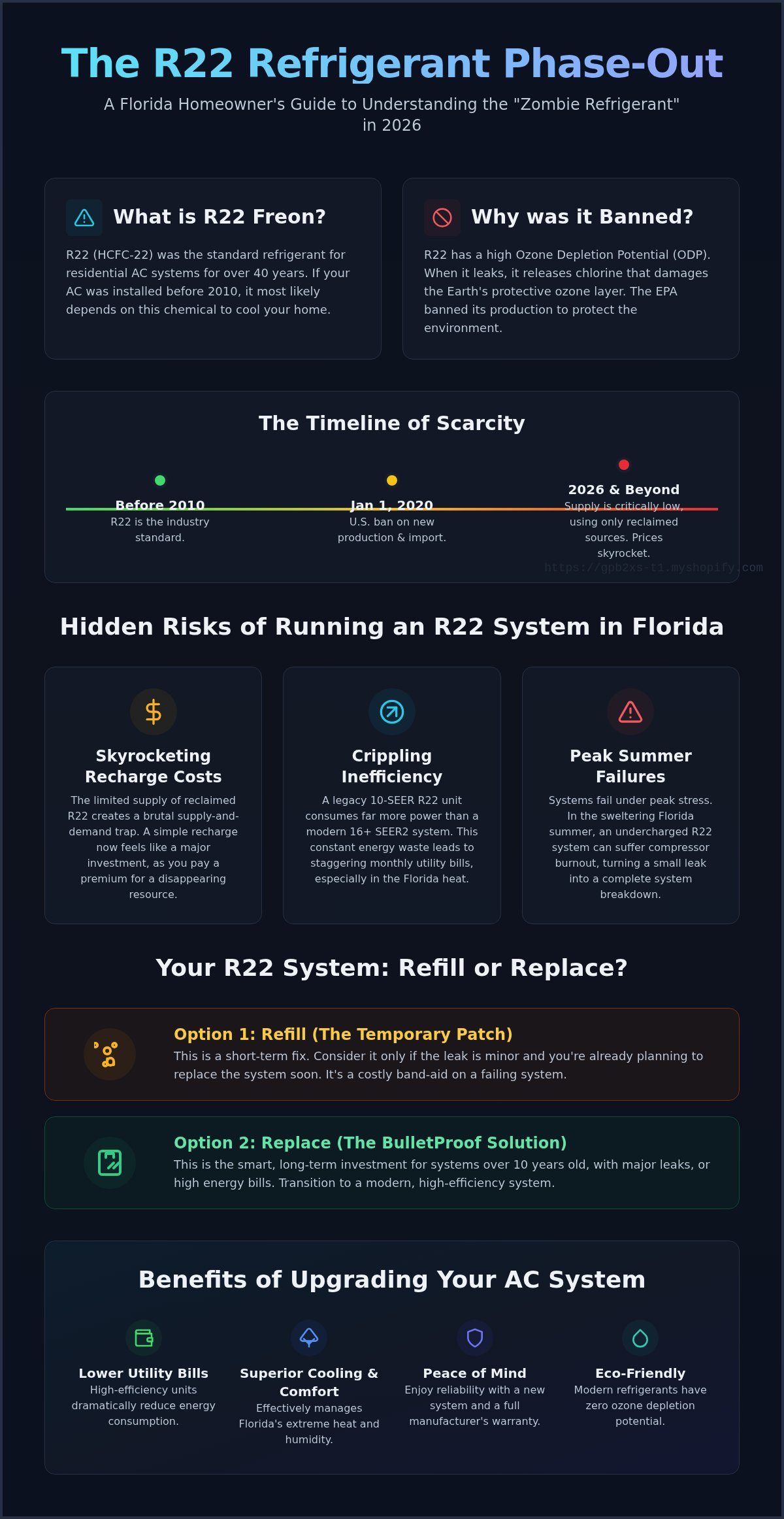
R22, scientifically known as Chlorodifluoromethane (HCFC-22), served as the primary refrigerant for residential air conditioning for nearly four decades. If your home was built or your AC was installed before 2010, your system likely relies on this chemical to absorb and release heat. While it was once the industry standard, the regulatory landscape has shifted. The United States officially ended the production and import of virgin r22 freon on January 1, 2020, following mandates set by the Montreal Protocol and the EPA. This wasn't an overnight ban on owning these units, but it effectively capped the available supply.
By 2026, the supply of this refrigerant has become incredibly tight. Because new production is illegal, every ounce used to service a leaking unit must come from reclaimed or recycled sources. This creates a brutal supply and demand trap for Southwest Florida homeowners. As older systems continue to develop leaks, the remaining stockpile of recycled gas dwindles. This scarcity drives prices upward, making a simple recharge feel more like a major investment than a routine maintenance task. You're no longer just paying for a service; you're paying a premium for a disappearing resource that is becoming harder to source every year.
The Environmental Impact of R22
The transition away from R22 is driven by its high ozone depletion potential (ODP). When this gas escapes from a leaking system, it releases chlorine into the atmosphere, which thins the protective ozone layer. In our sensitive coastal ecosystem near Sarasota and Bradenton, protecting the environment is a shared responsibility. Modern refrigerants like R-410A and the newer R-454B are the new standard because they offer much lower global warming potential and zero ozone depletion. Switching to these modern standards ensures your home sanctuary remains cool without compromising the safety of the Florida environment.
How to Tell if Your AC Uses R22
Determining if your system is outdated is a simple task you can perform in minutes. You don't need a technician to verify the basics. Start by locating the data plate on your outdoor condenser unit. This is usually a metal sticker or plate containing the manufacturer's technical specifications. Look specifically for the terms "HCFC-22" or "R-22." If the manufacture date on that plate is prior to 2010, your system is almost certainly R22-based. Systems manufactured between 2010 and 2015 might also use it, though they are less common. Knowing this information now allows you to plan for the future before a mechanical failure leaves you in the heat.
The Hidden Risks of Running an R22 System in Florida
Running an aging AC system in the relentless Florida sun is a gamble with your home's comfort. While your unit might still be blowing air, its ability to actually cool and dehumidify your space is likely dropping every year. Most legacy systems using r22 freon were designed for a different era of energy standards. As these units age, mechanical wear and internal fouling mean they rarely achieve their original efficiency ratings. This degradation forces the system to run longer cycles, which is especially dangerous in our climate where the outdoor temperature frequently stays above 90 degrees for weeks at a time. When the system runs constantly on a low charge, the compressor, the heart of your AC, overheats and eventually burns out, turning a simple leak into a catastrophic mechanical failure.
The Cost of Inefficiency
The financial impact of keeping an old unit alive shows up every month on your utility bill. A legacy 10-SEER R22 unit consumes significantly more power than a modern 16-SEER or 18-SEER system. Because the Florida sun forces these older units to work almost 24/7 during the summer, the cumulative energy waste is staggering. Moving to a high-efficiency system isn't just about the environment; it's about stopping the energy bleed in your monthly budget. SEER2 ratings are the modern efficiency benchmark for 2026, representing a more rigorous testing standard that accounts for real-world external static pressure. By upgrading, you ensure your home sanctuary remains affordable to maintain while enjoying superior cooling performance.
Emergency Failures in Peak Summer
Mechanical systems follow a cruel logic: they fail when they are under the most stress. In Sarasota and Bradenton, that stress peaks during the sweltering humidity of July and August. Sarasota's extreme humidity requires a system that can move enough air across the cooling coils to pull gallons of water out of your indoor environment every day. An undercharged or aging r22 freon system lacks the precision to manage this moisture, leaving your floors feeling sticky and your air feeling heavy. This isn't just an inconvenience; it can lead to indoor air quality issues that affect your family's health and safety.
When a leak occurs, your system loses its ability to transfer heat, leading to a frozen evaporator coil. Finding a technician with immediate access to reclaimed refrigerant during a heatwave is becoming a major challenge. The scarcity of stock means you might wait days in a hot home while a supplier is located. This is why many homeowners now look for air conditioning repair close to me at the first sign of a struggle. Following the EPA guidelines on R-22 refrigerant, it's clear that the era of easy refills is over. If your home feels like a swamp despite the AC running, it's time to consider a more permanent solution from BulletProof Air to restore your peace of mind.
Refill, Retrofit, or Replace? The Homeowner’s Decision Framework
When your air conditioner begins to fail, the pressure to make a quick decision is intense. You need to restore your home sanctuary immediately, but you also want to avoid a financial mistake. Most homeowners face three distinct paths when dealing with an r22 freon system. The first is a simple refill, which acts as a temporary patch for minor leaks. However, because reclaimed refrigerant is scarce and expensive in 2026, this is often a high-risk gamble. If the leak isn't found and sealed with precision, you'll be facing the same hot home and high bill in just a few weeks.
To gain clarity, use the Rule of 5,000. Multiply the age of your equipment by the quoted repair cost. If your unit is 14 years old and the repair costs $400, the total is 5,600. Since this exceeds the 5,000 threshold, investing in a new, reliable system is usually the more professional and cost-effective recommendation. For systems well past their prime, a BulletProof installation provides the long-term peace of mind that a series of expensive patches simply cannot offer. It moves you away from a "zombie" system and into modern, dependable comfort.
The Problem with "Drop-in" Refrigerants
Some may suggest retrofitting your system with "drop-in" replacements like MO99 or R-422D. While these gases are marketed as easy fixes, the technical reality is more complex. These substitutes have different chemical properties than r22 freon, which can lead to a 10% to 15% loss in cooling capacity. In the peak of a Sarasota summer, that loss is the difference between a comfortable home and a swampy one. Additionally, these gases often require oil changes or seal replacements to prevent leaks. Using a non-standard gas may also void any remaining manufacturer warranty protection you have left.
Replacement ROI in Southwest Florida
Choosing a full AC installation Sarasota FL is an investment that starts paying dividends immediately. Modern high-efficiency systems qualify for significant federal tax credits and local utility rebates that offset the initial cost. Because these units use significantly less power, your monthly FPL or Bradenton utility bills will drop noticeably. Beyond the energy savings, a new system in 2026 comes with a comprehensive manufacturer warranty. This protects you from unexpected repair costs for years, ensuring your home remains a peaceful, cool sanctuary regardless of the temperature outside.
Identifying and Fixing R22 Leaks: What to Expect
When your AC stops cooling, a leak is the most likely culprit. Finding a leak in an older system requires specialized tools and a high level of technical precision. Our technicians use electronic sniffers that can detect even the smallest trace of r22 freon escaping into the air. These sensitive devices "smell" the chemical signature of the refrigerant. If the leak is buried deep within the system, we may use ultraviolet dye tests to pinpoint the exact exit point. This professional diagnostic approach ensures we aren't just guessing with your home's comfort.
The evaporator coil is the most frequent site for these failures. In Southwest Florida, the salt air is a constant threat. It causes formicary corrosion in copper coils, creating microscopic holes that allow refrigerant to bleed out. Vibration leaks in the outdoor condenser or failing Schrader cores in the service valves are also common. Identifying these specific locations is the first step in restoring your sanctuary. Once we find the source, we provide a clear assessment of whether the metal is healthy enough to hold a repair or if the system has reached the end of its life.
Common Leak Locations
Leaks rarely happen in a vacuum. They are often the result of environmental stress or mechanical wear. In our coastal climate, salt air accelerates the breakdown of metal components. Vibration from an aging compressor can also cause copper lines to rub against each other, eventually wearing through the metal. Additionally, leaky service valves and worn-out seals are frequent offenders. These small components are easy to overlook, but they can lead to a total loss of cooling if not addressed by a professional.
Why "Topping Off" is Illegal and Unwise
It's vital to understand that "topping off" a leaking system is both illegal and unwise. EPA Section 608 regulations prohibit the intentional venting of refrigerants into the atmosphere. While the strictest repair mandates often apply to larger systems, the law is clear: you cannot knowingly add refrigerant to a system that is actively leaking without a plan to fix it. Simply adding more gas without fixing the source is an environmental violation. It also wastes your money because that expensive r22 freon will simply leak out again. A reputable hvac company near me will always insist on a permanent repair or a full system replacement.
Don't let a minor leak turn into a total system burnout. Protecting your family from the Florida heat requires a system that is sealed and efficient. If you suspect your unit is losing its charge, contact BulletProof Air for a professional diagnostic today. We provide the accuracy you need to decide if your aging AC is worth one more fix or if it's time for a fresh start.
BulletProof Solutions: Transitioning to Modern Comfort
At BulletProof Air, we don't just look at your air conditioner as a piece of machinery; we see it as the shield that protects your home sanctuary. When we evaluate legacy systems that rely on r22 freon, our technicians bring a level of technical precision that goes beyond a simple visual check. We perform a comprehensive diagnostic to determine if your unit is still capable of maintaining a safe and comfortable environment. In Sarasota and Bradenton, the demands on an AC are extreme. Our customized replacement plans are engineered to meet these local challenges, ensuring your new system provides the reliability you need to outlast the Florida sun.
One of the most critical parts of our process is the "Precision" guarantee. Many contractors simply swap an old unit for a new one of the same size, but that's often a mistake. We perform detailed load calculations to ensure your new high-efficiency system is sized perfectly for your home's specific square footage and insulation levels. A perfectly sized unit doesn't just cool better; it manages humidity more effectively and prevents the short-cycling that leads to premature wear. This accuracy is how we restore your home's sanctuary with cooling you can trust for years to come.
Our Urgent Response Process
We know that a cooling failure in 95-degree heat isn't just an inconvenience; it's an emergency that affects your family's well-being. That's why we prioritize same-day diagnostics for total system failures. When our experts arrive, you'll receive transparent quoting with no hidden fees or surprise costs. We provide honest advice based on the actual condition of your equipment, helping you decide if your system is truly "beyond the patch." If a replacement is necessary, we offer fast-track installation services to get your home back to a comfortable temperature without delay. You'll never be left wondering about the status of your repair or the cost of the project.
Maintenance Plans to Prevent Future Crises
Once you've moved away from the high costs of r22 freon and invested in modern comfort, the goal is to protect that investment. Regular hvac services near me are the most effective way to ensure your new system reaches its full life expectancy. The BulletProof Maintenance Plan is built specifically for the Southwest Florida climate, focusing on the precision tuning and cleaning required to fight off salt-air corrosion and heavy humidity. By catching small issues early, we prevent the kind of catastrophic failures that happen during the hottest weeks of the year. Protect your sanctuary today and ensure your home remains a peaceful, cool haven for your family.
Secure Your Home’s Future Comfort
The era of r22 freon has officially come to an end, leaving many Southwest Florida homeowners at a critical crossroads. Continuing to patch a "zombie" system only leads to higher energy bills, poor humidity control, and the constant threat of an emergency failure during a heatwave. By understanding the risks of outdated refrigerants and the long-term benefits of modern efficiency, you can stop throwing good money after bad. Transitioning to a high-performance system isn't just a technical upgrade; it's an investment in your family's safety and your home's tranquility.
BulletProof Air is here to guide you through this transition with professional precision. We provide fast response times for Sarasota emergencies and employ expert technicians who specialize in high-efficiency transitions. Our customized HVAC solutions are engineered specifically for the unique demands of the Florida climate. Don't wait for the next mechanical failure to leave you in the heat. Restore your home sanctuary with expert AC repair and installation from BulletProof Air. You deserve a cooling system that works as hard as you do to keep your home a peaceful, protected haven.
Frequently Asked Questions
Can I still buy R22 Freon for my home AC in 2026?
You can still purchase it, but every ounce must come from reclaimed or recycled sources. Federal law banned the production and import of virgin r22 freon on January 1, 2020. This means the total supply is finite and shrinking every year. While it's legal to service your existing unit, finding a technician with available stock during a Sarasota heatwave is becoming increasingly difficult. Relying on a dwindling resource is a risky strategy for home comfort.
Why is R22 Freon so expensive compared to newer refrigerants?
Scarcity is the primary driver of the high cost. Because no new supply is entering the market, technicians must rely on gas recovered from older systems that have been decommissioned. In high-demand regions like Southwest Florida, the remaining stockpile is disappearing fast. This imbalance between a fixed supply and constant demand creates a pricing trap that makes simple recharges feel like major financial investments. It's often a sign that a system is obsolete.
Is there a "drop-in" replacement for R22 that actually works?
Substitutes like MO99 and R-422D exist, but they are rarely a perfect solution for Florida homes. These gases have different thermodynamic properties, which often results in a 10% to 15% loss in cooling capacity. In our extreme humidity, that loss can make your home feel swampy and unsafe. Many retrofits also require oil changes or seal replacements to function correctly. Most professionals recommend a full system transition rather than using these temporary substitute gases.
How much R22 does a typical 3-ton AC unit hold?
A standard 3-ton residential air conditioner typically holds between 6 and 12 pounds of refrigerant. The exact amount depends on the length of the copper lines connecting your indoor and outdoor units. You can find the specific factory charge listed on the manufacturer data plate located on your outdoor condenser. Keep in mind that even a small leak of two pounds can significantly degrade your system's ability to dehumidify and cool your home sanctuary.
Will my AC unit explode if it runs out of Freon?
Your air conditioner will not explode if the refrigerant charge is lost. However, the consequences are still severe for your equipment. Refrigerant also carries the oil that lubricates the compressor. Without a proper charge, the compressor will overheat, seize, and eventually suffer a total mechanical burnout. Once the compressor fails, the system is usually beyond repair. It's a critical failure that often happens during the most stressful, hottest days of the summer.
What happens if a technician finds a leak in my R22 system?
A professional technician will use electronic leak detectors to find the exact source of the failure. Once the leak is identified, they will calculate the cost of the repair versus the cost of the r22 freon needed to restore the charge. If the leak is in a corroded evaporator coil, the repair is often just a temporary patch. We provide a clear diagnostic so you can decide if the unit is worth one more fix or replacement.
Is it illegal to refill an R22 unit in Florida?
It is not illegal to refill your system, but federal EPA regulations prohibit "topping off" units that have significant leak rates. Technicians are ethically and legally bound to recommend a permanent repair rather than just venting more gas into a failing system. In Florida, where environmental protection of our coastal ecosystem is vital, responsible companies insist on sealing the system. Homeowners in the Mid-Atlantic region can similarly rely on B&B Air Conditioning & Heating Service for expert guidance on these federal refrigerant phase-outs. Adding gas to a known leak is a waste of money and a violation of standards.
Homeowners frequently see their monthly cooling costs drop by 20% to 50% after a modern upgrade. Legacy R22 systems often operate at a 10-SEER rating or lower due to age and wear. Modern systems meet much higher SEER2 standards, using significantly less electricity to move the same amount of heat. In the relentless Florida sun, these energy savings add up quickly, often allowing a new, high-efficiency installation to pay for itself over its operational lifespan.