

Reducing HVAC Noise in My Home: The Definitive 2026 Guide to a Quieter Sanctuary
What if that persistent rattling in your living room isn't just a nuisance but your air conditioner's way of screaming for help before a total mechanical failure? You've likely spent nights tossing and turning while a mechanical hum vibrates through your bedroom walls, or found yourself cranking the TV volume just to hear the dialogue over the roar of the vents. It's exhausting to feel like your own house is working against you. We understand that a noisy system is more than an annoyance; it's a disruption to your well-being and a source of anxiety about your equipment's safety. Reducing hvac noise in my home is the first step toward reclaiming your peace of mind.
This definitive 2026 guide will teach you how to identify, troubleshoot, and eliminate disruptive sounds to restore your Southwest Florida residence to a quiet, efficient sanctuary. You'll discover why your system makes specific noises, ranging from whistling ducts to banging compressors, and learn which low-cost DIY fixes can stop the racket immediately. We'll also preview the latest "Quiet-Tech" innovations and federal standards. These advancements ensure modern systems stay whisper-quiet while keeping your family safe and comfortable.
Key Takeaways
- Learn how to interpret specific sounds like banging or whistling to identify mechanical issues before they lead to a total system breakdown.
- Master simple DIY techniques for reducing hvac noise in my home, such as tightening loose panels and clearing debris, without risking your system’s safety.
- Discover high-impact soundproofing solutions like compressor blankets and vibration isolation pads that can decouple equipment from your home's foundation.
- Understand how ductwork turbulence and undersized vents create "wind tunnel" effects and how professional calibration restores a peaceful environment.
- Explore the benefits of modern variable-speed technology and high-SEER2 systems that prioritize both energy efficiency and whisper-quiet operation.
Decoding the Clatter: What Your HVAC Noise is Trying to Tell You
Your home is more than a building; it's your sanctuary. In Sarasota, where the afternoon sun can feel like a physical weight, your air conditioning system is the primary line of defense protecting that peace. When your AC begins to groan, rattle, or shriek, it does more than just interrupt your favorite show. It shatters the sense of security you feel in your own space. Listening to these sounds is the first step in reducing hvac noise in my home because your system is actually trying to communicate its health status to you.
The Sound-to-Source Diagnostic Map
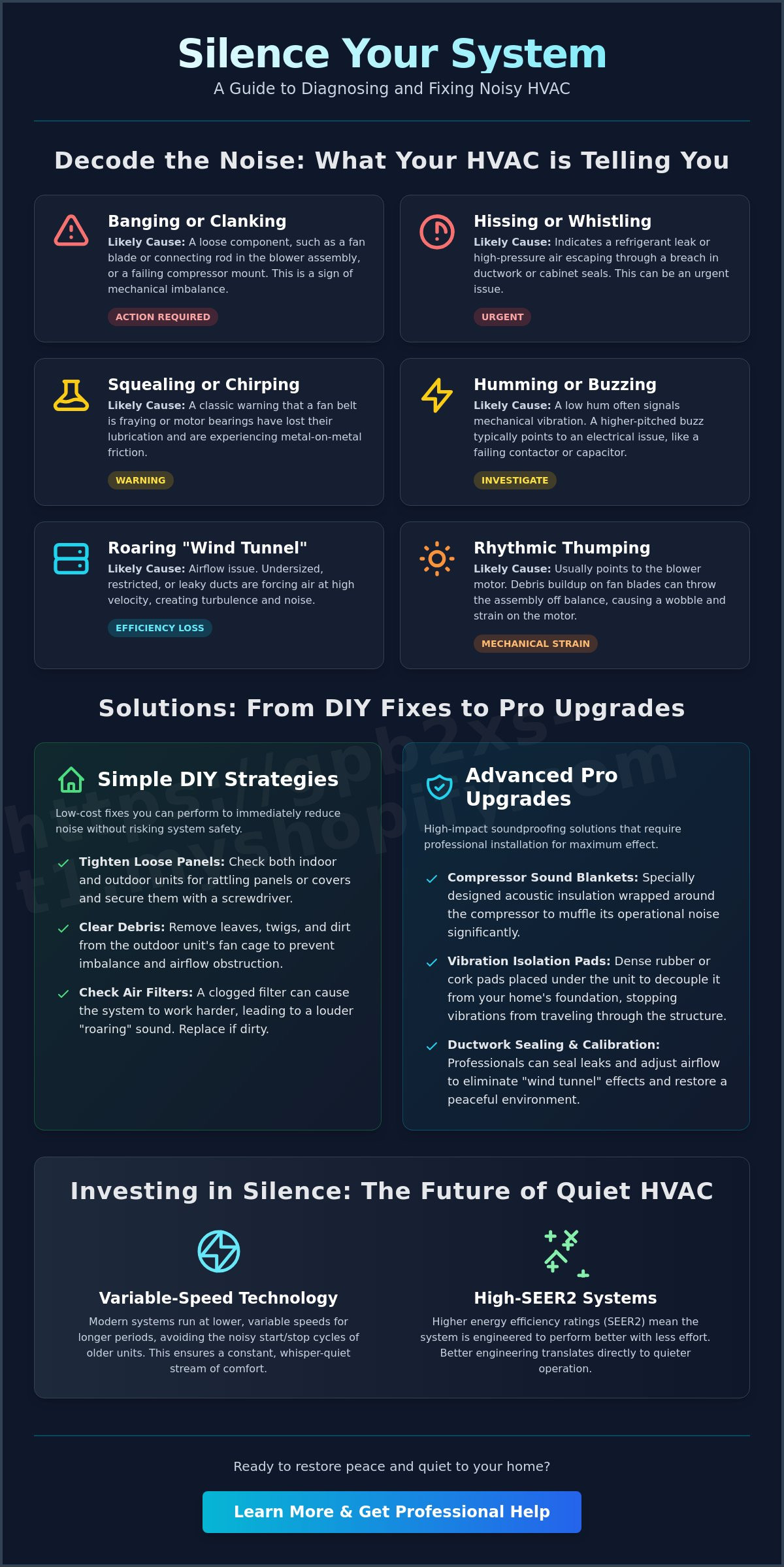
Identifying the specific "flavor" of noise helps you act quickly. If you hear rhythmic banging or clanking, you're likely dealing with a loose component in the blower assembly or a failing compressor mount. Hissing or whistling is often more urgent. This sound typically indicates a refrigerant leak or high-pressure air escaping through a breach in the cabinet. While commercial buildings might use a sound attenuator to manage airflow noise, a whistle in a residential system usually means your seals are failing. Squealing or high-pitched chirping is a classic warning sign that a fan belt is fraying or motor bearings have lost their lubrication.
Why Florida Humidity Makes HVAC Noise Worse
Living in Southwest Florida presents unique challenges for mechanical systems. The extreme humidity doesn't just make you sweat; it actively degrades the lubricants inside your fan motors and bearings. When grease breaks down due to moisture, metal-on-metal contact creates the grinding sounds that keep you awake at night. In coastal communities like Sarasota and Bradenton, salt air is another silent predator. It corrodes outdoor unit fasteners and brackets, leading to loose panels that vibrate violently during operation. Additionally, the rapid expansion and contraction of ductwork in high-humidity environments can cause popping sounds as the metal struggles to adjust to temperature shifts. Addressing these local environmental factors is essential for reducing hvac noise in my home and ensuring long-term system durability.
The Science of Silence: Identifying Mechanical Culprits
Mechanical vibration is the most common cause of low-frequency humming in Bradenton homes. This deep drone often feels like it's vibrating through the floorboards before you even hear it. While we've discussed how resonance impacts your home's structure, the source is almost always a mechanical component losing its balance. When your system's "heart," the compressor, starts to growl or chatter, it's often a sign of internal wear or slugging. Ignoring this sound is risky. A failing compressor can lead to a total system lockdown, leaving you without cooling in the peak of a Florida summer.
Airflow issues create a different kind of disturbance. If your vents sound like a wind tunnel, you're likely dealing with ductwork turbulence. Undersized or restricted ducts force air through small openings at high velocities, creating a constant roar. Beyond the noise, leaky ducts force your system to work harder. Reviewing the official benefits of duct sealing shows that fixing these leaks doesn't just quiet the air; it improves efficiency and indoor air quality. If you hear buzzing instead of humming, the culprit is likely electrical. Failing contactors or aging capacitors can chatter at high frequencies, signaling that an electrical failure is imminent.
Blower Motor and Fan Assembly Issues
Rhythmic thumping usually points to the blower motor. Fan blades are precision-engineered, but even a small amount of debris accumulation can throw off their equilibrium. In homes with pets, hair and dust can build up on the blades, causing the motor to wobble. This imbalance puts immense strain on the motor bearings. Over time, the isolation mounts designed to absorb movement will wear out. When these rubber mounts harden or crack, they can no longer stop vibration from transferring directly into your home's framing. Regular maintenance is the most effective way of reducing hvac noise in my home caused by these mechanical imbalances.
Ductwork Rattle and Air Leaks
Loose metal-on-metal connections in your attic or crawlspace often manifest as sharp rattles or clicking sounds. You might also encounter the "oil canning" effect. This happens when the pressure change from the air turning on causes thin metal duct walls to pop or snap. It's a startling sound that can echo throughout the house. While sealing connections helps, sometimes the noise is a symptom of internal blockages. Understanding if air duct cleaning is a viable solution for your specific noise issue can help you decide on the next step. If these mechanical sounds persist, it's time to seek expert HVAC repair to protect your system's longevity.
DIY Strategies vs. Professional Calibration
When a disruptive sound interrupts your peace, your first instinct is likely to find a quick fix. While a loose screw on an exterior panel is a simple task for any homeowner with a screwdriver, deeper mechanical imbalances require a more sophisticated approach. BulletProof Air focuses on precision calibration. This goes beyond just "quieting" a sound; it involves aligning every component to ensure your system operates at peak efficiency without the disruptive clatter. Relying on "band-aid" fixes like stuffing foam into gaps might offer temporary relief, but these measures often mask serious underlying issues that lead to expensive failures later.
The limit of DIY intervention is clear when it comes to the internal heart of your system. You should never attempt to open the compressor housing or handle refrigerant lines. These tasks require specialized licensing and equipment to ensure safety and environmental compliance. Professional maintenance provides a comprehensive diagnostic that DIY checks simply cannot match. We look for the root cause of the resonance to ensure your home remains the quiet sanctuary you deserve. Reducing hvac noise in my home is most effective when you combine simple homeowner vigilance with the technical expertise of a seasoned professional.
Quick Fixes You Can Do Today
You can take several safe steps right now to lower the decibel levels in your living space. Start with these high-impact actions:
- Change your air filters: A clogged filter starves your system of air, creating a high-pitched whistling sound as the motor struggles to pull air through the debris.
- Level the outdoor condenser pad: Southwest Florida's sandy soil can shift over time. If your unit isn't level, the internal components will vibrate unevenly and create a deep, structural hum.
- Clear the fan cage: Use a flashlight to check the outdoor unit for twigs, leaves, or mulch. Even a small piece of debris hitting the fan blades can sound like a loud clicking or tapping.
When to Call BulletProof Air for Urgent Service
Some sounds are more than just annoying; they are distress signals. If you hear persistent electrical buzzing or notice a "burning" smell coming from your vents, shut the system down immediately. These are signs of failing capacitors or compromised wiring that pose a significant risk to your home. Sudden, loud metal-on-metal grinding sounds are equally urgent, as they usually indicate a motor bearing has completely failed or a fan blade is striking the housing. For these high-stress situations, you need a dependable partner who understands the critical nature of cooling in our climate. Contact us for ac repair in sarasota to restore your system's safety and silence. Our team acts as a calm first responder, providing the definitive resolution needed to protect your comfort and your equipment.
Advanced Soundproofing: Strategic Upgrades for Total Quiet
If you've already handled basic DIY fixes and your system is still too loud, it's time to explore advanced soundproofing upgrades. These strategic modifications go beyond simple maintenance. They actively block and absorb noise before it enters your living space. For many homeowners, the most effective tool for reducing hvac noise in my home is a compressor sound blanket. These heavy-duty, weather-resistant covers fit snugly around the compressor, the primary source of airborne noise in your outdoor unit. By adding this layer of mass, you can achieve a decibel reduction of up to 40% without compromising your system's cooling capacity.
Vibration isolation pads are another essential upgrade for total quiet. While the sound blanket handles airborne noise, these pads address structure-borne vibration. By placing rubber-and-cork pads under the base of your unit, you decouple the machine from your home's foundation. This prevents the low-frequency humming we identified earlier from traveling through your walls and floors. For internal noise, professional solutions like duct silencers or acoustic liners can be integrated into your existing setup to dampen the "wind noise" caused by high-velocity airflow.
Don't overlook the power of your Florida landscape. Strategic planting of dense foliage, like viburnum or areca palms, creates a natural sound barrier between your outdoor unit and your windows. Just ensure you maintain at least two feet of clearance for proper airflow. This combination of mechanical upgrades and environmental planning transforms your property into a true sanctuary.
Implementing Sound Barriers
To effectively silence your system, follow this three-step implementation process:
- Step 1: Identify if the noise is airborne (traveling through the air) or structure-borne (vibrating through the building).
- Step 2: Install a heavy-duty, weather-resistant sound blanket around the compressor to trap high-frequency mechanical clatter.
- Step 3: Add rubber-and-cork isolation pads to the base of the outdoor unit to break the physical connection to your home's slab.
Ductwork Optimization
If your ducts still rattle, consider replacing rigid metal segments with flexible, insulated ducting. This material absorbs sound waves rather than reflecting them like a tin can. Sealing every joint is also critical to eliminate high-pitched whistling caused by air leaks. You should always ensure hvac services near me are scheduled regularly to check your system's static pressure. Incorrect pressure makes even the best soundproofing ineffective. To secure your home’s comfort and silence, schedule a professional soundproofing evaluation with BulletProof Air today.
Investing in Silence: Modern Quiet-Tech HVAC Solutions
If your current system is over a decade old, soundproofing blankets and isolation pads might only be temporary fixes for a deeper mechanical decline. Investing in a modern system is the most definitive way of reducing hvac noise in my home. Modern "Quiet-Tech" systems are designed with the 2026 federal standards in mind, prioritizing both energy efficiency and near-silent operation. The primary difference lies in variable-speed technology. Unlike older, binary systems that slam on at 100% capacity with a loud mechanical jolt, variable-speed units ramp up and down slowly. This eliminates the abrupt "clunk" of the compressor starting and the sudden roar of air through your vents.
High-SEER2 systems play a critical role in noise reduction. These units use advanced refrigerants like R-454B and are built with insulated compressor cabinets as a standard feature. BulletProof Air provides precision installation to ensure your new system operates exactly as the engineers intended. A quiet machine can still be noisy if it's poorly mounted or connected to imbalanced ductwork. We focus on total accuracy from Day 1 to protect your "Sanctuary." A quiet home isn't just a luxury; it's a healthy environment that supports better sleep and lower stress levels for your entire family.
The Quietest Systems for 2026
Daikin and Lennox variable-capacity units currently represent the gold standard for silence in the industry. These systems utilize inverter technology, which allows the compressor to run at precise speeds rather than just "on" or "off." This results in library-quiet cooling that you'll barely notice even when standing right next to the unit. When you choose AC installation Sarasota FL through our team, we calibrate the system to match your home's unique acoustics. This eliminates the vibration and airflow turbulence common in standard installations.
Maintenance as a Noise Prevention Strategy
You don't always need a new system to find peace. Regular lubrication of fan motors and bearings prevents the high-pitched "chirp" that often signals aging components. In our coastal climate, salt air can loosen fasteners over time, leading to what locals call the "Sarasota Growl," a deep, vibrating rattle from the outdoor cabinet. Our proactive maintenance plans are essential for reducing hvac noise in my home by catching these wear-and-tear issues early. We perform annual system tightening and precision cleaning to keep your sanctuary whisper-quiet and safe through every season.
Reclaim Your Quiet Sanctuary Today
You've learned that a noisy system is more than just a nuisance. It's a diagnostic signal that requires your immediate attention. By identifying mechanical culprits early and utilizing advanced soundproofing tools like compressor blankets and vibration pads, you can take control of your environment. Whether you're performing safe DIY checks or investing in library-quiet variable-speed technology, the goal remains the same: restoring your home’s status as a peaceful retreat. Reducing hvac noise in my home doesn't have to be a source of stress when you have the right partner.
BulletProof Air offers a precision-crafted Sanctuary Guarantee to ensure your results are permanent and accurate. Our expert technicians specialize in noise reduction and provide 24/7 Emergency Response across Sarasota and Bradenton. We act as calm first responders, ready to troubleshoot and eliminate disruptive sounds before they lead to a total system failure. We understand that your comfort and safety are non-negotiable.
Restore your home’s peace and quiet; schedule your BulletProof Air noise diagnostic today!
You deserve a home that supports your well-being and provides a break from the Florida heat. Take the first step toward a quieter, more efficient future now, and to explore other ways to enhance your home wellness routine, learn more about high-performance recovery systems.
Frequently Asked Questions
Is it normal for my AC to make a loud noise when it turns on?
A brief, low-volume click or gentle hum is normal, but a loud bang, grind, or heavy clunk is a sign of trouble. These sounds often indicate a failing start capacitor or a compressor mount that has lost its integrity. In our intense Florida heat, these components work harder and can fail suddenly. If the sound is startling, your system is under mechanical duress and needs a professional inspection to prevent a total shutdown.
How much does an HVAC sound blanket cost to install?
While material costs for blankets vary based on size and brand, the final installation price depends on the accessibility of your unit and your specific model. It is a specialized task that requires precision to ensure the blanket doesn't trap moisture or obstruct airflow. Trapped moisture can lead to corrosion in our humid climate. You should check with a local professional for a specific quote tailored to your equipment's configuration.
Can dirty air filters really cause my HVAC to be loud?
Yes, a clogged air filter is a leading cause of high-velocity air noise and whistling. When the filter is full of debris, the blower motor must work significantly harder to pull air through the restriction. This creates a vacuum effect that can cause the motor to whine and the ductwork to vibrate. Regularly changing your filter is the simplest DIY step for reducing hvac noise in my home.
Why is my AC making a high-pitched whistling sound?
High-pitched whistling usually indicates an air leak or a severe restriction in your return air system. This happens when air is forced through a tiny gap in the ductwork or a dirty coil at high pressure. It can also signal that your system is air starved due to undersized vents. This sound is a clear sign of inefficiency that forces your unit to run longer and work harder than necessary.
What is the "oil canning" sound in my ductwork?
"Oil canning" is the popping or snapping sound made when thin metal ductwork expands or contracts due to pressure changes. When the blower turns on, the sudden change in static pressure causes the metal walls to flex. While common in older installations, persistent popping can be minimized by reinforcing the duct walls or adjusting the blower speed. It is often a sign that your ductwork was not sized correctly for the system's airflow requirements.
How can I tell if my AC noise is an emergency?
You should treat any sound accompanied by a burning smell, electrical buzzing, or a complete lack of cooling as an emergency. Shrieking or heavy metal-on-metal grinding also requires immediate attention to prevent the motor from seizing. In Southwest Florida, a failed system can quickly lead to unsafe indoor temperatures. If you hear these distress signals, shut the power off and contact a technician immediately to protect your safety.
Will a newer, higher SEER system be quieter than my old one?
Modern high-SEER2 systems are significantly quieter because they utilize variable-speed compressors and insulated cabinets. Older units typically operate at only one speed, which is 100% power, creating a loud start-up and a constant roar. New technology allows the system to run at lower, whisper-quiet speeds most of the time. Upgrading is a definitive long-term solution for reducing hvac noise in my home while lowering your monthly energy bills.
Can I use foam spray to stop my ducts from rattling?
You should never use standard expanding foam spray on your HVAC ducts because it can create a fire hazard and restrict necessary movement. Standard foam is not rated for the temperature fluctuations found in attics and can degrade quickly. Instead, use professional-grade acoustic sealants or foil tape to secure loose joints. If the rattling persists, it is safer to have a professional evaluate the structural integrity of your duct system to avoid accidental damage.