

Troubleshooting Thermostat Issues: A Homeowner’s Guide to Restoring Comfort
What if the stifling heat currently trapped in your home isn't caused by a total AC system failure, but by a simple communication breakdown? In Florida, where soaring humidity can quickly turn your living room into a sauna, troubleshooting thermostat issues becomes a race against the clock to restore your home's sanctuary status. We understand the immediate stress of facing a non-responsive screen and the fear of an expensive, unexpected repair bill. It's common to feel overwhelmed by complex smart settings or worry that a small DIY mistake might lead to bigger problems while the indoor temperature rises.
This guide provides a professional roadmap to help you regain control of your climate without the panic. We promise to deliver clear, actionable steps that identify common electrical glitches and configuration errors quickly. You will learn how to fix basic problems yourself and gain the confidence to know exactly when a professional technician is required to safeguard your equipment. From checking power sources to navigating smart menus, you'll find the definitive answers needed to get your cooling system back on track today.
Key Takeaways
- Learn to distinguish between a simple dead battery and a total system failure to avoid unnecessary panic and restore your home's sanctuary.
- Follow our five essential DIY steps for troubleshooting thermostat issues to quickly resolve common electrical glitches before calling for backup.
- Discover why Sarasota's unique combination of high humidity and salt air corrosion makes your thermostat's sensitive electronics fail faster than average.
- Apply the 10-year rule to determine if a professional repair or a smart technology upgrade is the most cost-effective path for your household.
- Identify the critical warning signs, such as burning odors or persistent blank screens, that signal it's time to contact a professional for a safe resolution.
Common Signs You Are Dealing with Thermostat Issues
When the Florida sun pushes outdoor temperatures toward the triple digits, your home should be a cool sanctuary. If you notice your AC isn't keeping up, the problem often starts right at the wall unit. Understanding what a thermostat is and how it communicates with your HVAC system is the first step in troubleshooting thermostat issues. A malfunctioning controller can't accurately tell your AC when to start or stop, leaving you in a hot, humid mess. You need a fast resolution to restore your comfort and protect your equipment from unnecessary wear.
A blank screen often triggers immediate panic for homeowners. You might assume the entire HVAC system has failed, but it's often a simple power issue. Check if the batteries are dead first. If they're fresh and the screen remains dark, the unit might have lost its connection to the transformer or reached the end of its service life. This loss of power prevents the thermostat from sending the crucial "cool" signal to your outdoor unit, effectively silencing your air conditioner when you need it most.
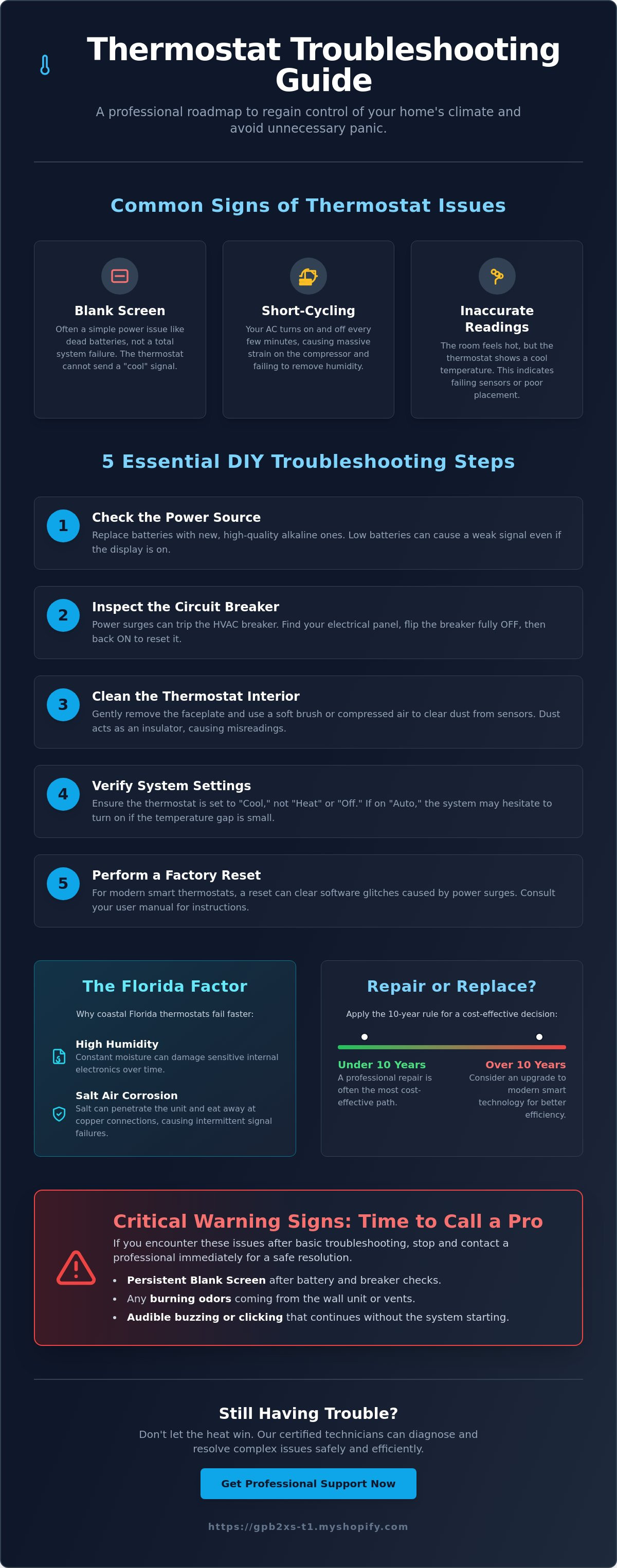
Short-cycling is another major red flag. This happens when your AC turns on and off every few minutes without completing a full cooling cycle. It puts massive strain on your compressor and prevents the system from removing humidity. Similarly, watch for temperature discrepancies. If your living room feels like 80 degrees but the display insists it's a perfect 72, your sensors are likely failing. These inaccuracies mean your comfort is being compromised by faulty data, and your system is working harder than it should.
Identifying Erratic System Behavior
Sometimes a thermostat "forgets" its schedule after a power surge or battery change. This leads to the system running nonstop, which spikes your energy bills and wears down vital components. Sensors inside the unit must be clean and unobstructed to read the air temperature correctly. If they're blocked by dust or located in a drafty hallway, the readings will never match the actual conditions in your home. This erratic behavior requires urgent attention to prevent a total system breakdown.
Visual and Audible Warning Signs
Listen for a clicking sound that isn't followed by the hum of the outdoor unit. This usually indicates a faulty relay trying and failing to engage. Look for flickering displays or fading text, which signal failing internal circuitry. In coastal Sarasota, salt air corrosion is a silent killer. Salt can penetrate the backplate, eating away at copper connections and causing intermittent signals. These physical signs of decay mean the unit is no longer dependable and needs professional inspection to ensure your home stays protected.
5 Essential DIY Steps for Troubleshooting Thermostat Issues
Don't let a rising indoor temperature cause you to panic. Before you assume your entire cooling system has failed, realize that many climate control problems originate at the wall unit. Effective troubleshooting thermostat issues begins with a systematic approach to eliminate simple power and setting errors. These steps allow you to regain control of your home's sanctuary without waiting for a technician to arrive. Perform these checks immediately to restore your comfort and safeguard your equipment from unnecessary strain.
- Step 1: Check the power source and replace batteries immediately. Digital interfaces are incredibly sensitive to voltage drops. Even if the display seems visible, low batteries can prevent the unit from sending a strong enough signal to the air handler. Always use high-quality alkaline batteries rather than rechargeable ones to ensure consistent performance.
- Step 2: Inspect the circuit breaker for a tripped switch. Florida's frequent summer thunderstorms often cause power surges. Head to your electrical panel and locate the dedicated HVAC breaker. If it has moved to the middle position, flip it fully to "Off" and then back to "On" to reset the connection.
- Step 3: Clean the interior of the thermostat. Carefully remove the faceplate and use a soft brush or a can of compressed air to clear away debris. Dust acts as an insulator on sensitive sensors, causing the unit to misread the actual temperature of your room.
- Step 4: Verify the "Switch Over" settings. It sounds simple, but ensure your system is set to "Cool" rather than "Heat" or "Auto." In "Auto" mode, the system may hesitate to engage if the temperature gap is too narrow.
- Step 5: Perform a factory reset to clear software glitches. Modern programmable and smart thermostats sometimes experience software freezes. Consult your manual for the specific button combination required to reboot the processor and clear temporary bugs.
Power and Battery Basics
In a standard Florida home, the HVAC circuit breaker is typically found in the garage or on an exterior wall near the condenser unit. If the breaker is fine but the system remains silent, you might be dealing with a blown fuse inside the air handler unit located in your attic or closet. This small component protects the control board from electrical damage. If you suspect a deeper electrical problem, seeking professional HVAC repair is the safest way to prevent a total system failure.
Settings and Programming Verification
Check your display for "Hold" or "Vacation" indicators. These modes override your daily schedule and can keep the house warmer than you intended. Remember that most units feature a built-in 5-minute delay to protect the compressor from short-cycling. Set your thermostat five degrees lower than the current room temperature to see if the outdoor unit engages immediately. If the system stays silent after this test, the communication link between the wall unit and the AC is likely broken.
The Florida Factor: Why Sarasota Thermostats Fail Faster
Living in Sarasota means your HVAC system faces unique environmental stressors that homeowners in other regions never encounter. While troubleshooting thermostat issues, you must account for the relentless humidity and salty air that define our coastal life. These factors don't just affect your comfort; they actively degrade the sensitive electronic control boards inside your thermostat. A standard unit might last fifteen years in a dry climate, but the intense local conditions often cut that lifespan significantly. You need a solution that respects the reality of our Gulf Coast environment.
Salt air corrosion is a silent killer for thermostats in coastal Sarasota. Microscopic salt particles settle on copper connections, causing them to oxidize and lose conductivity over time. This leads to intermittent signals that can mimic a failing compressor. Combine this with Florida's status as the lightning capital of the world, and your thermostat's digital "brain" is constantly at risk. A single power surge can fry the processor, leaving you with a non-functional unit. Following a reliable Department of Energy thermostat guide can help you understand how to optimize your settings and protect your investment from these regional hazards.
Humidity and Sensor Accuracy
High moisture levels can lead to "ghost" temperature readings, where the thermostat detects heat that isn't actually there because of condensation on the internal sensors. This causes your AC to run longer than necessary, driving up costs and reducing the lifespan of your system. Ensuring you have a properly sealed backplate is vital in humid environments to prevent moist air from the wall cavity from reaching the electronics. You can learn more about managing these environmental factors by improving your home's indoor air quality, which helps stabilize your home's internal sanctuary.
Emergency Heat vs. Normal Operation
Many Sarasota residents accidentally trigger the "EM Heat" or Emergency Heat setting during our rare cool nights. This setting bypasses your efficient heat pump and activates expensive electric resistance heat strips, which can triple your energy consumption instantly. Unless your outdoor unit is physically damaged or covered in ice, you should avoid this setting. To restore efficiency, simply toggle your thermostat back to the standard "Heat" or "Cool" mode. This simple fix prevents a massive shock when your next utility bill arrives and ensures your system operates with the precision we promise.
Should You Repair or Replace Your Thermostat?
Troubleshooting thermostat issues often leads to a critical decision point: do you repair the existing unit or invest in a replacement? Following the 10-year rule is the most reliable way to make this choice. If your thermostat has been on the wall for a decade, its internal components have likely degraded from years of constant cycling and Florida's high humidity. Older mercury or basic digital models lack the precision required for modern high-efficiency systems. Upgrading ensures your home remains a BulletProof sanctuary while eliminating the risk of sudden failure during a heatwave.
Compatibility is a major factor that many homeowners overlook. If you have a multi-stage HVAC system, a basic thermostat may only engage the first stage, forcing your unit to work longer and harder. Smart thermostats are designed to communicate perfectly with these complex systems, optimizing energy use and reducing wear. In Florida, where cooling costs dominate the household budget, a smart thermostat often pays for itself within one to two years through energy savings of 10% to 15%. This equates to roughly $125 to $175 in annual savings on your Florida Power & Light bills.
The Benefits of Upgrading to Smart Technology
Bradenton residents, especially seasonal snowbirds, benefit immensely from remote access capabilities. You can monitor your home's temperature from anywhere in the world, ensuring your AC hasn't failed while you're away. Smart technology also provides detailed energy usage reports, allowing you to identify exactly when your system is working hardest. This level of control provides the security and peace of mind necessary for maintaining a safe home environment year-round.
When a Professional Repair is the Better Choice
Sometimes, a professional repair is the only logical path. High-end proprietary systems from brands like Lennox or Daikin often use specialized wiring that isn't compatible with off-the-shelf thermostats. A technician can also determine if the problem actually lies within the furnace or air handler control board rather than the wall unit itself. The C-wire, or common wire, provides a continuous 24-volt power supply to modern thermostats, and its absence often requires professional installation to avoid damaging your HVAC circuitry.
If you're unsure whether your system needs a simple fix or a total upgrade, contact us for expert residential HVAC services to ensure your comfort is restored with precision.
When to Call BulletProof Air for Professional Support
While troubleshooting thermostat issues can resolve minor glitches, some symptoms demand immediate professional intervention to prevent catastrophic system damage. If your screen remains stubbornly blank after you've replaced the batteries and verified the circuit breaker, the problem likely lies deep within your system's electrical architecture. A failed transformer or a short in the low-voltage wiring requires the precision of a certified technician to resolve safely. We act as the first responders for your home's climate, ensuring that a small electrical fault doesn't escalate into a total system meltdown.
Never ignore the smell of burning plastic or the sight of sparks near your wall unit. These are critical warning signs of an electrical fire hazard that could jeopardize your entire home. Similarly, if your AC continues short-cycling after you've cleaned the sensors and checked the settings, the issue might be a failing control board or a refrigerant leak. Our "Precision Guarantee" means we don't just swap parts. We identify the root cause to ensure your comfort is restored correctly the first time, providing the durability and resilience your home deserves.
Expert Diagnosis in Sarasota & Lakewood Ranch
Our team understands that a broken AC in Southwest Florida is a true emergency. We provide rapid response times for emergency AC repair in Lakewood Ranch and surrounding communities. Our technicians look beyond the thermostat to evaluate your entire HVAC ecosystem, from duct integrity to compressor health. We're dedicated to restoring your sanctuary status before the afternoon heat becomes unbearable, using our specialized knowledge of the local climate to provide long-lasting solutions.
Protect Your System with a Maintenance Plan
The most effective way to avoid the stress of a failing thermostat is through proactive care. Regular checkups through our HVAC maintenance plans ensure that your control boards are clean, your connections are tight, and your sensors are calibrated. These routine inspections catch minor wear from salt air and humidity before it turns into an expensive midnight emergency. Don't wait for your system to fail during a heatwave. Schedule your thermostat inspection with BulletProof Air today!
Take Control of Your Home’s Sanctuary
You now have a definitive roadmap for troubleshooting thermostat issues and identifying the environmental stressors unique to the Gulf Coast. Whether you're dealing with a simple battery swap or deciding if it's time to upgrade for better energy efficiency, your comfort is within reach. Remember that Sarasota's salt air and humidity don't take a day off. Staying proactive with your HVAC controls is the best way to avoid a total system breakdown during a summer heatwave.
As a family-owned and locally operated business in SW Florida, BulletProof Air understands the urgency of a cooling failure. We offer 24/7 emergency service in Sarasota and employ expert technicians specialized in Daikin and Lennox systems. We're here to ensure your repairs are accurate and your home remains a peaceful, protected space. Don't let a faulty thermostat compromise your well-being or drive up your utility bills another day.
Restore your comfort now—contact BulletProof Air for expert thermostat repair!
We're ready to provide the professional support you need to keep your air conditioner running at peak performance. You've got the knowledge to act, and we've got the expertise to help. To explore additional resources on home maintenance and climate control, read more.
Frequently Asked Questions
Why is my thermostat screen blank even after changing the batteries?
A blank screen usually indicates a tripped circuit breaker or a blown fuse within your air handler. If you've confirmed the batteries are fresh, check your electrical panel for a flipped HVAC switch. In many Florida homes, a clogged condensate drain line triggers a safety float switch that cuts power to the thermostat to prevent water damage. If the breaker and drain line are clear, you likely have a failed 24V transformer requiring professional repair.
Can a bad thermostat cause my AC to stop blowing cold air?
Yes, a malfunctioning thermostat can fail to engage the outdoor compressor even if the indoor fan is running. While troubleshooting thermostat issues, we often find that internal relays have failed or wiring has corroded due to salt air. If the thermostat can't send the "cool" signal to the condenser, your system will only circulate warm air. This breakdown in communication prevents your home from reaching the desired temperature and compromises your comfort.
How do I know if my thermostat is compatible with my AC system?
Compatibility depends on the number of "stages" your heating and cooling equipment uses. You can check the wiring behind your current unit; a basic system typically has four wires, while heat pumps and multi-stage units require more. Proprietary systems from brands like Daikin or Lennox often require specific communicating thermostats to function correctly. Using an incompatible device can lead to inefficient operation, higher energy bills, or permanent damage to your HVAC control board.
What does 'Emergency Heat' mean on my thermostat, and should it be on?
Emergency Heat (EM Heat) activates supplemental electric resistance strips and should only be used if your primary heat pump fails. In our Southwest Florida climate, you should rarely need this setting. It bypasses the energy-efficient cooling and heating cycle and uses a significant amount of electricity, which will spike your utility bill. Only activate this mode if your outdoor unit is physically damaged and you require immediate warmth during an unusual cold snap.
Why does my thermostat show a different temperature than my thermometer?
This discrepancy is often caused by poor placement or uncalibrated sensors. If your thermostat is mounted near a drafty window, a heat-producing lamp, or an exterior wall, it will provide an inaccurate "ghost" reading. Digital sensors can also drift over time as dust accumulates inside the unit. This lack of precision causes your AC to cycle at the wrong times, making your home feel warmer or more humid than the display suggests.
Is it worth upgrading to a smart thermostat in Florida?
Yes, smart thermostats are highly effective at managing Florida's intense humidity and high cooling demands. These models offer dew-point control and can integrate with whole-home dehumidifiers to maintain a perfect sanctuary. They also provide remote access, which is vital for seasonal residents who need to monitor their property while away. By optimizing your cooling schedule based on real-time data, these units provide superior comfort and help prevent mold growth in vacant homes.
How often should I replace my home's thermostat?
You should consider a replacement every 10 years to maintain accuracy and take advantage of better technology. Digital sensors and internal circuitry degrade over time, especially when exposed to the moisture and salt air common in Sarasota. If you've recently installed a new high-efficiency AC unit but kept your old thermostat, you aren't receiving the full benefits of your investment. A decade of service is the standard limit for reliable, precise climate control.
Can a power surge damage my digital thermostat?
Yes, Florida's frequent lightning strikes and grid fluctuations can easily "fry" the delicate microprocessors in a digital thermostat. A surge can cause the unit to lose its programming, display error codes, or stop communicating with the air handler entirely. If your thermostat behaves erratically or resets itself after a summer storm, the internal circuitry may be compromised. We recommend high-quality surge protection to safeguard these sensitive electronics and ensure your system stays operational.