

What Is a Variable-Speed Air Conditioner? How It Works and When It Helps
A variable-speed air conditioner doesn’t run at full power every time it turns on. So, what is a variable speed air conditioner? It’s a system that can adjust its cooling output to match your home’s needs instead of switching only between off and full capacity. That difference can matter in Southwest Florida, where humidity can make a home feel uncomfortable even when the thermostat reaches its setting.
“Variable speed” doesn’t mean constant maximum operation or guaranteed energy savings. A system may run at a lower output for longer periods, which can help maintain steadier temperatures and remove humidity. The results depend on the home, system design, and installation.
This guide explains how variable-speed cooling works and compares it with single-stage and two-stage air conditioners. You’ll learn which comfort priorities, home conditions, and equipment details to consider when weighing your options, so you can judge whether variable-speed technology fits your Florida home.
Key Takeaways
- Learn what is a variable speed air conditioner and how it adjusts cooling output as demand changes.
- Compare single-stage, two-stage, and variable-speed systems by how they operate and the trade-offs to consider.
- Assess how your home’s comfort needs, including Southwest Florida humidity, may affect system fit.
- See what an installation evaluation considers, from the home’s needs to equipment configuration.
- Understand how BulletProof Air tailors HVAC installation solutions to the home and the homeowner’s priorities.
What Is a Variable-Speed Air Conditioner? The Meaning Behind the Name
A variable-speed air conditioner adjusts its cooling output as a home’s needs change, rather than operating at only one fixed capacity. The key is modulation: the equipment can change how hard it works as conditions shift. “Variable speed” doesn’t mean the system runs at maximum power all the time.
Thermostat temperature and cooling capacity are related, but they aren’t the same. The thermostat setting is your target temperature; cooling capacity is how much cooling the system delivers at a given moment. A variable-speed system can adjust its output while working toward that target. The available operating range and controls depend on the system’s design.
What does variable speed mean in an air conditioner?
A basic single-stage system generally runs at its fixed capacity when cooling is needed, then shuts off when the thermostat’s demand is satisfied. A variable-speed system can increase or decrease its output to meet changing demand. Think of it as having multiple output levels, not as changing the temperature you set. The specific adjustments vary by equipment, so one model’s operating range doesn’t necessarily apply to another.
In systems designed with an inverter, the control technology can vary compressor speed. An inverter compressor lets the system adapt its cooling output instead of relying only on repeated starts and stops at full capacity. The equipment configuration determines how that adjustment works.
Is variable speed the same as a variable-speed fan?
No. The compressor and indoor blower have separate jobs. The compressor circulates refrigerant through the cooling system, while the blower moves air through the indoor unit and ductwork. Either component may have speed-control capabilities, but those capabilities don’t automatically match.
A system could have a variable-speed blower without a variable-speed compressor. Other combinations are possible, depending on equipment design. The phrase “variable-speed air conditioner” needs context: identify which component adjusts speed and how the complete system is configured. That distinction makes equipment comparisons more accurate and prevents assuming that a variable-speed fan means the compressor also modulates.
How Does a Variable-Speed Air Conditioner Adjust Cooling?
A variable-speed system responds to signals from the thermostat and its controls. When the indoor temperature differs from the setting, the thermostat sends a cooling demand to compatible system controls. Those controls direct the equipment. Rather than relying only on one fixed output while running, a modulating system can adjust compressor operation to meet the cooling load.
Variable capacity means the system can adjust its cooling output instead of operating at just one fixed level whenever it’s on. The process is coordinated, but the exact response depends on the equipment and controls.
What does the compressor do as cooling demand changes?
The compressor circulates refrigerant through the system. As the refrigerant moves, it helps carry heat from indoors to outdoors. Compressor operation affects how quickly refrigerant circulates, which influences the system’s cooling output.
A home may need more cooling on a hot afternoon than during milder conditions. A compatible variable-speed control system can adjust compressor operation in response. The available modulation depends on the equipment and controls, so one speed range or capacity shouldn’t be assumed for every model. The central idea behind what is a variable speed air conditioner is its ability to vary compressor output as demand changes, not a promise that every system adjusts in the same way.
How do the thermostat and blower affect comfort?
The thermostat provides the signal, but system controls determine how the equipment responds. The thermostat and system need to communicate as intended for their available functions to work together. Features and control arrangements differ, so “variable speed” alone doesn’t describe how a system will respond to every setting.
The indoor blower moves air across the indoor coil, where it is cooled, and then through the home’s ductwork. Some equipment can adjust blower speed or airflow as conditions change; other configurations work differently. A variable-speed compressor doesn’t automatically mean the blower has the same capability or that both components always change speed together.
That distinction helps clarify comparisons: compressor modulation changes cooling output, while blower operation affects how air moves through the home. During a customized HVAC installation, BulletProof Air evaluates the home, comfort priorities, and equipment configuration to shape a solution for the project. Explore custom HVAC installation to see how system design can fit your home.
Variable-Speed vs. Single-Stage and Two-Stage AC: What Really Changes?
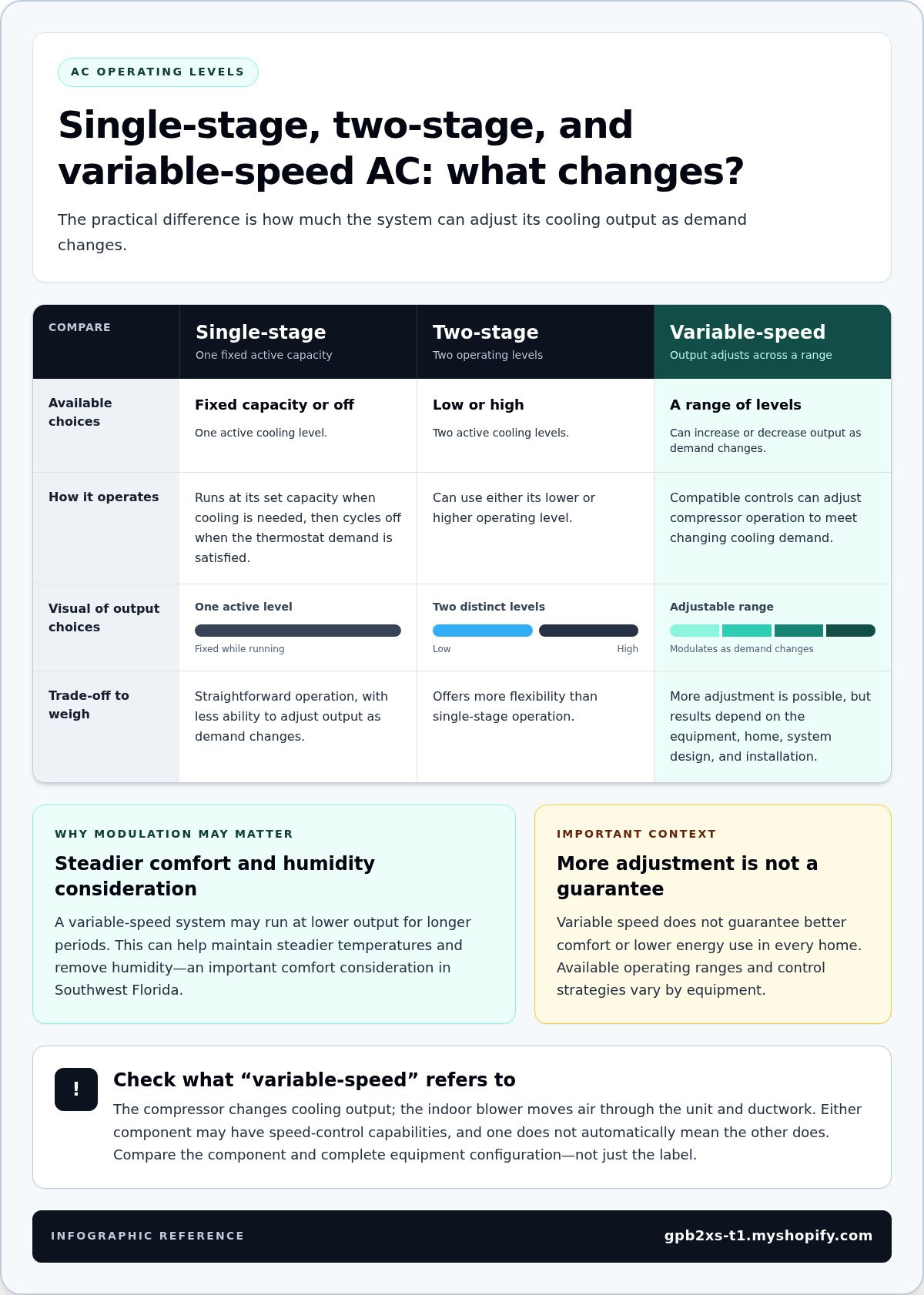
The practical difference is how many operating levels a system can use to meet cooling demand. A single-stage unit has one active capacity, a two-stage system has two, and a variable-speed system can adjust across a range of levels. The range and control strategy vary by equipment. More adjustment can offer flexibility, but it doesn’t guarantee better comfort or lower energy use in every home.
| System type | Operating choices | Typical behavior and trade-off |
|---|---|---|
| Single-stage | Fixed capacity or off | Runs at its set capacity when cooling is needed, then cycles off. Its operation is straightforward, with less ability to adjust output as demand changes. |
| Two-stage | Low or high capacity | Can use a lower or higher operating level, offering more flexibility than single-stage operation but fewer choices than variable speed. |
| Variable-speed | Multiple operating levels | Can adjust output to suit demand, subject to the system’s design and controls. This flexibility may support steadier operation, but results depend on the complete setup. |
Does variable speed always use less energy?
No system type guarantees lower energy use in every home. When cooling demand is light, a variable-speed system may operate at reduced output, which can improve efficiency under suitable conditions. Actual energy use also depends on equipment efficiency, system sizing, thermostat and equipment controls, duct condition, and household use. Compare the full system and its installation, not just the “variable-speed” label.
Can variable speed improve humidity and temperature consistency?
Longer periods of lower-output operation may help maintain more even cooling in some homes. They may also support humidity removal because the system can continue running instead of stopping as soon as it reaches its target. Performance depends on sizing, system operation, indoor conditions, and airflow. A variable-speed feature can’t guarantee identical temperatures or humidity in every room.
In practical terms, what is a variable speed air conditioner? It’s a system with more ways to respond, not a universal upgrade with a guaranteed outcome. A suitable selection and installation account for the home, ductwork, controls, and comfort priorities. That whole-system view makes a comparison more useful for your household.
Is a Variable-Speed Air Conditioner a Good Fit for a Florida Home?
Southwest Florida’s heat and humidity make steady indoor comfort a priority, but variable speed isn’t automatically the right choice for every home. It may suit households that value consistent temperatures or want the cooling system to adjust as demand changes throughout the day. Whether those advantages matter in your home depends on the house, existing equipment, and how the complete system is selected and installed.
Which comfort priorities can make variable speed worth considering?
Consider where and when comfort feels uneven. If occupied rooms warm up at different times or cooling demand shifts as the day goes on, more adjustable operation may be worth considering. Humidity is another part of comfort in Florida. A system’s operating pattern can affect moisture removal, but variable speed alone can’t guarantee a particular humidity level.
Sound may also factor into the decision. Some systems can run at lower output for periods, which may make operation less noticeable in certain situations. Actual sound depends on the equipment and installation, so quieter operation isn’t guaranteed. Focus on the comfort concerns you want the system to address and compare them with its capabilities.
What should be evaluated before replacing an AC system?
Start with the home, not a feature label. An HVAC professional can evaluate the home’s cooling load, existing ductwork, current equipment condition, and compatibility between system controls. These details help determine whether the complete system can deliver the operation and airflow your home needs.
Correct sizing matters. A system that doesn’t match the home’s cooling needs may struggle to maintain comfort, even if it offers variable-speed operation. Ductwork and controls matter too, because the equipment needs to work as a coordinated system. The right choice depends on the project and your priorities, not simply on selecting the most adjustable option.
For a broader look at a local replacement project, read this Sarasota AC installation guide. If you’re considering a system change, explore BulletProof Air’s HVAC installation services and how a customized installation can account for your home, comfort goals, and equipment configuration.
What to Expect When Evaluating a Variable-Speed AC Installation
Choosing an air conditioner starts with the home, not a feature label. A professional evaluation connects your comfort needs with equipment and an installation approach suited to the project. Understanding what is a variable speed air conditioner is one part of the decision; the next is determining whether that operating style suits your home and system setup.
How does an HVAC professional assess the home's needs?
The assessment considers how the home is built and how it feels to live in. An HVAC professional may review the layout, existing equipment, ductwork, insulation, and comfort concerns you’ve noticed, such as rooms that feel uneven or areas that are difficult to cool. Together, these details inform system sizing and which equipment configurations fit the home.
That evaluation matters because a system that’s too large or too small can undermine comfort, regardless of its features. Priorities also differ by project: a lived-in home, commercial space, and new construction don’t have identical requirements. BulletProof Air tailors HVAC installation solutions to the project and customer needs, taking the home and equipment configuration into account.
What happens after the system is selected?
Once the system is selected, installation planning accounts for how the equipment will be set up and integrated with the home. Professional installation includes configuring the system for its intended application. The specific work depends on the equipment and project. Proper setup, followed by appropriate maintenance, supports reliable operation over time.
For information about ongoing system care, see the Southwest Florida AC repair guide. It offers additional context on what homeowners may need after installation.
If you’re weighing a system replacement, explore BulletProof Air’s HVAC installation services to learn how a tailored approach can account for your project and comfort priorities.
Choose Cooling That Fits Your Home
Understanding what is a variable speed air conditioner makes system comparisons clearer: it adjusts cooling output to respond to demand instead of relying on only one fixed operating level. Single-stage, two-stage, and variable-speed systems work differently, and more adjustability doesn’t guarantee the best result for every home.
In Southwest Florida, heat and humidity make comfort important, but the right choice depends on more than climate. Home layout, cooling needs, ductwork, controls, equipment condition, and installation all influence how a system performs. A careful evaluation connects those details with your priorities without assuming one feature will solve every comfort concern.
BulletProof Air provides customized HVAC installation for residential, commercial, and new-construction projects in Southwest Florida. Each project can be approached with its own requirements in mind. If you’re considering a replacement or planning a new system, explore customized HVAC installation with BulletProof Air and take the next step toward an indoor space tailored to your comfort needs.
Frequently Asked Questions
What is a variable-speed air conditioner?
A variable-speed air conditioner adjusts its cooling output as demand changes instead of running at only one fixed capacity. The term usually refers to how the compressor can modulate, though equipment designs differ. It doesn’t mean the system constantly runs at maximum power, and it doesn’t describe the thermostat setting. The thermostat sets the target temperature; the system’s capacity determines how much cooling it delivers while working toward that target.
How does a variable-speed air conditioner work?
A thermostat communicates a cooling demand to compatible system controls. Those controls adjust compressor operation according to demand and the equipment’s capabilities. The compressor circulates refrigerant, affecting the system’s cooling output. In some configurations, the indoor blower can also adjust airflow through the ductwork. Compressor and blower controls are separate, so the system’s response depends on its equipment and control setup.
Is a variable-speed air conditioner more efficient than a single-stage AC?
It can be more efficient in suitable conditions, but the label alone doesn’t guarantee lower energy use. A variable-speed system may reduce output when demand is lighter, while a single-stage unit operates at its fixed capacity when running and then cycles off. Actual energy use depends on equipment efficiency, system sizing, controls, duct condition, and household use. Comparing the full system and installation gives a more useful picture than comparing stages alone.
Does a variable-speed air conditioner remove humidity better?
It may help with humidity control in some homes. Longer operation at lower output can give the system more time to remove moisture as air passes over the indoor coil. Results depend on sizing, system operation, indoor conditions, and airflow. Variable speed by itself can’t guarantee a specific humidity level. If your home feels damp despite reaching the thermostat setting, include that comfort concern in the system evaluation.
Is a variable-speed air conditioner quieter?
It may be quieter during some operating conditions, especially if the system can run at a lower output instead of frequently operating at full capacity. Sound levels vary by equipment, installation, location, and operating mode, so a variable-speed feature isn’t a promise of silent operation. Consider the complete system and component locations, and use equipment-specific sound information when comparing options.
Is a variable-speed air conditioner worth it in Florida?
It may be worth considering if you value adjustable cooling, steadier temperatures, or humidity management in Southwest Florida’s hot, humid conditions. It isn’t automatically right for every home. System sizing, existing ductwork, controls, equipment condition, installation, and comfort priorities all affect the outcome. A professional evaluation can help determine whether the system’s capabilities address your home’s needs instead of relying on the feature name alone.
What is the difference between a variable-speed compressor and a variable-speed blower?
A variable-speed compressor adjusts refrigerant circulation and affects the system’s cooling output. A variable-speed blower adjusts how indoor air moves through the coil and ductwork. They perform different jobs, and speed control in one component doesn’t mean the other has the same capability. Equipment configurations vary, so compare the compressor and blower separately when reviewing system details. This distinction clarifies what “variable speed” means for the complete setup.
If you would like maintenance or repair assistance with your Florida Air Conditioner, contact BulletProof Air Or call: 941.599.9999 for more information about how we can help.