

What is SEER Rating and Why It Matters for Florida Homeowners in 2026
In the relentless Florida heat, your air conditioner isn't just a luxury; it's a lifeline for your home's sanctuary. Most homeowners look at efficiency labels and see confusing numbers, but in our climate, a high rating is actually a humidity-control metric disguised as an energy-saving tool. You likely feel the sting of climbing electric bills every July. You might also worry if an aging system can survive the corrosive salt air for another year. Understanding what is SEER rating and why it matters is the definitive way to tell the difference between a home that feels like a swamp and one that remains a crisp, dry refuge.
We understand the stress of choosing a new system without overpaying for features you don't need. This guide will help you master the technical shift to SEER2 standards and the mandatory 2026 refrigerant requirements. Our goal is to help you slash your power bills while maximizing indoor comfort. We will explain how modern units pull moisture from the air more effectively and which ratings offer the best durability for our unique coastal environment. By the end, you will have the professional knowledge needed to secure a high-performance system that lasts.
Key Takeaways
- Understand how the updated SEER2 testing standards more accurately reflect the real-world pressure and heat your system faces every day.
- Learn exactly what is SEER rating and why it matters for homeowners who want to slash their power bills without sacrificing indoor comfort.
- Compare the upfront costs against long-term savings to see if a variable-speed unit is the right financial move for your specific property.
- Uncover the "Florida Secret" of how high-efficiency systems act as powerful dehumidifiers to keep your home's sanctuary dry and healthy.
- Get a clear roadmap for choosing a system that meets the 2026 low-GWP refrigerant requirements while securing a high-durability warranty.
Decoding the SEER2 Standard: What It Means in 2026
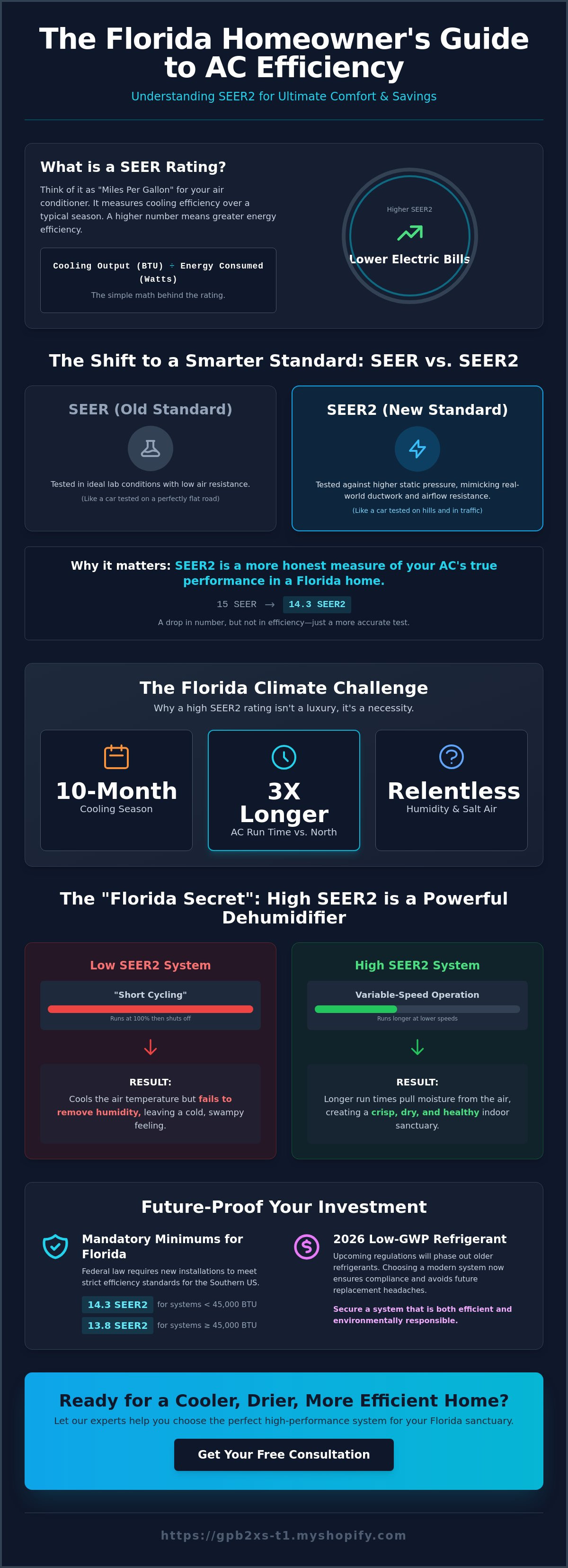
Think of your air conditioner as a specialized vehicle designed for a marathon. You wouldn't purchase a car without checking the "miles per gallon" on the window sticker. The Seasonal Energy Efficiency Ratio (SEER) is that exact sticker for your cooling system. It measures the total cooling output compared to the electricity consumed over a typical season. In our relentless heat, understanding what is SEER rating and why it matters is the first step toward reclaiming your home's comfort. A higher number always translates to a lower power bill. It's a direct correlation you can count on.
The Simple Math Behind the Rating
The rating comes from a specific ratio. Engineers take the total cooling output, measured in British Thermal Units (BTUs), and divide it by the total electric energy input. This creates a standardized score for every unit on the market. Think of it like highway versus city driving. Your system doesn't run at full tilt every hour of the day. The "Seasonal" part of the name accounts for these fluctuations over a year. New 2026 testing standards now account for higher external static pressure. This measures the resistance your ductwork provides. It ensures the rating you see on the box matches the actual performance in your living room.
SEER vs. SEER2: Why the Change Matters
The industry transitioned to SEER2 because the old testing methods were too lenient. They didn't accurately reflect the intense conditions of a Florida summer. Old SEER tests assumed your system was breathing easily in a controlled lab. SEER2 testing forces the unit to work against the pressure of real-world ductwork. This is vital because our attics often trap extreme heat and create massive resistance. Because the new test is more difficult, the numbers have shifted. A 14.3 SEER2 rating is roughly equivalent to the old 15 SEER standard. It's not a drop in efficiency; it's a more honest measurement of power.
Federal law now mandates strict minimums for the Southern United States. For systems under 45,000 BTU, the minimum is 14.3 SEER2. Larger systems must hit at least 13.8 SEER2. When you look for hvac services near me, you must verify that your new installation meets these 2026 requirements. Installing a sub-standard unit is no longer an option. Choosing a higher rating isn't just about following the law. It's about choosing a system that survives the Florida sun while keeping your bank account intact. High-efficiency units use less energy to move more heat. This keeps your sanctuary cool even when the humidity peaks.
Why SEER Rating is the Most Critical Factor for Florida Homes
Florida homeowners face a unique environmental challenge that most of the country simply doesn't understand. In northern states, an air conditioner might only run for a three-month window during the peak of summer. In Sarasota and Bradenton, we live through a 10-month cooling season where the humidity never truly relents. This is why understanding what is SEER rating and why it matters becomes a financial survival strategy. While a lower-rated unit might survive a mild Ohio summer, it will quickly buckle under the weight of a Florida July. You need a system built for a marathon, not a sprint. High-efficiency units are engineered to handle the constant load of our climate without suffering premature mechanical failure.
The Sarasota Cooling Marathon
Data suggests that AC units in Sarasota run nearly three times longer than those in the Northeast. A "good" efficiency rating in a cooler climate is often unacceptable in Lakewood Ranch. When your system runs for 3,000 or more hours per year, every point on the SEER2 scale represents a massive difference in your monthly overhead. Continuous operation puts immense strain on internal components. If your current system is struggling to keep up, securing professional ac repair in sarasota is vital to ensure your efficiency hasn't been compromised by wear and tear.
Environmental Stress and Efficiency
Intense UV radiation and stagnant heat don't just make you uncomfortable; they actively degrade the efficiency of baseline cooling units. Low-SEER systems often rely on single-stage compressors that can only operate at 100% capacity. This leads to "short-cycling," where the unit turns on and off rapidly. This process wastes energy and fails to remove humidity from your sanctuary. Following the University of Florida's recommendations for energy-efficient homes, homeowners should prioritize systems that can handle our specific latent heat loads. Modern high-SEER2 models often include specialized salt-air protection to prevent the corrosion that typically kills local systems within a decade.
System longevity is the ultimate goal for any investment in your home. When a unit has a higher efficiency rating, it often utilizes variable-speed technology. This allows the system to run at lower, more consistent speeds rather than slamming on at full power. It reduces the physical stress on the motor and compressor. By not working at 100% capacity 24/7, these units stay reliable for years longer than their budget counterparts. If you are worried about your current system's ability to survive the next heatwave, consider scheduling a professional HVAC inspection to evaluate your options before an emergency strikes.
The ROI Analysis: Is a High SEER Rating Actually Worth It?
A common argument found on internet forums is that anything above a base-level efficiency rating is a waste of money. While that logic might hold weight in a climate with a three-month summer, it's a dangerous assumption for Southwest Florida. In our region, the air conditioner is the primary driver of your monthly overhead for ten months of the year. Mastering what is SEER rating and why it matters allows you to view your HVAC system as a financial asset rather than just a recurring expense. In Sarasota, a high-efficiency system often pays for itself in five to seven years through reduced utility consumption alone.
ROI isn't just about the monthly bill. High-SEER units are premium machines built with more durable components. They typically experience fewer emergency breakdowns because the variable-speed technology allows them to maintain your sanctuary without the constant mechanical stress of "all or nothing" operation. Additionally, a modern, high-efficiency system significantly increases your home's resale value. Potential buyers in 2026 prioritize energy-efficient properties to avoid the sticker shock of rising Florida utility rates.
Estimated Monthly Savings in SW Florida
The gap in performance between an old 10 SEER unit and a modern 20 SEER2 system is staggering. While an older unit might struggle to keep up, a high-efficiency system can reduce the cooling portion of your electric bill by 40% or more. Florida Power & Light (FPL) rates continue to fluctuate, and as energy costs rise, the payback period for an efficient unit shrinks. The "Break-even Point" for a 16 SEER2 heat pump in Sarasota typically occurs midway through its expected lifespan, after which the system generates pure savings for the remainder of its service life.
Tax Credits and Rebates for 2026
The federal government provides significant incentives to help homeowners upgrade. Under the Energy Efficient Home Improvement Credit (25C), you may be eligible for a tax credit of up to $600 for qualifying central air conditioners or up to $2,000 for high-efficiency heat pumps. These incentives are tied to the new minimum energy efficiency standards aimed at reducing regional power grid strain. Local utility rebates in Sarasota also offer additional financial relief for a professional AC installation Sarasota FL. BulletProof Air helps homeowners navigate these complex financial incentives to ensure you maximize your return on investment from day one.
The "Florida Secret": SEER and Humidity Control
In the Sarasota area, the number on your thermostat is only half the story. You can set your home to 72 degrees, but if the air is heavy with moisture, your sanctuary will still feel sticky and oppressive. This is where understanding what is SEER rating and why it matters shifts from a financial discussion to a fundamental comfort necessity. Most homeowners don't realize that high SEER ratings, specifically those 18 and above, are achieved through advanced compressor technology that serves as the ultimate dehumidifier for your indoor environment. In our climate, an air conditioner's ability to remove water from the air is just as vital as its ability to lower the temperature.
Variable-Speed: The Engine of High SEER
Standard, low-efficiency units use single-stage compressors that operate like a light switch; they are either 100% on or completely off. These units blast cold air into your home and shut down as soon as the temperature target is met. This rapid cycle often leaves the humidity untouched. High-SEER systems utilize variable-speed technology, which acts more like a dimmer switch. The system runs at lower, more consistent speeds for longer durations. This "low and slow" cooling method allows the evaporator coil to pull significantly more moisture out of the air. In homes with older, low-SEER units, you often experience the "Comfort Gap," where you feel cold but clammy. While ac repair for these sophisticated machines requires a higher level of technical precision, these units actually suffer fewer breakdowns because they avoid the mechanical stress of constant starting and stopping.
Preventing Mold and Mildew
For Sarasota homes, the target is 50% relative humidity. When your indoor humidity consistently climbs above 60%, your home becomes a breeding ground for mold and mildew. High-efficiency systems are your first line of defense against these biological threats. Because they maintain a steady, dry environment, they protect your drywall, furniture, and clothing from moisture damage. Many high-SEER models also come standard with superior filtration systems. This is a massive benefit for families dealing with allergies or respiratory issues, as it scrubs the air of triggers that thrive in damp conditions. By prioritizing a system that masters humidity, you aren't just saving money; you are protecting your family's health. If you are tired of a home that feels like a swamp, it is time to consult with a professional about a high-efficiency humidity solution.
Choosing Your BulletProof Solution: What SEER is Right for You?
Deciding on a new AC system is a high-stakes investment in your property's future. You now understand what is SEER rating and why it matters for both your bank account and your daily comfort. However, the "best" rating isn't a one-size-fits-all answer. Your choice should balance your immediate budget with your long-term goals for the home. Whether you're looking for a quick replacement or a permanent upgrade, the goal is to ensure your system survives the brutal Florida environment while maintaining a peaceful, dry interior.
The 14.3 vs. 18 SEER2 Dilemma
If you own a rental property or plan to move within the next few years, the federal minimum of 14.3 SEER2 is often a practical choice. It meets legal requirements and provides reliable cooling without a massive upfront cost. Conversely, 18+ SEER2 systems are the definitive choice for "forever homes" in Bradenton and Sarasota. These units offer the variable-speed technology essential for total humidity control. BulletProof Air technicians perform customized load calculations for every estimate. This ensures your chosen SEER rating matches the specific cooling demands of your square footage. We don't guess; we measure.
Living near the Gulf means your equipment faces a constant barrage of salt-laden air. High-efficiency units often feature advanced, corrosion-resistant coil coatings that baseline models lack. We consider a 10-year parts warranty the "BulletProof" standard for any high-efficiency install. It provides the security you need in a climate where salt air can eat through unprotected aluminum in less than half a decade. Don't settle for a system that isn't built to withstand our local atmosphere.
Why Installation Quality Trumps the Rating
Even the most advanced 20 SEER2 unit will fail to deliver its promised savings if it's installed incorrectly. A poor installation can make a premium system perform like a 10 SEER relic. Precision sizing is critical. We use Manual J calculations to determine exactly how much cooling your home needs. If your system is oversized, it will short-cycle and leave you damp. If it's undersized, it will never stop running. Both scenarios destroy your efficiency and your comfort. Precision matters.
Check your ductwork integrity as well. Leaky ducts can waste up to 30% of your conditioned air before it ever reaches your living space. To protect your investment, you should find a trusted hvac company near me that prioritizes technical accuracy over speed. Restoring your home as a sanctuary requires a partner who understands the local climate and respects the critical nature of your cooling needs. Take action today to secure a system that delivers lasting reliability and lower bills.
Secure Your Home's Sanctuary and Savings Today
Navigating the transition to SEER2 standards is more than a regulatory hurdle; it's an opportunity to optimize your home for the long haul. You've learned how a higher efficiency rating acts as a powerful shield against Florida's relentless humidity and climbing energy costs. By prioritizing variable-speed technology and precision installation, you ensure your system survives the Sarasota marathon while keeping your monthly overhead low. Understanding what is SEER rating and why it matters empowers you to choose a system that delivers consistent comfort rather than clammy air.
Don't wait for your current unit to fail during a record-breaking heatwave. As authorized Daikin and Lennox elite installers with over 500+ 5-star reviews in SW Florida, we specialize in high-performance humidity control solutions tailored for our unique climate. Our team is ready to provide the professional guidance you need to make a BulletProof choice for your property. Get Your Free High-Efficiency AC Estimate in Sarasota Today and take the first step toward a more reliable, cost-effective home. You deserve a cool, dry space where you can truly relax.
Frequently Asked Questions
What is the federal minimum SEER rating for Florida in 2026?
The federal minimum for new air conditioners installed in Florida is 14.3 SEER2 for systems with a capacity under 45,000 BTU. For larger residential systems, the minimum requirement is 13.8 SEER2. These standards apply to all equipment manufactured after January 1, 2023. You must ensure any new installation complies with these regional mandates to guarantee your system is legal and efficient.
Will a higher SEER rating really lower my FPL bill?
Yes, a higher rating directly reduces the amount of electricity your system consumes to cool your home. Upgrading from a 14 SEER2 unit to a 20 SEER2 unit can result in approximately $231 in annual electricity savings in a hot climate. Over a 15-year period, these savings can add up to over $3,465. This makes a high-efficiency choice a smart hedge against rising utility rates.
Is SEER2 the same as SEER?
SEER2 is the updated testing standard that replaced the original SEER system to better simulate real-world conditions. It uses a higher external static pressure during testing to account for the resistance found in typical household ductwork. Because the test is more difficult, the numbers look slightly lower; a 14.3 SEER2 unit is roughly equivalent to an old 15 SEER model. It's a more accurate measure of performance.
How long does a high-SEER air conditioner last in Florida?
A high-efficiency air conditioner typically lasts between 10 and 15 years in Florida when properly maintained. The salt air and extreme heat in coastal areas like Sarasota can accelerate wear on outdoor coils and components. Premium units often include specialized coatings to resist this corrosion. This protection helps your system remain a reliable part of your sanctuary for its full expected service life.
Can I just upgrade my outdoor unit to a higher SEER and keep my old indoor coil?
You shouldn't replace only the outdoor unit while keeping an old indoor coil. Modern high-efficiency systems require perfectly matched components to achieve their rated SEER2 performance. Using an old coil with a new, high-efficiency outdoor unit will likely cause mechanical failure and void your manufacturer warranty. Total system replacement is the only way to ensure the system operates at peak efficiency and reliability.
What SEER rating qualifies for the federal tax credit in 2026?
For central air conditioners, a SEER2 of 17.0 or higher is typically required to qualify for federal tax credits. Under the Energy Efficient Home Improvement Credit, homeowners could receive up to $600 for qualifying AC units or up to $2,000 for high-efficiency heat pumps. Since these credits were originally set to expire at the end of 2025, you should verify if Congress extended these incentives for the 2026 tax year.
Does a higher SEER rating mean the AC cools faster?
A higher rating doesn't mean the system cools your home faster; it means it cools more efficiently. Efficiency is a measure of how much cooling output you get for every dollar spent on electricity. High-SEER units often run for longer cycles at lower speeds to maintain a steady temperature. This is a key part of what is SEER rating and why it matters, as it provides superior dehumidification.
Is there a SEER rating that is considered "too high" for a small home?
No SEER rating is "too high" for a small home, but the physical capacity or tonnage must be correct. A 20 SEER2 unit is an excellent choice for a small space as long as a professional performs a Manual J load calculation to ensure the system isn't oversized. High-efficiency units in small homes often provide the fastest return on investment and the best possible indoor comfort levels.
If you would like maintenance or repair assistance with your Florida Air Conditioner, contact BulletProof Air Or call: 941.599.9999 for more information about how we can help.