

What Size AC Unit Do I Need for My House? A 2026 Florida Sizing Guide
Choosing a larger air conditioner isn't just a waste of money; in Florida's climate, it's a recipe for a moldy and humid disaster. Many homeowners assume that a bigger unit will cool their space faster, but an oversized system often shuts off before it can properly dehumidify your air. If you're currently asking, "what size ac unit do i need for my house" to avoid being oversold, you're already making a smart move for your home's health. We understand the stress of facing a mechanical failure during a heatwave, and we know you want a solution that provides lasting security for your family.
It's exhausting to deal with sticky indoor air and utility bills that keep climbing higher every month. You deserve a home that feels like a true sanctuary from the heat. This 2026 Florida sizing guide promises to give you the clarity you need to calculate tonnage and BTU requirements with total accuracy. We will preview the critical shift from simple square footage rules to the precision of Manual J calculations required by the latest Florida Building Code. You'll learn how to select a system that delivers lower monthly bills and a longer lifespan without the need for constant, expensive repairs.
Key Takeaways
- Learn why finding the "Goldilocks" size for your AC is the only way to eliminate sticky Florida humidity and restore your home's comfort.
- Discover why the old square footage rule is outdated and how to accurately answer "what size ac unit do i need for my house" using modern standards.
- Understand the real meaning of BTU and tonnage so you can talk to technicians with confidence and avoid paying for capacity you don't need.
- See how the Manual J calculation acts as the industry gold standard to ensure your new system is perfectly calibrated for your specific floor plan.
- Find out how professional, precision installation protects your investment and ensures your unit lasts for its full expected lifespan.
Why Correct AC Sizing is the Foundation of Your Home’s Comfort
Florida heat is relentless. In this climate, your cooling system acts as the primary barrier between your family and the punishing outdoor humidity. AC sizing is the precise measurement of a cooling system’s capacity to remove both heat and moisture from your indoor environment. It isn't just about the physical dimensions of the machine. It's about how much thermal energy the unit can displace in an hour. Professionals look at this through the lens of Air conditioning tonnage and BTU ratings. If you find yourself asking, "what size ac unit do i need for my house," you're asking the most important question for your long-term comfort and financial security.
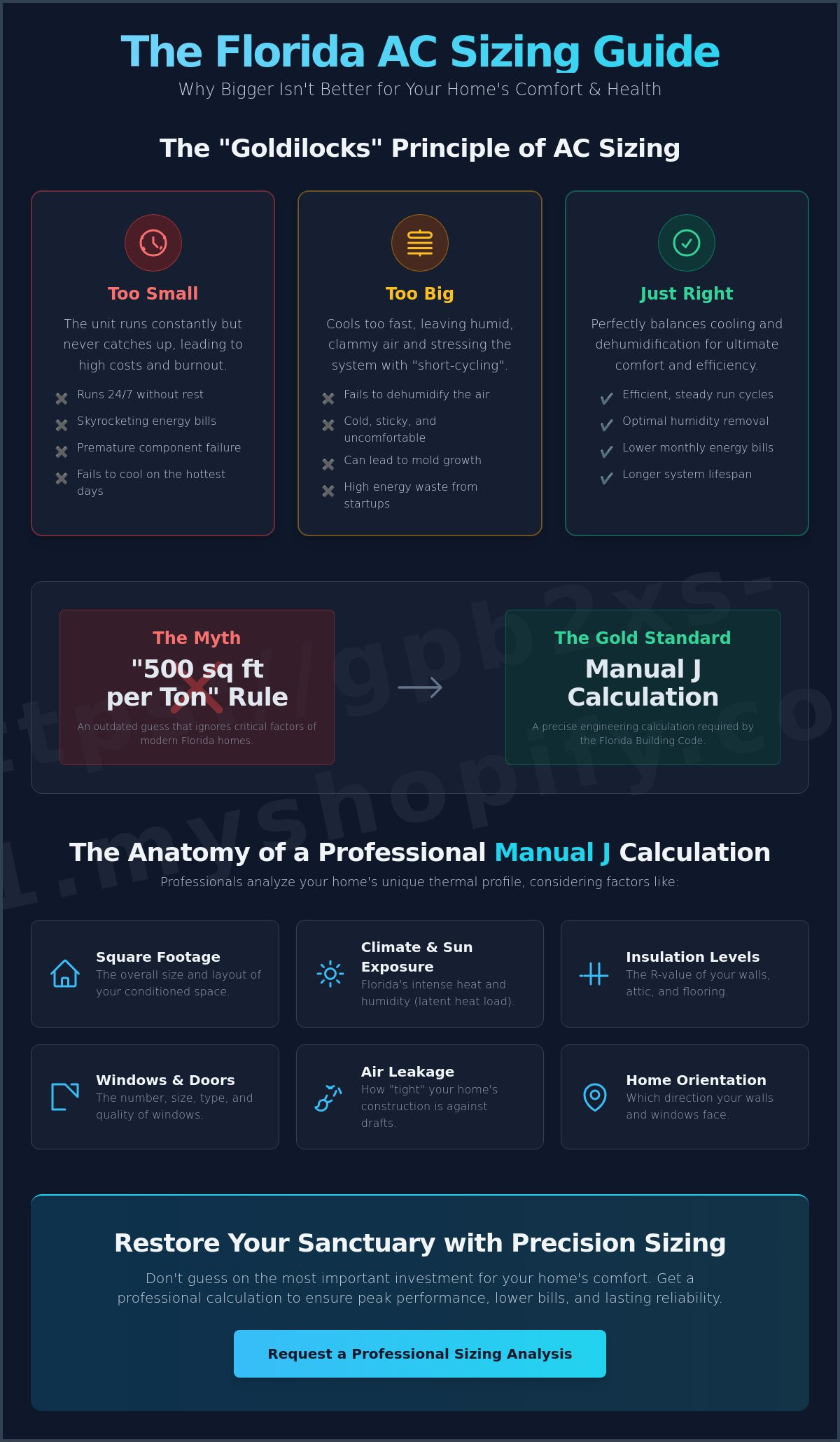
Finding the right unit follows the "Goldilocks" Principle. The system cannot be too small, or it will never reach the target temperature during a July afternoon. It cannot be too large, or it will cool the air without removing the water vapor. It must be exactly right for your specific floor plan and insulation levels. Most homeowners want to avoid the two expensive extremes of underperformance and overspending. Getting this calculation wrong at the start leads to a decade of frustration and high utility costs.
An undersized unit is a constant drain on your finances. Because it lacks the power to meet the heat load of a local summer, it runs 24/7 without a break. This leads to skyrocketing energy bills and causes internal parts to wear out years before they should. You'll likely face a premature mechanical failure exactly when you need cooling the most. On the other hand, oversized units are equally problematic. They blast the house with cold air so quickly that the thermostat reaches its goal in minutes, but cooling is only half the job. Removing humidity takes time. A unit that shuts off too fast leaves you with "cold but clammy" air, which can eventually lead to mold growth in your ductwork.
The Hidden Cost of Short-Cycling
When a unit is too big for a space, it engages in a process called short-cycling. This means the compressor starts and stops every few minutes rather than running in a steady, efficient cycle. These frequent starts place immense stress on the electrical components and the compressor motor, leading to frequent repairs. Short-cycling is a primary cause of high 2026 energy costs in Florida because a system uses the most electricity during the startup phase. By the time the unit begins to operate efficiently, it's already shutting down again.
Restoring Your Sanctuary with Precision
Your home should be a protected space. True comfort is about more than just the number on your thermostat; it's about the quality and dryness of the air you breathe. At BulletProof Air, we believe in restoring your sanctuary through absolute accuracy. Proper initial sizing creates "BulletProof" reliability that lasts for years. We don't rely on guesses or outdated rules of thumb. Our commitment to precision ensures your system remains a dependable force against the climate, keeping your indoor environment cool, dry, and safe. When we determine what size ac unit do i need for my house, we are building the foundation for your home's efficiency.
The Square Footage Myth: Why Florida Homes Need More Than a Rule of Thumb
Many contractors still rely on the "500 square feet per ton" rule when recommending a new system. In the modern era, this is a dangerous oversimplification that often leads to expensive mistakes. While square footage is a starting point, it doesn't account for the unique thermal challenges of the Florida climate. The Department of Energy emphasizes that proper sizing is essential for both comfort and energy efficiency. If you rely solely on a basic chart to decide "what size ac unit do i need for my house," you risk installing a system that can't handle the actual heat load of your property.
In Sarasota, cooling is about more than just dropping the temperature; it's about moisture removal. This is known as the latent heat load. An AC unit sized only by floor area might cool the air too quickly, leaving your home damp and uncomfortable. Modern 2026 building codes in Florida now require rigorous standards for heat retention and air leakage. High-performance insulation and tighter building envelopes mean that a modern 2,000-square-foot home requires a completely different tonnage than an older home of the same size. Orientation matters just as much as area. A house with a long side facing the western afternoon sun will absorb far more heat than one oriented north-to-south. When we calculate "what size ac unit do i need for my house," we must analyze the specific building materials used in your construction, as concrete block homes retain heat differently than wood-frame structures.
Environmental Factors in Southwest Florida
The heat index in Sarasota often exceeds 100 degrees for weeks at a time. This puts an incredible strain on your equipment. Coastal salt air also plays a critical role. It can corrode coils and reduce the heat-transfer efficiency of your unit over time. If your property lacks natural shade from trees, your roof and walls absorb significantly more solar radiation. These local variables make generic rules obsolete; just as maintaining a desert landscape might require professional irrigation repair Surprise AZ to ensure efficiency, you need an AC system designed for the specific intensity of our local environment to ensure long-term reliability.
Window Placement and Solar Heat Gain
Your windows act as thermal holes in your walls. Large, west-facing windows can create a "greenhouse effect" that forces your AC to work twice as hard in the late afternoon. There is a massive performance gap between old single-pane glass and modern, high-efficiency impact windows. While window treatments and overhangs help, they don't replace the need for an accurately sized system. If you want to ensure your home remains a cool sanctuary, you should consider a professional HVAC installation that accounts for every window and wall in your layout.
Decoding AC Tonnage and BTU Ratings for Homeowners
Understanding the technical jargon of the HVAC industry is the first step toward securing your home's long-term comfort. A BTU, or British Thermal Unit, is a measurement of thermal energy. In the context of cooling, it represents the amount of heat an air conditioner can remove from your home in one hour. Tonnage is a term that often confuses homeowners because it has nothing to do with the physical weight of the equipment. Instead, it refers to the cooling capacity. One ton of cooling is exactly equal to 12,000 BTUs per hour. This 12,000 BTU rule is the standard conversion used by every professional technician in Florida to bridge the gap between your home's heat load and the system's power.
The 2026 SEER2 standards have shifted the focus toward higher efficiency, but the core tonnage requirements are still dictated by your home's physical properties. While a 15 SEER2 unit and a 22 SEER2 unit might both be rated at 3 tons, the higher-rated system will remove that heat using significantly less electricity. When you're trying to determine "what size ac unit do i need for my house," you must evaluate both the capacity and the efficiency rating. This ensures you create a bulletproof solution for your monthly utility budget while maintaining a perfect indoor environment.
Quick Reference: Square Footage to Tonnage Chart
While every home is unique, this chart provides a ballpark estimation for typical Florida residences. Use these figures as a starting point for your research:
- 1,000 to 1,200 sq. ft.: 1.5 to 2 Tons
- 1,200 to 1,500 sq. ft.: 2 to 2.5 Tons
- 1,500 to 2,000 sq. ft.: 2.5 to 3 Tons
- 2,000 to 2,500 sq. ft.: 3 to 4 Tons
- 2,500 to 3,000 sq. ft.: 4 to 5 Tons
CRITICAL DISCLAIMER: This chart is for estimation purposes only. Florida homes with vaulted ceilings, sunrooms, or large open floor plans often require 10% to 20% more cooling capacity than a standard layout. Never purchase a system based on square footage alone; a professional must verify these numbers on-site.
BTUs vs. Tonnage: Which Number Matters More?
Technicians generally use tonnage to describe the size of the equipment and BTUs to describe the specific heat load discovered during a Manual J® Residential Load Calculation. You can often find your current system's tonnage by checking the exterior data plate. Look for a two-digit number in the model string that is divisible by 6 or 12. For example, a "24" indicates a 2-ton unit, while a "48" indicates a 4-ton unit. However, you shouldn't automatically replace your old unit with the same size. If you've upgraded your windows or added insulation since your last installation, your actual needs may have changed. Recalculating "what size ac unit do i need for my house" is the only way to guarantee precision and avoid the high costs of an incorrectly sized system.
The Manual J Calculation: How Professionals Restore Your Sanctuary
Guesswork has no place in your home's comfort. When you ask what size ac unit do i need for my house, a professional doesn't just look at your square footage. We perform a Manual J Load Calculation. This is the industry gold standard. It’s a scientific assessment of how much heat your home actually gains throughout the day. At BulletProof Air, we insist on this step for every installation because it’s the only way to guarantee your home remains a sanctuary during the peak of a Florida summer. Without it, you are just guessing with your wallet and your family's safety.
The calculation goes deep into the DNA of your property. We analyze wall thickness and the specific R-values of your attic insulation. We even count the number of occupants and heat-generating appliances. Every person in a room adds a specific amount of latent and sensible heat to the environment. By accounting for these variables, we prevent the mid-July emergency where a system simply can’t keep up with the rising mercury. You get a system that is calibrated for your life, not a generic estimate. Precision is the only way to ensure your system doesn't fail when you need it most.
What to Expect During a Professional Sizing Visit
Our technicians arrive ready to investigate your home's unique thermal profile. You’ll see us measuring every room and recording ceiling heights to understand the total volume of air we need to move. We don’t just look at the rooms; we inspect your ductwork integrity. If your ducts are leaking, even the most perfectly sized unit will struggle to cool your home. Finally, we check your electrical panel. We must ensure your home can safely handle the new unit’s power draw without risking a circuit failure or a fire hazard.
Ductwork: The Veins of Your AC System
Think of your ducts as the veins of your cooling system. A perfectly sized unit is useless if the pathways are too narrow or full of holes. This is why we often perform a Manual D calculation alongside Manual J. Manual D focuses on duct sizing and airflow distribution. If you suspect your current system is failing due to poor airflow or hot spots, you should look for professional HVAC services near me to get a full ductwork evaluation. Precision in the unit means nothing without precision in the delivery.
Don't leave your comfort to chance. Contact BulletProof Air today to schedule a professional load calculation and secure your home's future.
Precision AC Installation in Sarasota: The BulletProof Air Standard
Choosing a local expert isn't just about convenience. It’s about survival in the Florida climate. When you finally determine "what size ac unit do i need for my house," the installation process must be flawless to realize those efficiency gains. At BulletProof Air, we understand the unique thermal stressors of Sarasota and Bradenton. We don't just drop a unit on a pad and leave. Our commitment to precision means we measure twice so you only have to install once. This level of accuracy is the only way to ensure your home remains a cool, dry sanctuary when the heat index climbs into the triple digits.
Proper sizing is the ultimate protection for your investment. A system that is calibrated perfectly for your home's specific heat load operates with less strain. This extends the life of the compressor and reduces the frequency of emergency repairs. We treat every service call with the urgency it deserves. If your current system is failing, you don't have days to wait for a solution. Our technicians act as first responders for your comfort, restoring your home’s peace with speed and dependability. The BulletProof guarantee is our promise of total accuracy and a system that stands up to the most extreme weather conditions.
Customized Solutions for Sarasota & Bradenton
Every community in our region has different needs. We provide specialized AC construction for new homes in Lakewood Ranch, ensuring the ductwork and unit capacity are integrated into the design from day one. For older homes with sunrooms or recent additions, we offer specialized solutions like ductless mini-split systems. These units provide targeted cooling without the need for extensive ductwork modifications. If you are ready for a system that actually fits your floor plan, visit our Sarasota AC Installation page for a professional estimate. We tailor every installation to the specific architecture of your property.
Ready to Upgrade Your Comfort?
Don't wait for a total system collapse in the middle of July. Replacing an old, incorrectly sized unit now prevents a high-stress emergency later. Once we help you decide "what size ac unit do i need for my house," our maintenance plans ensure that unit continues to run at peak efficiency for its entire lifespan. We proactively check your system to prevent small issues from turning into catastrophic failures. Your comfort is our priority. Take control of your home environment today. Contact BulletProof Air right now to schedule your professional load calculation and experience the security of a perfectly cooled home.
Secure Your Home’s Comfort Before the Next Heatwave
Don’t leave your family’s well-being to chance by relying on outdated rules of thumb. Precision is the only way to avoid the high costs and humidity issues of an incorrectly sized system. By focusing on expert Manual J Load Calculations instead of simple square footage, you ensure your equipment is perfectly matched to your home's unique thermal needs. We specialize in the intense Southwest Florida climate, providing the specialized care required to keep your indoor environment a dry, cool sanctuary. If you are still wondering, "what size ac unit do i need for my house," it’s time to stop guessing and start measuring. Our team provides fast, professional emergency response and absolute accuracy to protect your investment for years to come. Take the first step toward a more efficient, reliable home today. Get Your Free Precision AC Sizing Estimate Today and enjoy the peace of mind that comes with a BulletProof solution. Your comfort is our mission; we're ready to restore your sanctuary with the urgency it deserves.
Expert Answers on AC Sizing in Florida
Is a 3-ton AC unit enough for a 2,000 sq ft house in Florida?
A 3-ton unit provides 36,000 BTUs of cooling, which is often sufficient for a 2,000-square-foot home built to modern energy codes. However, older Florida homes with less attic insulation or single-pane windows may require 3.5 or even 4 tons to maintain a safe temperature during a July heatwave. To mitigate this, you can learn more about Emerald Coast Window Authority to see how high-efficiency windows can lower your home's heat load. You must have a professional verify your specific heat load before purchasing a system to ensure it can protect your sanctuary.
What happens if my AC unit is too big for my house?
An oversized unit will cool your home so quickly that it fails to remove the humidity from the air. This leads to a cold but clammy environment that is uncomfortable and prone to mold growth. The system will also experience short-cycling, which causes unnecessary wear and tear on the compressor and spikes your monthly utility bills due to frequent startups.
How many BTUs do I need per square foot in Sarasota?
Most Sarasota homes require between 20 and 30 BTUs per square foot as a baseline. Because of our extreme heat index and coastal sun exposure, west-facing rooms often need a higher concentration of cooling power. If you are trying to determine what size ac unit do i need for my house, remember that these numbers are only estimates and require a professional load calculation to be accurate.
Does a higher SEER2 rating mean I need a different size unit?
No, a higher SEER2 rating does not change the tonnage or BTU capacity you need. SEER2 measures how efficiently the unit uses electricity to remove heat, not the total amount of heat it can displace. A 3-ton 15 SEER2 unit and a 3-ton 20 SEER2 unit provide the same cooling power, but the higher-rated system will lower your monthly bills significantly.
Can I calculate the AC size I need myself?
You can use basic square footage charts to find a ballpark range, but you cannot perform a precise Manual J calculation without specialized software and training. Professionals must account for wall R-values, ductwork integrity, and local climate data to ensure total accuracy. Relying on a DIY estimate often leads to an incorrectly sized unit that fails during extreme weather.
How much does a professional Manual J load calculation cost in Florida?
The cost of a Manual J calculation varies depending on the size and complexity of your floor plan. Many reputable HVAC contractors in Florida include this professional sizing service as a standard part of a comprehensive replacement estimate. It is a critical investment that prevents the much higher costs of installing an inefficient or incorrectly sized system.
Will a new AC unit lower my humidity levels if it is sized correctly?
Yes, a correctly sized unit is specifically designed to run long enough to pull moisture out of your indoor air. This process restores your home’s comfort and prevents the sticky feeling common in Florida summers. Modern variable-speed systems are especially effective at humidity control because they can run at lower speeds for longer periods to maximize dehumidification.
How do high ceilings affect the AC size I need?
High or vaulted ceilings increase the total volume of air in a room, which increases the cooling load. Since air conditioners cool cubic feet rather than just square feet, a room with 12-foot ceilings will require more BTUs than a room with 8-foot ceilings. In many Florida homes, these architectural features can increase your total tonnage requirements by 10% to 20%.