

AC Dry Mode vs. Cool Mode for Humidity: Which Should You Use?
The setting that removes moisture best may not be the one labeled “Dry.” If your home feels clammy while the AC is running, choosing ac dry mode vs cool mode for humidity can be confusing: one setting sounds designed for dampness, while the other is what you reach for when you feel too warm. Does Dry mode cool the room, too?
It makes sense to want relief from sticky air and high temperatures without wasting energy or making a room feel too cold. In general, Dry mode prioritizes moisture removal, while Cool mode prioritizes lowering the temperature. Both may remove some moisture as air passes over the system’s cold coil, but their operation and results depend on the equipment.
This guide explains when each mode may make sense, what to check in your system’s manual, and why a room can still feel damp after you change the setting. You’ll also learn when persistent humidity in Sarasota and Southwest Florida may call for a closer look at your HVAC system.
Key Takeaways
- For ac dry mode vs cool mode for humidity, choose based on your main comfort need: moisture relief or a lower room temperature.
- Dry-mode behavior varies by equipment, so check your system’s manual before relying on it to manage dampness.
- Compare how the room feels before and after trying a setting, and use a separate hygrometer to track relative humidity.
- Note recurring clamminess, condensation, or uneven comfort. These clues can help guide a closer HVAC assessment.
- If simple setting changes don’t resolve persistent dampness, a professional assessment can help identify what to check next.
AC Dry Mode vs. Cool Mode for Humidity: What Each Setting Does
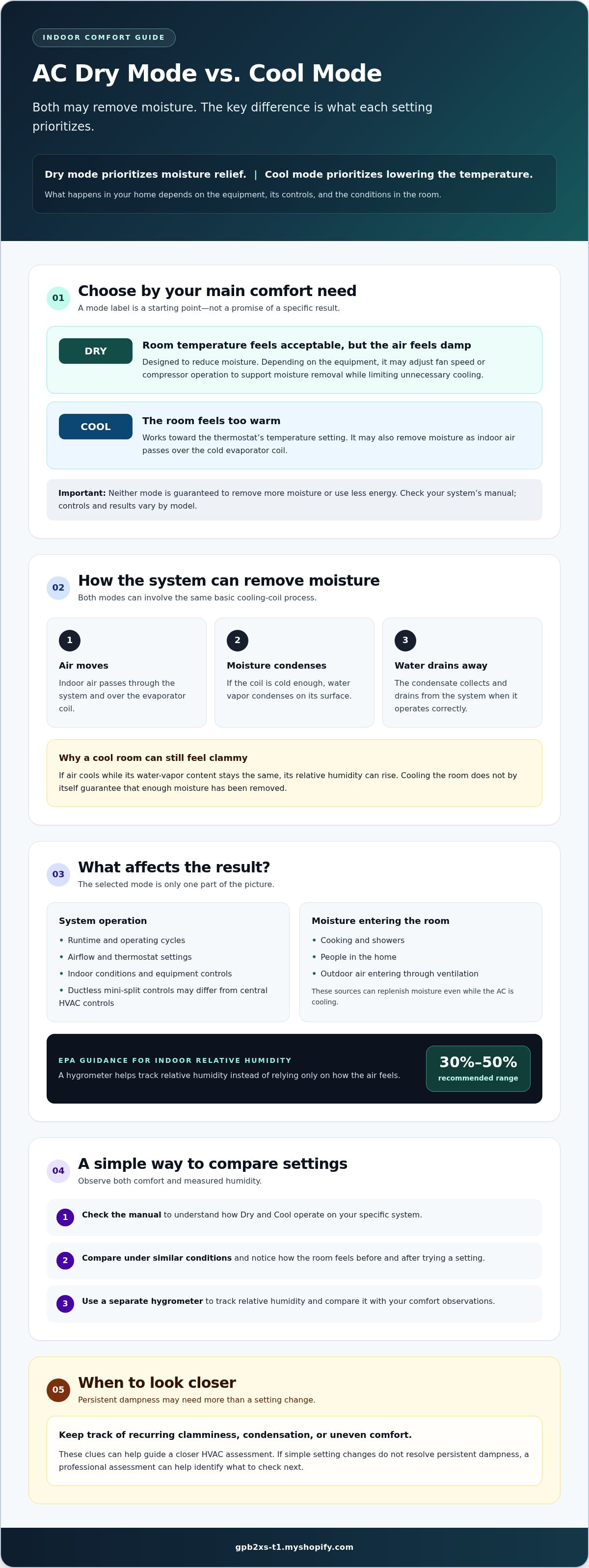
Both Dry and Cool modes may remove moisture from indoor air, but they prioritize different comfort goals. Dry mode focuses on reducing humidity, while Cool mode works toward the thermostat’s temperature setting. For ac dry mode vs cool mode for humidity, that distinction is a useful starting point, not a promise of a particular result. Performance depends on your equipment, its controls, and the conditions in the room.
What does dry mode do on an air conditioner?
Dry mode is designed to reduce moisture while limiting unnecessary cooling where the equipment allows. It may adjust fan speed and compressor operation to support moisture removal, but the controls vary by model. Don’t assume every system runs the same way or that Dry mode will hold a specific temperature. Check your manufacturer’s manual to see how the setting works on your unit.
This mode may be useful when the room temperature feels acceptable but the air feels damp. Dry mode can help reduce that clammy feeling without making temperature reduction its main goal. Its actual effect still depends on the system and indoor conditions.
Does cool mode also remove humidity?
Yes. In Cool mode, warm indoor air passes over the cold evaporator coil. If the coil is cold enough, moisture in the air condenses on its surface and is removed from the airstream. This is part of the process of removing heat and controlling humidity. Cool mode, however, continues to prioritize the thermostat’s temperature setting.
A room can become cooler and less humid at the same time, but the balance varies by system. When the thermostat reaches its set temperature, the system may reduce or stop cooling, which can affect how much moisture it removes. Lowering the temperature setting isn’t a dependable substitute for understanding how your system handles humidity.
In short: Dry mode prioritizes moisture control; Cool mode prioritizes temperature reduction, and either may remove moisture depending on the equipment. Mode labels alone can’t guarantee a humidity result or energy savings. Check your system’s manual rather than assuming a setting works the same way across models.
How Dry and Cool Modes Remove Moisture from Indoor Air
Both modes rely on the same basic physical process: air moves through the system, gives up heat at the evaporator coil, and may lose some of its water vapor there. The difference is how the controls operate the equipment and what they’re designed to achieve. That’s why the ac dry mode vs cool mode for humidity comparison can’t be settled by the mode names alone.
Why the cooling coil matters for humidity
Warm indoor air passes across the cold evaporator coil. If the coil is below the air’s dew point, water vapor condenses into droplets on its surface, collects, and drains away when the system is operating correctly. In practical terms, the coil can remove moisture while it cools the air.
Moisture-removal process: Indoor air flows over a cold coil, water vapor condenses on the coil, and the resulting condensate drains from the system.
Why results vary by system and room
Relative humidity describes how much water vapor is in the air compared with the maximum it could hold at that temperature. It’s not the same as the actual amount of moisture. If air cools but its water-vapor content stays the same, its relative humidity can rise. A room may therefore feel cool yet clammy if enough moisture remains in the air.
The amount of moisture removed depends on more than the selected mode. Runtime, airflow, thermostat settings, indoor conditions, and operating cycles all affect how air moves across the coil and how long it stays there. Ductless mini-split controls may also work differently from central HVAC controls, so check the manufacturer’s guidance for your equipment.
Household activities matter, too. Cooking, showers, people in the home, and outdoor air entering through ventilation can add moisture. If these sources keep replenishing water vapor, the AC may remove some moisture without making the room feel consistently dry. This can happen even when the system is cooling.
For context, the U.S. Environmental Protection Agency recommends keeping indoor relative humidity between 30% and 50%. Its guidance on checking indoor humidity also explains why moisture control matters for indoor air quality. A hygrometer can help you track relative humidity instead of relying only on how the air feels.
Because operating behavior and results depend on the equipment and the room, neither Dry nor Cool mode always removes more moisture or uses less energy. Compare settings under similar conditions and observe both comfort and measured humidity before deciding which works better in your home.
Dry Mode vs. Cool Mode: Which Is Better for Humidity?
The right setting depends on what’s making you uncomfortable. Try Dry mode when the temperature already feels acceptable but the air feels damp. Choose Cool mode when the room is too warm and needs active cooling. Both may reduce moisture, but neither guarantees a humidity fix. Results depend on your equipment and indoor conditions.
Dry mode
- Primary goal: Focus on reducing moisture, with cooling limited where the equipment’s controls allow.
- Likely comfort use: The room feels clammy, but you don’t need a major temperature drop.
- Limitations: It may still cool the space, and operation varies by model.
- What to check: Consult the manufacturer’s manual for the mode’s specific behavior.
Cool mode
- Primary goal: Lower the room temperature to the thermostat setting.
- Likely comfort use: The room feels too warm and needs cooling.
- Limitations: Moisture removal may happen as a by-product, but humidity control isn’t its main objective.
- What to check: Observe both room temperature and humidity instead of judging by the setting alone.
When should you try dry mode?
Imagine a humid afternoon when your living room is already cool enough, yet the air still feels heavy. If your system has Dry mode, check the manual and try it according to the manufacturer’s instructions. Then monitor how the room feels and whether the temperature changes. Some equipment may cool more than expected, so switch settings if comfort worsens.
When is cool mode the better choice?
If the room is too warm and the thermostat is calling for cooling, use Cool mode. As air passes over the cooling coil, some moisture may condense and drain away, but the system is still working toward the temperature setting. Lowering that setting further doesn’t guarantee better humidity control and may make the room colder than you want.
For ac dry mode vs cool mode for humidity, use the mode that addresses your immediate comfort need, then check the result. Don’t assume one setting always removes more moisture or uses less energy. If neither setting resolves persistent dampness, the issue may need a closer assessment beyond a mode change.
How to Test AC Modes and Check Indoor Humidity
A simple, consistent comparison can help you learn which setting feels better in your home. It won’t be a controlled test, since outdoor weather and household activity can change, but you can reduce confusion by changing one setting at a time and recording what happens.
A simple dry-mode and cool-mode comparison
Start with your system’s manual. Confirm how its modes work and whether it has a Dry setting. Then follow these steps:
- Record a baseline. Note the room temperature and, if you have a separate hygrometer, the relative humidity. Place the meter in the room you’re assessing, away from direct sun, vents, and other obvious sources of heat or moisture.
- Choose one mode. Try Dry or Cool according to your current comfort need. Keep the thermostat and other settings unchanged during the comparison.
- Keep household conditions similar. Use windows and doors as you normally would, and compare periods with similar cooking, shower, and occupancy patterns where possible. Avoid changing ventilation or several AC settings at once.
- Observe the result. Note how comfortable the room feels, its temperature, and the hygrometer reading. Repeat with the other mode under reasonably similar conditions, following the manual.
This practical check can help you decide whether ac dry mode vs cool mode for humidity makes a noticeable difference in your space. Treat the readings as useful observations, not proof that one mode will always perform better.
What humidity readings can and cannot tell you
A hygrometer measures relative humidity, which changes as air temperature changes. A reading can help you track conditions, but one number alone doesn’t reveal the air’s full moisture content, diagnose an HVAC problem, or establish indoor air quality. Look for patterns alongside room temperature and comfort instead of treating a single result as a verdict.
If you’re also weighing equipment choices for your home, consult an AC installation Sarasota FL guide for relevant planning information. When repeat comparisons still show uncomfortable conditions, record the settings, readings, and circumstances to share during a professional HVAC assessment.
For help assessing persistent comfort concerns, explore residential HVAC services.
When Persistent Humidity Needs an HVAC Assessment
A setting change can help with occasional discomfort, but it may not resolve dampness that keeps returning. If your home still feels clammy after you’ve checked the manual and tried appropriate modes, look for patterns rather than assuming the AC has a specific fault. Persistent humidity can relate to system operation, maintenance, airflow, or moisture entering the home. Symptoms are clues, not a diagnosis.
Signs that a setting change may not be enough
Pay attention to recurring conditions, especially if they continue while the system appears to run normally. Note what you observe and when it happens:
- Damp or clammy-feeling rooms that persist despite adjusting the mode.
- Condensation that repeatedly appears on windows or other surfaces.
- Musty odors that return or remain in particular areas.
- Uneven comfort, such as one room feeling damp while another feels comfortable.
Record the room, approximate time, thermostat setting, selected mode, and any available humidity reading. Note relevant circumstances, such as recent cooking, showers, or changes in ventilation. This record can help distinguish a one-time condition from a recurring pattern and give a technician useful context.
What a technician can assess
A professional assessment can consider how the system operates, whether airflow is appropriate, and whether maintenance needs may be affecting comfort. The evaluation can also take relevant indoor air quality concerns and household moisture sources into account. No single clue confirms the cause, so don’t treat condensation or an odor as proof of a particular equipment problem.
If the concern includes ongoing cooling trouble as well as humidity, the AC repair in Southwest Florida guide may offer related information. There’s no need to keep switching between settings without a clear result. If your checks haven’t resolved the issue, explore HVAC help from BulletProof Air for a professional assessment of persistent comfort concerns in Southwest Florida, including Sarasota.
Choose the Setting That Fits Your Comfort
The choice in ac dry mode vs cool mode for humidity comes down to your main concern: try Dry mode when the room feels damp but is already cool enough, and choose Cool mode when lowering the temperature is the priority. Both modes may remove moisture, but their results depend on your equipment and indoor conditions.
Check your system’s manual, change one setting at a time, and compare how the room feels with readings from a separate hygrometer if available. If clamminess, condensation, or uneven comfort keeps returning, record what you notice and consider a professional assessment instead of relying on mode changes alone.
BulletProof Air provides residential HVAC repair, maintenance, installation, and indoor air quality services in Southwest Florida. If simple adjustments haven’t restored comfort, explore HVAC help from BulletProof Air.
With a clearer picture of your system and indoor conditions, you can take the next step toward a more comfortable home.
Frequently Asked Questions
Is dry mode better than cool mode for humidity?
Dry mode may be the better setting when the room feels damp but is already cool enough. Cool mode is the better choice if the room is too warm and needs cooling. For ac dry mode vs cool mode for humidity, remember that both modes can remove moisture, but their priorities and results vary by system. Check your equipment’s manual and compare comfort and humidity readings rather than assuming one mode always works best.
Does cool mode remove humidity from the air?
Yes, Cool mode can remove some moisture as indoor air passes over the cold evaporator coil. Water vapor may condense on the coil and drain away while the system cools the room. How much moisture is removed depends on factors such as runtime, airflow, thermostat settings, and indoor conditions. Cool mode’s main purpose is still to reach the thermostat’s temperature setting, not to guarantee a particular humidity level.
Can I use dry mode all day?
Whether you can run Dry mode for an extended period depends on how your particular system is designed and controlled. Some units may cool the room while reducing moisture, so monitor temperature as well as comfort. Check the manufacturer’s manual for operating guidance, and switch modes if the room becomes too cool or uncomfortable. If humidity remains a concern despite using the setting as directed, record what you observe for further assessment.
Does dry mode use less electricity than cool mode?
Not necessarily. Dry mode may operate differently from Cool mode, but energy use varies by equipment, controls, settings, and how long the system runs. The mode label alone can’t confirm which setting uses less electricity in your home. Check the manufacturer’s guidance and observe your system’s operation rather than relying on a general savings estimate. Choose based on comfort needs, and don’t assume Dry mode is always more efficient.
Why is my house humid even when the AC is running?
An AC can run and cool your home while moisture continues to enter or build up indoors. Cooking, showers, occupancy, and ventilation can contribute moisture, while system operation, airflow, or maintenance needs may also affect comfort. These clues don’t identify a specific fault on their own. Note where and when the damp feeling occurs, which settings you used, and any humidity readings. If the pattern persists, consider a professional HVAC assessment.
What humidity level should I keep my home at?
The U.S. Environmental Protection Agency recommends keeping indoor relative humidity between 30% and 50%. A separate hygrometer can help you track readings, since how a room feels doesn’t always tell you its humidity. Relative humidity also changes with air temperature, so interpret readings alongside room conditions rather than treating one measurement as a diagnosis. If levels repeatedly fall outside the recommended range or comfort remains poor, seek advice about the conditions in your home.
Should I use dry mode in Florida?
Dry mode may be worth trying in Florida when your room feels damp but the temperature is comfortable, including during humid-weather conditions in Southwest Florida. Use Cool mode if lowering the room temperature is the priority. Dry mode’s operation differs by equipment, so consult your manual and watch for unwanted cooling. If clamminess or condensation keeps returning after reasonable setting changes, document the pattern and consider an HVAC assessment.
If you would like maintenance or repair assistance with your Florida Air Conditioner, contact BulletProof Air Or call: 941.599.9999 for more information about how we can help.