

AC Repair for Rental Property: A Guide for Florida Landlords and Tenants
In the sweltering Sarasota heat, a broken air conditioner isn't just an inconvenience. It's a fast track to dangerous indoor temperatures and property-damaging mold. You probably believe that cooling is a basic necessity in our climate, yet the legal reality of ac repair for rental property is surprisingly nuanced. Florida law doesn't actually mandate that landlords provide air conditioning. However, if a unit is included in your lease, the landlord is legally obligated to maintain it.
We understand the distress of a failing system when the humidity starts to climb. You need clarity and you need it now. This guide explores your rights under Florida Statute 83.51 and explains the critical seven day window for repairs required by Statute 83.56. You'll discover the fastest path to restoring your indoor sanctuary while ensuring your property remains safe and compliant. We'll look at the responsibilities of both parties so you can resolve disputes quickly and get back to the cool comfort you deserve.
Key Takeaways
- Navigate the legal complexities of ac repair for rental property to determine exactly who pays for restoration and when.
- Master the essential troubleshooting steps and documentation required to protect your rights during an emergency cooling failure.
- See how regular maintenance plans prevent costly system breakdowns and keep your property’s indoor sanctuary protected.
- Secure your investment by partnering with Sarasota experts who specialize in rapid response for rental-specific HVAC systems.
Is AC Repair a Legal Requirement for Florida Rentals?
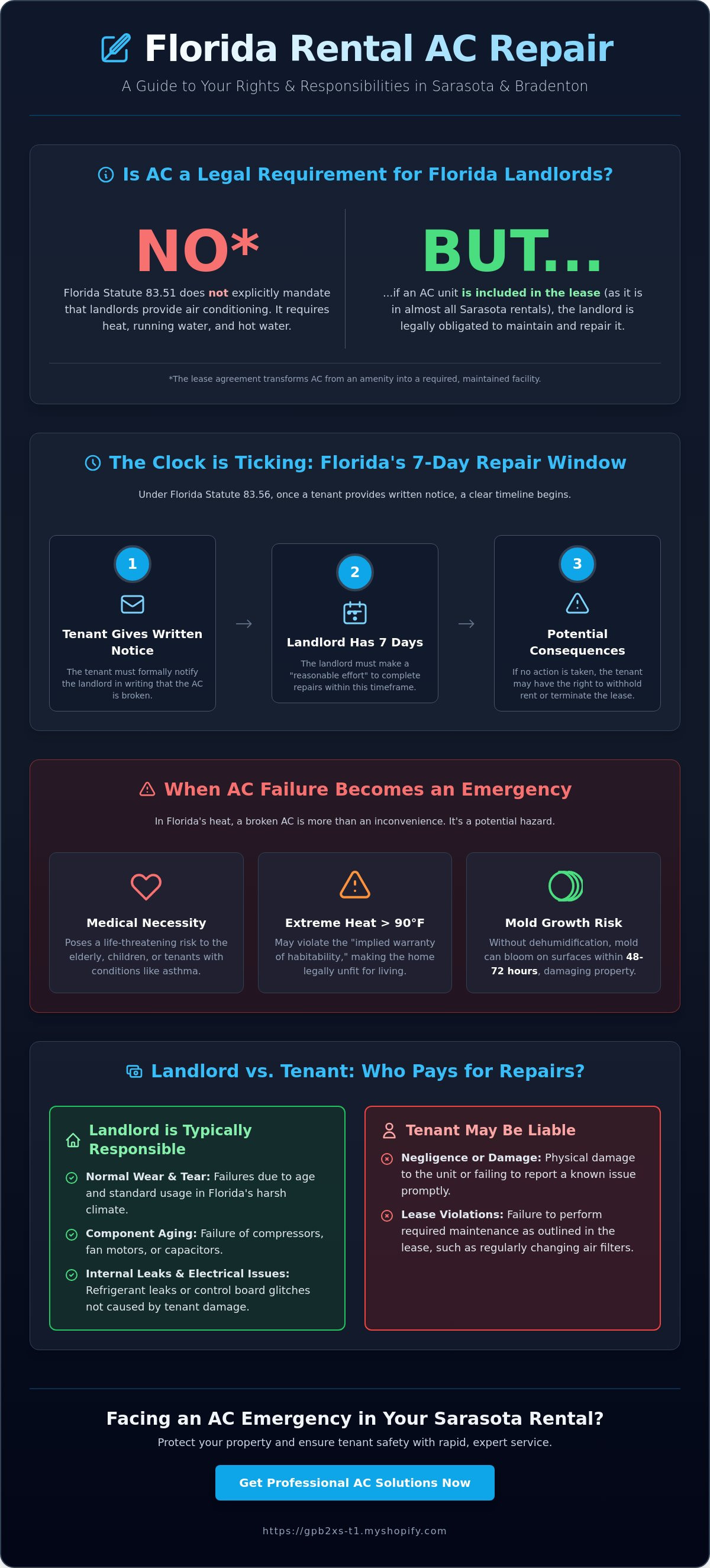
The Florida sun is relentless. When the cooling stops, the clock starts ticking. Many people assume that because air conditioning is vital for survival in Sarasota, it's a guaranteed right under state law. The reality is more complex. Florida Statute 83.51, which governs Landlord-tenant law, requires landlords to provide functioning facilities for heat during winter, running water, and hot water. It doesn't explicitly name air conditioning as a mandatory utility.
However, there's a major catch for residents. If a landlord provides an AC unit at the start of the lease, they're legally obligated to maintain it. In Sarasota and Bradenton, almost every standard lease agreement explicitly includes air conditioning as a provided amenity. Once that box is checked, ac repair for rental property becomes a non-negotiable responsibility. If the indoor temperature climbs above 90 degrees, the property may violate the implied warranty of habitability. This makes the home legally unfit for residents and requires immediate intervention.
Florida Statute 83.51 and the Landlord’s Obligation
Landlords must maintain the structural components of the building in a safe and sanitary condition. While some states like California allow up to 30 days for non-emergency repairs, Florida's climate demands much faster action. Under Florida Statute 83.56, once a tenant provides a formal written notice of the failure, the landlord has exactly seven days to make a reasonable effort to fix the issue. If they fail to act within this window, the tenant may have the legal right to withhold rent or even terminate the lease. Don't wait for a crisis to understand these deadlines. Speed is the only way to avoid legal disputes and property damage.
When AC Failure Becomes an Emergency
In the Gulf Coast heat, a broken AC unit quickly transitions from an inconvenience to a health hazard. This is especially true for vulnerable populations. You must recognize when a standard repair becomes a critical emergency.
- Medical Necessity: If a tenant is elderly, a child, or has a documented medical condition like asthma, a heat index above 90 degrees is a life-threatening emergency.
- The Sanctuary Concept: Your home should be a protected sanctuary from the elements. When the cooling fails, that protection vanishes, leaving residents in a state of distress.
- Mold Prevention: Florida's humidity is a silent enemy. Without active cooling and dehumidification, mold can begin to bloom on walls and furniture within 48 to 72 hours of a system failure.
Urgency is paramount for everyone involved. Landlords should treat every request for ac repair for rental property as a priority to protect both the tenant's health and the structural integrity of the asset. A proactive approach saves money and preserves the safety of the living environment.
Landlord vs. Tenant: Who Pays for AC Repair?
Determining who covers the bill for ac repair for rental property often creates tension between owners and residents. The foundational principle in Florida is simple: the party who provides the equipment is responsible for its upkeep. Since most landlords in Sarasota and Bradenton provide central air as a standard amenity, they are typically the ones paying for the technician's visit. This duty is grounded in Florida Statute 83.51, which requires landlords to maintain the property in a condition that meets basic habitability standards.
Clarity starts on day one. A thorough move-in inspection serves as the baseline for the system's health. If the unit was blowing cold air and had a clean filter when the keys were handed over, any future issues can be judged against that starting point. Landlords should prioritize professional AC repair to protect their investment. Using a qualified expert ensures the work is done right the first time, preventing small mechanical glitches from turning into catastrophic system failures that require a full replacement.
Scenarios Where the Landlord Pays
Most mechanical failures fall under "normal wear and tear." Florida's intense humidity and heat mean systems work harder here than almost anywhere else. Landlords are generally responsible for the following:
- Component Aging: Failure of compressors, fan motors, or capacitors in systems that are 10 to 12 years old.
- Internal Leaks: Refrigerant leaks within the evaporator or condenser coils that occur due to standard usage.
- Electrical Issues: Wiring failures or control board glitches not caused by external tampering.
Scenarios Where the Tenant May Be Liable
Tenant liability usually stems from negligence or a failure to follow the maintenance terms outlined in the lease. If a resident's actions directly cause the breakdown, the cost of ac repair for rental property may shift to them. Common examples include:
- Filter Neglect: Forgetting to change air filters, which leads to restricted airflow and frozen evaporator coils.
- Drain Line Clogs: If the lease explicitly states the tenant must keep the condensate drain line clear (often with a vinegar flush), a backup that causes water damage might be their responsibility.
- Thermostat Stress: Setting the thermostat to an "unreasonable" level, such as 60°F during a 95°F July afternoon. This forces the system to run indefinitely, leading to premature motor burnout.
Quick action is the best way to keep costs low and residents happy. If you are facing a cooling crisis, contact the BulletProof Air team to restore your home's comfort and protect your property's value.
Steps to Take When the AC Fails in a Rental
When the cooling stops in a Florida rental, the situation can escalate from a mild annoyance to a full-blown emergency in hours. You need a clear, decisive strategy to restore your sanctuary. Before calling for professional help, perform a quick check of the basics. Ensure the circuit breaker hasn't tripped and verify that the thermostat batteries are still functioning. If these simple fixes don't work, start documenting the failure immediately. Record the current indoor temperature and the exact time you noticed the system stopped cooling.
Communication is your most powerful tool in managing ac repair for rental property. While a quick phone call might seem faster, always follow up with a formal notification via email or text. Written records provide the legal protection required under Florida Statute 83.51. Avoid the common "repair and deduct" trap. Many tenants believe they can pay for a repair themselves and subtract the cost from their rent. In Florida, this is a risky legal move that can lead to eviction proceedings. Always consult with legal counsel before withholding any portion of your rent.
The Tenant’s Action Plan
- Step 1: Inspect the unit for a clogged drain line or ice buildup on the coils. If you see ice, turn the system off immediately to let it thaw.
- Step 2: Notify the landlord in writing. Be specific about the symptoms, such as "the fan is blowing but the air isn't cold."
- Step 3: Mitigate the heat. Close all blinds, use ceiling fans to circulate air, and avoid using the oven or dryer until the system is restored.
The Landlord’s Action Plan
- Step 1: Contact a trusted HVAC company near me to diagnose the issue professionally. A precise diagnosis prevents wasted time on "band-aid" fixes.
- Step 2: Provide the tenant with a clear repair timeline. Transparency reduces friction and builds trust during a high-stress situation.
- Step 3: If the repair will take longer than 24 hours, consider providing portable AC units. This proactive step protects the property from mold and keeps the resident safe in the Sarasota heat.
Effective ac repair for rental property requires partnership. When both parties follow a structured plan, the path to cooling is faster and less prone to conflict. Speed and documentation are your best defenses against the Gulf Coast humidity.
Protecting the Asset: Why Landlords Need Maintenance Plans
For a Florida landlord, the air conditioning system is often the most expensive piece of equipment on the property. Neglecting this vital component is a gamble with your profit margins. Reactive ac repair for rental property is almost always more expensive than proactive care. Emergency service calls often involve higher fees and the stress of a displaced, unhappy tenant. By investing in HVAC maintenance plans, you shift from a state of constant crisis to a position of controlled, predictable property management.
Most tenant-landlord friction over cooling stems from a lack of communication or perceived neglect. Regular service visits and detailed property evaluations, such as those provided by A Premier Home Inspection, provide a clear paper trail of professional care. This documentation proves you've met your obligations under Florida law. It also ensures that indoor air quality remains high, which is your best defense against mold-related litigation. High humidity in a rental unit is a massive liability. A well-maintained system keeps that humidity in check and protects the structural integrity of your building.
Rooftop units and split systems in the Gulf Coast environment face salt air and extreme heat daily. These systems should last 10 to 15 years. Without care, they might fail in seven. Maintenance extends the life of these expensive assets. It ensures you aren't forced into a total system replacement because a small component failed and caused a chain reaction. Protect your bottom line by catching small issues before they become catastrophic failures.
The ROI of Preventative Care
BulletProof Air’s Approach to Rental Maintenance
We understand that property managers and multi-unit owners have unique logistical needs. Our approach removes the landlord from the middle of the scheduling headache. We can communicate directly with your tenants to coordinate service windows, saving you hours of administrative work. Our precision inspections are designed to eliminate the need for follow-up visits. We get the job done right the first time. We offer priority scheduling for our maintenance partners to ensure your properties remain a cool, safe sanctuary even during the peak of summer.
Secure your investment today and avoid the stress of unexpected breakdowns by contacting BulletProof Air for a customized maintenance strategy.
BulletProof Air: Rapid AC Solutions for Sarasota Properties
When the Gulf Coast heat index climbs, every hour without cooling feels like an eternity. BulletProof Air operates with a "First Responder" mentality because we know that ac repair for rental property is a race against time and humidity. We don't just show up; we arrive prepared to restore your property's sanctuary state immediately. Our team understands that a cooling failure is a high-stress event for both landlords and tenants. We provide the speed and technical precision required to resolve the issue during the first visit, preventing the need for frustrating follow-up appointments.
Our technicians possess specialized expertise in the systems most frequently installed in Florida rentals, including Daikin, Lennox, and Mitsubishi. Whether it's a complex multi-unit split system or a standard residential unit, we have the tools and parts to handle the job. If you're facing a crisis, we provide emergency AC repair in Lakewood Ranch and throughout the greater Sarasota area. We prioritize these calls to ensure that dangerous indoor temperatures don't lead to health risks or property damage.
Why Property Managers Trust Us
Logistics can be the hardest part of managing a rental. We simplify the process by offering transparent, detailed reporting designed specifically for property managers. You'll receive comprehensive invoicing along with photo documentation of the repairs performed. This clear evidence is vital for justifying expenses to property owners and maintaining accurate maintenance records. We also prioritize the safety of your residents. Every technician on our team is licensed, insured, and has passed a rigorous background check. Our hyperlocal knowledge of Sarasota and Bradenton building codes ensures that every repair is compliant and built to last in our unique salt-air environment.
Get Your Rental Back to a Sanctuary State
Don't let a mechanical failure escalate into a legal dispute or a tenant turnover. Taking decisive action today protects your reputation as a landlord and preserves the value of your real estate asset. We're ready to act as your dependable partner in maintaining a safe, cool environment for your tenants. Our diagnostic visits are thorough, identifying the root cause of the problem rather than just treating the symptoms. We'll give you the facts, a fair price, and a fast resolution.
Restore the comfort and safety your tenants deserve without the typical scheduling headaches. Contact our team to experience the professional, urgent care that has made us a leader in the local HVAC industry. Schedule Your Rental Property AC Repair Now and let us handle the heat while you get back to business.
Secure Your Sarasota Rental’s Comfort Today
Managing a rental in Florida means respecting the relentless power of the heat. You've learned that while cooling isn't a state-mandated utility, the lease agreement and Florida Statute 83.51 make maintenance a binding obligation for landlords. Fast action and clear documentation protect everyone involved. Whether you're a tenant facing a 90-degree indoor crisis or a landlord looking to safeguard a valuable asset, the right partnership makes all the difference.
Handling ac repair for rental property doesn't have to be a source of legal friction when you prioritize professional, rapid intervention. BulletProof Air provides the expertise needed to restore your home's sanctuary state. Our licensed and insured technicians are ready with 24/7 emergency service to keep Sarasota and Bradenton properties safe and cool. We bring a first-responder mentality to every call, ensuring that your cooling is restored accurately on the first visit.
Restore Cooling to Your Rental Property with BulletProof Air. Don't let the humidity win or allow a mechanical failure to damage your property. Take the right steps now to ensure your rental remains a comfortable, protected space for your residents.
Frequently Asked Questions
How long does a landlord have to fix the AC in Florida?
Landlords have exactly seven days to make a reasonable effort to repair the system after receiving a formal written notice from the tenant. This timeframe is established by Florida Statute 83.56. If the landlord fails to act within this window, the tenant may have legal grounds to terminate the lease or seek other remedies. Speed is essential because Florida's extreme heat can quickly make a property uninhabitable for residents.
Can I withhold rent in Florida if my AC is broken?
You should almost never withhold rent in Florida without consulting an attorney first. While the law allows for rent withholding under very specific circumstances, failing to follow the exact notice requirements can lead to an immediate eviction filing. It's much safer to pay the rent and pursue legal remedies through the court system to avoid losing your housing over a maintenance dispute. Document everything while you wait for the repair.
Is a landlord required to provide a portable AC unit during repairs?
Florida law does not specifically require a landlord to provide a portable cooling unit or hotel stay while the central system is down. However, many proactive landlords provide these units to mitigate the heat and protect the property from high humidity. Providing temporary cooling is a professional gesture that maintains the tenant's safety and prevents the indoor sanctuary from becoming a health hazard during a prolonged outage.
What happens if the AC failure causes mold in my rental?
If the landlord was notified of a broken system and failed to act, they are typically responsible for the resulting mold remediation. High humidity can trigger mold growth in as little as 48 hours in the Gulf Coast climate. Tenants must document the humidity levels and the timing of the failure to prove that the landlord's delay in ac repair for rental property directly caused the structural damage or health risks.
Can a landlord charge a tenant for an AC service call?
A landlord can only charge a tenant for a service call if the damage was caused by tenant negligence or a violation of the lease terms. For example, if a technician finds that a system failure was caused by a tenant never changing the air filter or physically damaging the unit, the tenant may be liable for the bill. Standard mechanical failures and age-related wear are always the landlord's financial responsibility under Florida law.
Does Florida law consider air conditioning a "necessity" for habitability?
Technically, Florida law does not classify air conditioning as a basic necessity for habitability in the same way it does for heat or running water. Florida Statute 83.51 requires "functioning facilities" for heat, but remains silent on cooling. However, if the AC was provided at the start of the lease, the landlord is legally obligated to keep it in working order throughout the entire tenancy to meet the terms of the agreement.
How often should a landlord service the AC in a rental property?
Professional HVAC experts recommend that landlords schedule a precision tune-up at least twice a year. Regular maintenance is the most effective way to manage ac repair for rental property costs and prevent emergency breakdowns. These visits should focus on cleaning the coils, checking refrigerant levels, and ensuring the condensate drain line is clear to prevent water damage and mold growth before they start.
What should I do if my landlord refuses to fix the AC?
If your landlord refuses to act, you must send a formal "7-Day Notice to Cure" via certified mail with a return receipt. This starts the legal clock under Florida law. If the repair isn't addressed within those seven days, you may have the right to terminate the lease. Always keep a complete copy of every communication and any evidence of the indoor temperature to protect your rights if the dispute goes to court.
If you would like maintenance or repair assistance with your Florida Air Conditioner, contact BulletProof Air Or call: 941.599.9999 for more information about how we can help.