

What Happens If You Don't Change Your AC Filter? The Cost of Neglect
Would you intentionally place a mechanical chokehold on your home's most expensive appliance while the Florida sun beats down at ninety-five degrees? Most homeowners realize that maintenance matters, but it's easy to forget about that small cardboard rectangle tucked away in your intake vent. However, understanding what happens if you don't change ac filter is the difference between a cool, comfortable sanctuary and a catastrophic system failure. In the humid Sarasota climate, a neglected filter does more than just collect dust; it forces your unit to work overtime and puts your entire home's comfort at risk.
You're likely noticing the symptoms already: rising utility costs, dusty surfaces, or uneven cooling in different rooms. With Florida electricity rates averaging around 16 cents per kilowatt-hour, you can't afford an inefficient system. This article reveals the mechanical risks of a dirty filter and explains why the 2025 ASHRAE standards now recommend at least a MERV 11 rating for residential homes. You'll learn how to identify the warning signs before they lead to major mechanical failures that can cost $5,000 to resolve. Let's look at how to keep your air clean and your cooling costs under control.
Key Takeaways
- Understand why your air filter is a vital shield for your AC's internal machinery rather than just a simple dust-catcher for your home.
- Discover what happens if you don't change ac filter, including how restricted airflow can lead to a $1,000 blower motor failure and higher utility bills.
- Learn how to stop the "dust cycle" from polluting your home sanctuary and regain control over your family's indoor air quality.
- Explore why Florida's intense humidity and coastal salt air require a more aggressive maintenance schedule to prevent corrosive system damage.
- Master the balance of MERV ratings to ensure you choose a filter that effectively cleans your air without accidentally straining your specific HVAC unit.
The Immediate Impact: What Really Happens Inside Your AC Unit
Many homeowners believe their Air filter exists solely to scrub the air they breathe. While indoor air quality is a vital benefit, the filter's primary mission is to act as a mechanical shield for your HVAC system. It prevents dust, pet hair, and debris from coating the sensitive internal components. When you ask what happens if you don't change ac filter, the answer starts with a literal chokehold on your system's ability to breathe.
As debris builds up, it creates a wall of resistance. Your system is designed to move a specific volume of air to maintain a delicate thermal balance. When that airflow is restricted, it creates a vacuum effect. This increases the internal temperature of the unit and often triggers "short-cycling." This is when your AC turns on and off rapidly without completing a full cooling cycle. It's an emergency response from the system to prevent a total meltdown, but it causes massive wear and tear on the compressor.
The Science of Restricted Airflow
Your blower motor is the heart of the air distribution process. When it tries to pull air through a clogged filter, it's like trying to drink a thick milkshake through a pinhole straw. This increases the "static pressure" within your ductwork. High static pressure forces the motor to run at higher RPMs, which consumes more electricity and generates excess heat. You'll notice this when your vents start blowing lukewarm air. The system is running, but because it can't pull enough "raw" air in, it can't push enough "conditioned" air out to cool your sanctuary. This constant strain is a leading cause of premature motor failure.
When Coils Turn to Ice
It sounds counterintuitive to find ice on a machine during a Florida summer, but it's a common mechanical failure. Your evaporator coil needs a constant stream of warm indoor air to keep the refrigerant inside from getting too cold. Without that airflow, the refrigerant temperature drops below freezing. Moisture in the air then hits those sub-zero coils and instantly turns to ice. According to 2026 industry standards, evaporator coil freezing is defined as a thermodynamic failure where insufficient heat load from restricted airflow allows the coil surface temperature to drop below the dew point and the freezing point simultaneously.
If you see frost on the copper lines or water pooling around the indoor unit, turn the system off immediately. Never try to "force" the temperature lower on the thermostat. Doing so only accelerates the ice buildup and can lead to a liquid slugging event that destroys your compressor. Protect your home and your wallet by checking your filter monthly. A simple five minute task can prevent a complete system shutdown when you need cooling the most.
The Financial Fallout: Skyhigh Bills and Catastrophic Repairs
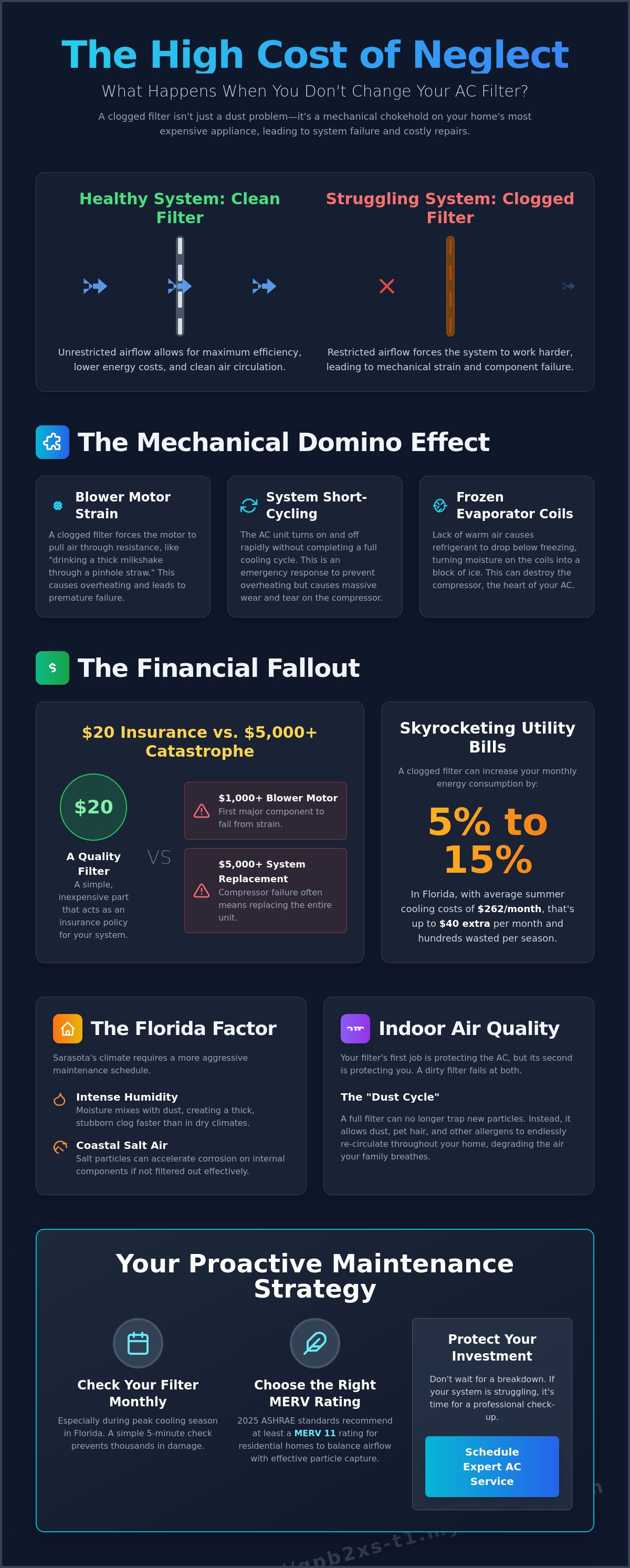
Neglecting your air filter is like throwing money directly into the wind. When you ignore what happens if you don't change ac filter, the first place you'll feel the impact is your monthly budget. A clogged filter forces the system to run significantly longer cycles to reach your thermostat's set temperature. According to industry data, this drop in efficiency can increase your monthly energy bill by 5% to 15%. In Florida, where summer cooling costs already average around $262, that small percentage translates into hundreds of dollars wasted over a single season.
The internal strain doesn't stop at high utility bills; it leads to mechanical "death sentences" for your equipment. The blower motor is often the first major component to fail. This part is responsible for pushing air through your home's ductwork. When it's forced to fight against a "brick" of dust, the motor overheats and eventually burns out. Replacing a blower motor is a major expense that often costs $1,000 or more. If the neglect continues, the compressor, which is the heart of your AC, is next. Once the compressor fails due to long-term strain, you're often facing a total system replacement rather than a simple repair.
The $20 vs. $2,000 Comparison
Think of a high-quality MERV 11 filter as a $20 insurance policy for your $10,000 HVAC investment. It's a small price to pay to avoid the stress of a mid-summer breakdown. While a filter costs less than a family lunch, the components it protects are incredibly expensive to replace. If your system is already making strange noises or struggling to keep up, it's vital to seek ac repair in sarasota before a minor restriction turns into a total mechanical loss.
The parts most likely to fail due to a dirty filter include:
- Blower Motors: These burn out from the heat generated by fighting high static pressure.
- Capacitors: These electrical components are stressed by the frequent starts and stops of "short-cycling."
- Compressors: These can be destroyed by liquid refrigerant "slugging" when coils freeze over.
Voiding Your System's Protection
Many homeowners don't realize that their manufacturer's warranty is a conditional agreement. Major brands like Lennox and Daikin often require documented proof of regular maintenance to honor a parts claim. If a technician discovers that a component failed because of a neglected filter, the manufacturer can legally deny your claim. This leaves you responsible for the full cost of the repair. Utilizing professional HVAC services near me ensures you have the paper trail needed to keep your warranty intact. Beyond saving money, these proactive steps help improve indoor air quality and keep your home a peaceful sanctuary. Don't let a simple maintenance task turn into a financial disaster; check your filter today.
Health and the Sanctuary: Indoor Air Quality Risks
Your home should be a sanctuary. It is the one place where you expect to escape the heat and breathe easy. However, clean air isn't a given; it is the direct result of a functional filtration system. When you ignore what happens if you don't change ac filter, that sanctuary is compromised by a "dust cycle." Instead of trapping allergens, a saturated filter begins to vibrate under the pressure of the blower motor. This vibration sheds captured particles and pet dander back into your living space. Since Americans spend approximately 90% of their time indoors, these concentrated pollutants can lead to immediate respiratory distress.
This cycle is particularly dangerous for the most vulnerable members of your household. Children, seniors, and those living with asthma or seasonal allergies rely on high-quality filtration to maintain their well-being. A neglected filter fails to remove fine particulate matter, which can trigger severe flare-ups and long-term health issues. Taking the time for regular maintenance is the only way to cut your HVAC system's energy consumption while simultaneously protecting your family's physical health. Do not wait for a medical emergency to address a maintenance chore.
When Your Filter Becomes a Polluter
Air always follows the path of least resistance. When a filter becomes a solid "brick" of debris, the suction from the blower motor creates a phenomenon known as "bypass." The air literally forces its way around the edges of the filter frame, carrying raw, unfiltered dust directly into your ductwork. You might notice thick layers of gray dust on your furniture just hours after a deep clean. This is a clear sign that your filter has stopped protecting you. If the debris has already settled deep within your vents, you may require professional air duct cleaning services to restore a healthy environment.
The Humidity-Mold Connection
In Sarasota, your air conditioner has a second, equally important job: dehumidification. To remove moisture effectively, the system needs a consistent, high-volume stream of air moving over the evaporator coils. A dirty filter slows this process to a crawl. When the AC cannot properly dehumidify, indoor humidity levels often spike well above the 50% threshold recommended by the EPA. This creates a perfect breeding ground for mold and biological growth. If you notice a sharp, musty smell whenever the air kicks on, your neglected filter has likely allowed moisture and organic matter to collide, turning your HVAC system into a source of contamination.
The Florida Factor: Why Sarasota Filters Clog Faster
Florida isn't just another state; it's a high-performance environment for HVAC systems. While a homeowner in a cooler climate might get away with ignoring their air vents for months, Sarasota residents face a different reality. If you wonder what happens if you don't change ac filter in the Sunshine State, the answer involves a much faster path to mechanical failure. Our units often run 24/7 for ten months of the year, processing three times the air volume of systems in Northern states. This constant operation means your filter reaches its debris capacity in a fraction of the standard time.
Beyond the sheer run time, coastal living introduces corrosive elements into your home's air. Salt air is a constant presence in Sarasota and Bradenton. These microscopic salt particles bond with dust and moisture, creating a sticky residue on the filter fibers. High humidity, which often spikes well above the EPA's recommended 30 to 50 percent indoor threshold, further complicates the issue. Standard paper-based filters can absorb this moisture, causing the material to sag or collapse into the intake. This creates gaps that allow unfiltered, salty air to reach your sensitive evaporator coils, accelerating corrosion and leading to expensive repairs.
The Gulf Coast Maintenance Reality
Generic advice found online often suggests changing filters every 90 days. In our local environment, following this rule is dangerous for your equipment. Sarasota's year-round growing season means pollen counts remain high even in the winter months. When you combine this with pet dander and the fine, silty sand common near our beaches, a filter can become completely obstructed in as little as 30 days. This unique "coastal dust" is heavier and more abrasive than typical household lint, putting immediate and significant stress on your blower motor.
Identifying the 'Florida Clog'
You cannot always rely on a calendar to tell you when it is time for a change. Perform a visual inspection every few weeks to catch problems early. Gray dust is typical, but black or dark brown spots can indicate mold growth or heavy moisture saturation within the filter media. Use the "Flashlight Test" for a definitive answer. Hold a bright light behind the filter; if you can't see the light glowing through the material, your system is already struggling to breathe. If your unit is already showing signs of strain from a heavy clog, contact a professional for Residential HVAC Services to ensure your system remains durable and efficient.
Simple Solutions: Your Proactive Maintenance Strategy
Taking control of your home's air quality doesn't have to be complicated. Now that you understand what happens if you don't change ac filter, it's time to implement a routine that guarantees your system's longevity. Safety is your first priority. Before touching the filter, always turn your system off at the thermostat. This prevents the blower motor from pulling in raw dust or loose debris while the intake is unprotected. Once the system is powered down, follow these steps:
- Locate the filter: Most are found behind a return air grate in a wall or ceiling, or inside a slot on the side of the indoor air handler.
- Note the direction: Look for the "airflow arrow" printed on the side of the old filter. It points toward the unit.
- Remove carefully: Slide the old filter out slowly to avoid shedding dust into your home sanctuary.
- Insert the new filter: Ensure the arrow on the new frame points in the same direction as the old one.
- Secure the cover: Close the grate or door tightly to prevent "bypass" air from leaking in.
In Sarasota, we follow the 30-day rule. Even if your filter packaging says it lasts three months, check it every four weeks. If it looks gray or feels heavy, replace it immediately. This simple habit is the most effective way to prevent the mechanical "chokehold" that leads to expensive emergency repairs.
Choosing the Right Filter for Your Home
Not all filters are created equal. While fiberglass filters are cheap, they often allow too much dust to pass through and coat your coils. On the other hand, pleated filters offer much better protection. However, be careful with extremely high MERV ratings. While a MERV 13 or 14 filter captures more microscopic particles, it can be too restrictive for older residential units. This creates the same airflow problems as a dirty filter. For standard residential use in Sarasota, we recommend filters rated between MERV 8 and MERV 11. Avoid washable filters in Florida; they often stay damp in our high humidity, which encourages the exact mold growth you are trying to prevent.
The Professional Safety Net
A clean filter is a great start, but it only represents about 10% of the care your system requires. Dust can still settle on electrical contacts, and refrigerant levels can fluctuate without you ever noticing. A BulletProof Air Maintenance Plan provides a comprehensive safety net that a filter simply cannot. Professional technicians check the "vitals" of your system, including the capacitor, blower motor, and drain lines, to catch minor issues before they turn into a $5,000 catastrophe. Don't wait for your system to fail during a heatwave. Secure your comfort and schedule your precision tune-up today.
Secure Your System and Your Savings
A dirty filter isn't just a nuisance; it's a direct financial and mechanical threat to your home. From the "dust cycle" polluting your air to the $1,000 blower motor failures we discussed, the risks are clear. In Sarasota, the 30-day rule is your best defense against humidity-driven mold and salt air corrosion. Now that you've seen what happens if you don't change ac filter, you have the power to stop the damage before it starts. It's about more than just equipment; it's about the long-term safety and comfort of your family.
Our expert technicians serve the Sarasota and Bradenton communities with fast response times for emergency repairs. We offer comprehensive maintenance plans designed to catch hidden issues and prevent catastrophic failure. Protect your sanctuary. Schedule your professional AC maintenance with BulletProof Air today! You've worked hard to make your home a peaceful retreat. Keep it that way with a simple, proactive approach to your HVAC health. We are ready to help you maintain a durable and efficient cooling system all year long.
Frequently Asked Questions
How often should I actually change my AC filter in Florida?
You should change your filter every 30 days during the peak cooling season in Florida. If you have multiple pets or live in a high-pollen area like Sarasota, checking it every two weeks is a safer practice. While some manufacturers suggest a 90-day timeframe, our local humidity and near-constant run cycles saturate filters much faster than in other regions. Regular changes are the easiest way to prevent what happens if you don't change ac filter.
Can a dirty air filter cause my AC to stop blowing cold air?
Yes, a clogged filter can lead to lukewarm air or a total lack of airflow. When the filter is blocked, the evaporator coil can freeze over, which physically prevents cold air from passing through your vents. In many modern systems, a high-pressure switch might trigger an automatic shutdown to protect the compressor from overheating. If your vents feel weak or warm, check your filter immediately before calling for professional assistance.
What are the signs that my AC filter needs to be changed immediately?
Look for visible dust buildup on your intake grilles or a distinct whistling sound coming from the return vent. You might also notice that your home feels more humid than usual or that the unit is running for hours without reaching the set temperature. If you see frost on the copper lines or water pooling around the indoor unit, these are urgent signs that your filter has caused a system freeze.
Will a dirty filter make my electric bill go up?
A neglected filter will absolutely increase your utility costs by forcing the blower motor to draw significantly more power. With Florida electricity rates reaching approximately 16 cents per kilowatt-hour in 2026, an inefficient system can waste hundreds of dollars annually. The extra resistance makes the motor work harder and longer, which shows up directly on your monthly statement. Keeping a fresh filter is one of the most effective ways to lower your energy consumption.
Is it okay to run my AC without a filter for one night?
You should never run your air conditioner without a filter, even for a single night. Without that barrier, raw dust and pet dander are sucked directly into the sensitive evaporator coils. This debris sticks to the wet surfaces of the coil, creating a layer of grime that is extremely difficult and expensive to clean. It's much better to leave the system off for a few hours until you can purchase a replacement.
What MERV rating is best for homes in Sarasota?
Most Sarasota homes perform best with a filter rated between MERV 8 and MERV 11. While the 2025 ASHRAE updates now recommend a minimum of MERV 11 for residential buildings, you must ensure your specific system can handle the increased resistance. Higher ratings like MERV 13 are excellent for capturing fine allergens, but they require a high-performance blower motor to maintain proper airflow and prevent unnecessary mechanical strain on older units.
Can a dirty filter cause my AC drain line to clog?
Yes, a dirty filter often leads to a backed-up drain line and potential water damage in your home. When dust bypasses a clogged filter, it settles on the wet evaporator coil and eventually washes down into the primary condensate pan. This sludge can easily plug the narrow drain line, causing the pan to overflow. This often triggers a safety float switch that shuts your entire system down until the line is cleared.
Does a dirty filter affect the smell of my home?
A clogged filter often traps odors and moisture, leading to a stale or musty smell throughout your living space. When debris sits on the filter in high humidity, it can become a source of biological growth. This contaminated air is then circulated into every room, compromising the sanctuary of your home. Replacing the filter regularly ensures that your AC continues to scrub odors rather than acting as a source of them.
If you would like maintenance or repair assistance with your Florida Air Conditioner, contact BulletProof Air Or call: 941.599.9999 for more information about how we can help.