

AC Unit Won't Turn On After a Power Outage? Here is How to Fix It Fast
Imagine the lights finally flicker back on after a Southwest Florida thunderstorm, but the silence from your vents is deafening. As the humidity begins to plate up sizzling in your living room, you realize your ac unit won't turn on after power outage, and the fear of a $2,500 compressor replacement starts to set in. It's a stressful moment when your home's sanctuary turns into a sauna. You're likely staring at a blank thermostat or a confusing breaker panel, wondering if a simple flick of a switch can save you from a $1,100 emergency repair bill.
At BulletProof Air, we know that a post-outage failure is often just a safety lockout designed to protect your equipment rather than a sign of total system death. We'll provide you with a professional step-by-step reset guide to restore your cooling safely and help you identify the specific signs that mean you truly need an expert. You'll learn how to navigate your electrical panel, reset your system's internal sensors, and understand when it's time to call for a reliable fix to get your comfort back on track.
Key Takeaways
- Understand the "internal lockout" mechanism that keeps your system off to protect the compressor from damage after a blackout or brownout.
- Follow our professional guide to safely reset your system if your ac unit won't turn on after power outage before the Florida heat becomes unbearable.
- Learn to identify the "humm-and-click" symptoms of a fried start capacitor, one of the most common and affordable post-storm repairs.
- Discover why dedicated HVAC surge protection is essential in the "Lightning Capital" to avoid a total system failure.
- Gain the confidence to know when a DIY reset is enough and when you need to call a trusted professional for emergency restoration.
Why Your AC Won't Start After a Power Outage (The Safety Lockout)
When the power returns after a Southwest Florida storm but your home remains silent, it's natural to feel a spike of anxiety. You might find that your ac unit won't turn on after power outage because of a built-in defense mechanism. This isn't necessarily a broken system; it's a calculated pause. A "blackout" refers to a total loss of electricity, while a "brownout" involves a drop in voltage that can be just as damaging to sensitive electronics. In both cases, your system detects the instability and shuts down to prevent the compressor from trying to start against high internal pressure. This protects your home's sanctuary from the risk of a total system meltdown.
You might notice your thermostat display is glowing while the outdoor condenser unit remains completely unresponsive. This happens because most thermostats run on low-voltage power or backup batteries, whereas your cooling equipment requires a full 240-volt circuit to operate. AC Lockout is a protective state triggered by irregular power cycles to prevent motor burnout. By forcing a delay, the system allows refrigerant pressures to equalize, which saves the motor from the high-torque stress of a "hard start" that could otherwise lead to a permanent failure.
Built-in Delay Timers vs. Electrical Damage
Modern systems from manufacturers like Lennox and Daikin are engineered with sophisticated control boards. These boards typically enforce a 5-minute delay before allowing the cooling cycle to resume. If your system hasn't kicked on after 10 to 15 minutes, you might be facing a tripped breaker or a component failure rather than a simple timer. Never attempt to force a start by rapidly toggling the thermostat settings. This behavior can lead to short-cycling, which puts immense strain on the compressor and may lead to an expensive emergency repair. We've seen many cases where a little patience saves a homeowner from a significant bill.
The Role of the Digital Thermostat Post-Outage
Your thermostat is the brain of your HVAC system, but even brains get confused. If you have a C-wire thermostat, it draws power directly from the furnace or air handler. A sudden surge can scramble its logic, requiring a hard reset to restore communication. Look for "Wait" or "Cool On" icons flashing on the screen. This indicates the system is in its safety delay. To prevent these electronic glitches, many homeowners install a surge protector at the electrical panel. This investment helps shield the sensitive microchips in smart thermostats from the volatile voltage spikes common in Sarasota and Bradenton, ensuring your system stays BulletProof against the elements.
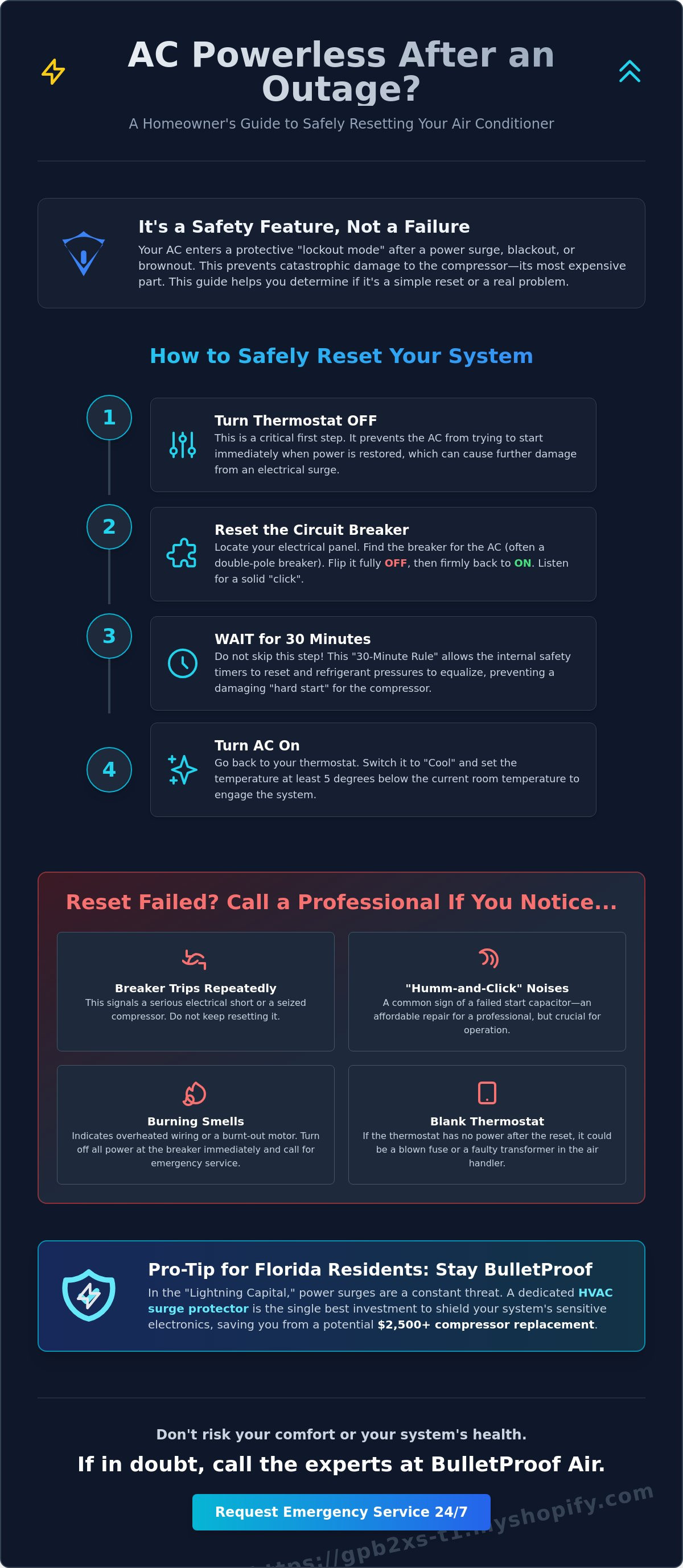
Step-by-Step Guide: How to Safely Reset Your AC System
Restoring your comfort doesn't have to be a guessing game. If your ac unit won't turn on after power outage, you need to follow a precise sequence to ensure you don't damage the compressor. First, head to your thermostat and switch it to the "OFF" position. This is a critical safety step. It prevents the system from trying to draw a massive amount of electricity the second the breaker is flipped. According to official safety protocols, disconnecting major appliances helps prevent damage from electrical surges that occur when the utility company restores power to the grid.
Next, locate your main electrical panel. You aren't just looking for a switch that is "off." You're looking for a breaker that has moved to the middle, "tripped" position. Once you find it, flip it all the way to the OFF position before switching it back to ON. This "full cycle" ensures the internal mechanism is properly engaged. If you feel any hesitation or if the panel feels hot, stop immediately. If you're uncomfortable handling the electrical components, our technicians are available 24/7 for fast HVAC repair services to keep your family safe.
Resetting the Circuit Breaker Correctly
A tripped breaker often looks like it's still on, but it will feel "mushy" to the touch. You must check two specific areas: the main panel and the outdoor disconnect box near your condenser. In Southwest Florida, lightning strikes often trip the outdoor breaker even if the indoor one remains fine. Push the lever firmly until you hear a distinct "click." This sound is your confirmation that the circuit is live. Without that physical engagement, the system won't receive the 240 volts it needs to start the cooling cycle.
The 30-Minute Rule and Re-engaging
Patience is your best tool here. Once the breakers are reset, do not touch the thermostat for at least 30 minutes. This gives the internal circuitry time to discharge any residual energy and allows the safety lockout mentioned earlier to clear. After the wait, set the thermostat to "COOL" and drop the temperature 5 degrees below the current room reading. Listen closely. You should hear a faint "click" from the air handler followed by the steady hum of the outdoor unit. If the breaker trips again the moment the system tries to start, do not reset it a second time. This is a clear sign of a short circuit or a grounded compressor that needs professional attention.
Beyond the Reset: Identifying Serious Electrical Component Damage
Sometimes, a simple flip of a switch isn't enough to restore your home's sanctuary. If you've followed the reset steps and your ac unit won't turn on after power outage, the electrical surge likely damaged a specific internal component. The most common casualty is the start capacitor. Think of the capacitor as a large battery that gives your motor the high-voltage shove it needs to start spinning. When the grid fluctuates during a blackout, that sudden spike can fry the capacitor's internal film, leaving your system unable to initiate the cooling cycle.
You'll often hear a distinct "humm-and-click" sound coming from the outdoor unit. This is the sound of the motor trying to draw power, failing because the capacitor is dead, and then the safety switch clicking off to prevent a fire. If you hear this, turn the system off immediately. Continuing to let it "try" to start can lead to the worst-case scenario: a total compressor failure. While a capacitor replacement typically costs between $150 and $400, a compressor replacement in Florida can range from $1,200 to over $2,500. If you're stuck in the heat, searching for air conditioning repair close to me is the fastest way to get a professional diagnostic and avoid these escalating costs.
Signs of a Blown AC Capacitor
A technician can quickly spot a failed capacitor, but there are visual cues for homeowners too. If you look through the service panel, a blown capacitor often has a bulging or domed top instead of being perfectly flat. In extreme cases, you might even see oil leaking down the side. Because these components store a lethal electrical charge even when the power is off, you should never touch them. Our expert team ensures every repair is handled safely, doing the job right the first time.
Control Board and Wiring Issues
Living in the "Lightning Capital" of Sarasota and Bradenton means our systems face unique threats. Sometimes a surge is so powerful it bypasses the standard breakers and hits the control board directly. If you smell a pungent, burnt-plastic odor or see any visible smoke, you've hit the safety redline. This indicates that the delicate wiring or the main logic board has scorched. In these moments, you need honest recommendations from a trusted pro who can determine exactly why your ac unit won't turn on after power outage and whether the board can be replaced or if the surge caused cascading damage throughout the unit.
The Florida Factor: Protecting Your AC from Lightning and Surges
Sarasota and Bradenton are frequently cited as the "Lightning Capital" of the United States. This isn't just a weather statistic; it's a direct threat to the longevity of your cooling system. While you may have already reset your breakers, you might still find that your ac unit won't turn on after power outage because a standard circuit breaker isn't designed to stop a lightning-induced surge. A breaker protects your home from a sustained overcurrent that could cause a fire. In contrast, a dedicated HVAC surge protector acts as a lightning-fast gatekeeper, diverting thousands of volts away from your sensitive compressor in less than a nanosecond.
Regular professional inspections are your best defense against the volatile Florida grid. During a routine check, technicians use specialized meters to test the electrical health of your system. A weak capacitor is like a frayed rope; it might hold during normal use, but the moment a power surge hits, it snaps. By catching these weak links early, you avoid the frustration of a system that fails exactly when the heat is most intense. "In Southwest Florida, it isn't a matter of IF a surge will hit your AC, but WHEN, making proactive protection a necessity for every homeowner."
Whole-Home vs. Point-of-Use Surge Protection
Many homeowners rely on a whole-home protector at the main panel, but for maximum security, we recommend point-of-use protection installed directly at the outdoor disconnect. A $300 to $700 investment in professional surge protection can prevent the catastrophic loss of a $5,000 compressor. BulletProof Air specializes in installing industrial-grade protection that filters out the "dirty power" common in our region. To ensure your system remains resilient year-round, explore our HVAC maintenance plans, which include electrical component testing as a standard feature.
Grid Instability and Brownouts in Sarasota
Total blackouts are obvious, but brownouts (low voltage) are often more damaging to your AC motors. When voltage drops during a heavy Florida summer storm, your AC motor tries to compensate by drawing more current. This extra current generates intense heat, which can melt internal wire insulation and lead to a "short to ground." Modern smart systems often have sensors to shut down during these fluctuations, but older units will simply struggle until they burn out. If you're leaving for vacation during hurricane season, always set your thermostat to a higher temperature but never "OFF." This keeps the internal safety logic active. If you want to fortify your home before the next storm, schedule a professional surge protection installation today to keep your sanctuary cool and safe.
Emergency AC Repair in Sarasota: Restoring Your Sanctuary
When the DIY reset steps fail and the Florida humidity begins to settle into your carpets, you need a professional who treats your comfort like a priority. If your ac unit won't turn on after power outage despite your best efforts, the issue likely resides deep within the electrical controls or the compressor itself. At BulletProof Air, we understand that a broken air conditioner is more than a nuisance; it's a health and safety risk in our climate. We've built our reputation on the "BulletProof" promise: we do the job right the first time, every time. You don't have to worry about repeat visits or temporary patches that fail when the sun hits its peak.
Our team operates as a specialized first-responder unit for your HVAC system. When a BulletProof Air technician arrives at your home post-outage, they perform a comprehensive diagnostic that goes beyond just checking the breakers. We inspect the contactor for pitting, test the capacitor's microfarad levels, and ensure the control board hasn't suffered a logic failure from a voltage spike. We arrive in fully stocked "warehouses on wheels," meaning we can often resolve the most common surge-related failures during that very first visit. We'll restore your home to a cool and comfortable sanctuary without the stress of long wait times or hidden fees.
Why Choose BulletProof Air for Post-Storm Repairs?
Speed is essential when the local temperature regularly climbs into the 90s. We offer true 24/7 emergency availability because we know that power outages don't follow a 9-to-5 schedule. Our technicians are factory-trained experts in high-performance systems from Lennox, Daikin, and Mitsubishi. Whether you have a traditional split system or a modern ductless mini-split, we provide honest recommendations and transparent pricing. In an industry where emergency fees can jump 30% to 50% during peak summer months, we focus on delivering lasting solutions that protect your long-term investment and your peace of mind.
Schedule Your Emergency Service Now
Don't let your home remain a sauna for another hour. We're proud to serve neighbors across Sarasota, Bradenton, and Lakewood Ranch with the fastest response times in the region. If your ac unit won't turn on after power outage, it is time to stop troubleshooting and start cooling. Our dispatchers are standing by to send a trusted expert to your door immediately. Contact BulletProof Air right now to schedule your repair. We're on our way to restore your comfort and ensure your HVAC system is as resilient as the home it protects.
Restore Your Cool Sanctuary Today
Navigating the sweltering heat after a storm is stressful, but you now have the tools to handle a system lockout safely. Remember that your cooling system often uses a built-in delay to protect the compressor from volatile voltage. If you followed the reset steps and your ac unit won't turn on after power outage, it is time to stop troubleshooting and let a professional take over. Persistent silence or repeated breaker trips indicate that the electrical surge has moved past a simple safety pause and damaged internal components like the start capacitor or control board.
Our expert technicians serve Sarasota and Bradenton with 24/7 emergency response to ensure you never have to spend a night in the humidity. We arrive with the specialized tools needed to provide honest diagnostics and lasting solutions. Every repair comes with a 100% satisfaction guarantee; you can trust that we'll do the job right the first time. Don't let the Florida sun turn your home into a sauna. Need Emergency AC Repair? We’re Available 24/7; Call BulletProof Air Now! We are ready to restore your home to a comfortable, reliable sanctuary immediately.
Frequently Asked Questions
How long should I wait for my AC to turn on after a power outage?
You should wait at least 5 to 10 minutes for your system's internal delay timer to expire. Modern units from brands like Lennox use this pause to allow refrigerant pressures to equalize before the motor starts. If you performed a manual breaker reset because your ac unit won't turn on after power outage, we recommend waiting a full 30 minutes before switching the thermostat back to "Cool" to ensure all safety lockouts have cleared.
Why is my AC thermostat blank after the power came back on?
A blank screen usually means your thermostat has lost its 24-volt power source or its backup batteries are depleted. Most digital thermostats draw power from the air handler via a "C-wire." If the air handler's specific circuit breaker tripped during the storm, the thermostat will lose its primary power. Check your indoor electrical panel first, and then replace any AA or AAA batteries in the display unit to restore the interface.
Can a power outage fuse or break my air conditioner's compressor?
Yes, a severe voltage spike can cause the compressor's motor windings to "short to ground," which permanently breaks the component. While a capacitor is a fast and affordable fix, a failed compressor is a major mechanical disaster. In Florida, a compressor replacement can cost between $1,200 and $2,500 in 2026. Proactive surge protection is the only reliable way to avoid this expensive worst-case scenario during hurricane season.
Is there a reset button on my outside AC unit?
Most residential outdoor condenser units do not have a physical "reset" button on the exterior cabinet. The reset process is properly handled by cycling the circuit breakers in your main electrical panel and the outdoor disconnect box. If your ac unit won't turn on after power outage, flipping the breaker to the "Off" position and then firmly back to "On" serves as the hard reset for the system's internal logic board.
What should I do if my AC breaker keeps tripping after a storm?
You must stop attempting to reset the system if the breaker trips a second time. A breaker that immediately "pops" back to the middle position is a critical safety warning that there is a direct electrical short or a grounded compressor. Forcing a restart under these conditions can lead to an electrical fire or total motor destruction. Call a trusted technician to identify the electrical fault before you attempt to restore power again.
Will a power surge protector actually save my AC unit from lightning?
A high-quality surge protector is designed to divert thousands of volts of excess energy into the ground before they reach your sensitive HVAC electronics. While no device can stop a direct, 100% lightning hit, these protectors handle the much more common indirect surges from nearby strikes. Installing a whole-house surge protector in Florida typically costs between $300 and $700 in 2026, providing a reliable layer of security for your investment.
Why is my AC blowing warm air after the power was restored?
This happens when your indoor blower fan is running, but the outdoor condenser unit has failed to start. The outdoor unit might be stuck in a 5-minute safety lockout, or the start capacitor might have been fried by a power surge. If the air coming from your vents isn't cold within 15 minutes of the power returning, turn the system off at the thermostat to prevent the indoor coil from freezing while you wait for a pro.
Can I reset my AC unit myself or do I need a licensed HVAC technician?
You can safely perform the basic thermostat and circuit breaker reset yourself if you follow the correct sequence. However, you need a licensed HVAC technician if the system fails to start after the reset or if you hear a loud buzzing sound. Handling internal electrical components like capacitors is dangerous for homeowners because they store a lethal electrical charge even when the main power to the home is completely disconnected.