

Troubleshooting Common AC Problems: A Homeowner’s 2026 Guide to Staying Cool
Imagine it is 2:00 PM on a Tuesday in Bradenton, the humidity is pushing 90 percent, and your air conditioner just let out a final, pathetic wheeze. Within minutes, your living room feels less like a home and more like a sauna, creating immediate health risks for your pets and elderly family members. You know that sinking feeling; the fear that a simple fix might turn into a $650 repair bill or a confusing battle with thermostat settings. Mastering troubleshooting common ac problems is your first line of defense against the relentless Florida sun.
We understand that a broken AC is an emergency that threatens your peace of mind. You shouldn't have to worry about being overcharged for a solution that could have been a simple reset. This 2026 guide promises to give you the clarity you need to diagnose issues quickly and identify safe DIY fixes. We will preview the impact of the 8th Edition Florida Building Code, explain why R-410A prices are climbing toward $75 per pound, and show you exactly when to call in the experts to restore your cool, comfortable sanctuary.
Key Takeaways
- Perform a five-minute triage by verifying your thermostat is set to "Cool" and "Auto" to rule out simple configuration errors.
- Master troubleshooting common ac problems by maintaining a two-foot clearance around your outdoor condenser to ensure proper airflow and cooling.
- Learn how to manage Sarasota’s extreme humidity by keeping your condensate drain line clear of algae and slime buildup.
- Identify the specific sounds and smells that signal a failing fan belt or a serious compressor issue before they lead to a total system breakdown.
- Know exactly when to stop DIY efforts and call a professional to handle high-risk components like high-voltage capacitors.
The First 5 Minutes: An Immediate AC Triage Checklist
Don't panic. When your air conditioner stops breathing in the middle of a Florida July, your first instinct might be to fear a total system replacement. Take a deep breath. A non-responsive unit doesn't always signal a catastrophic failure. Many times, the solution is a simple adjustment you can make in seconds. Starting your journey into troubleshooting common ac problems with a calm mind saves you stress and prevents unnecessary emergency service calls. We want to help you restore your sanctuary quickly without spending money on a fix you could handle yourself.
Thermostat Settings and Power Sources
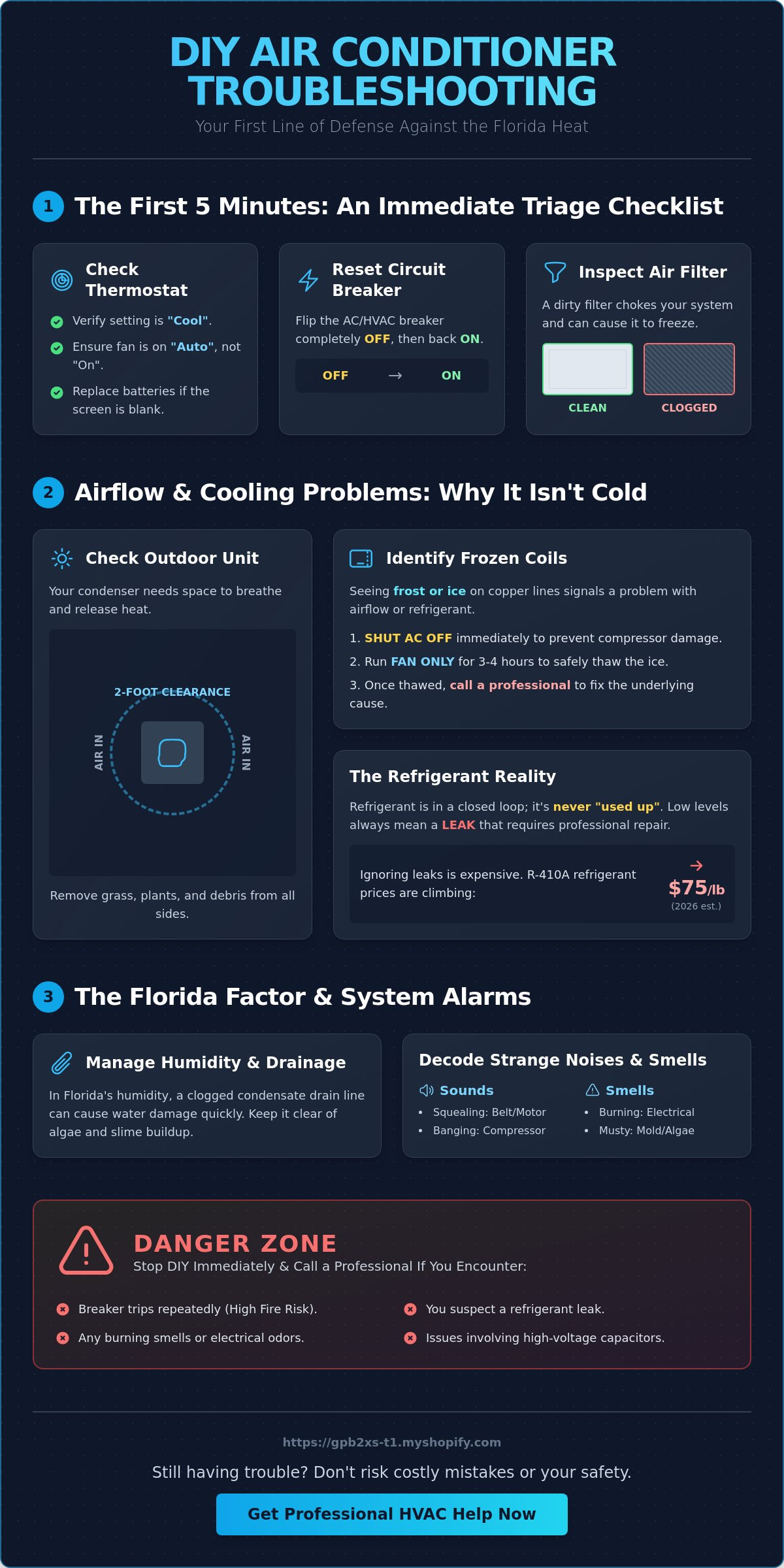
Start at the command center. Verify your thermostat is set to "Cool" and the fan is on "Auto" rather than "On." Setting the fan to "On" runs the blower continuously. This often blows humid air back into your home between cooling cycles, which is the last thing you want in Sarasota. If the display is blank, your batteries likely died. This is a common oversight that causes a total system shutdown. If the screen is active but nothing is happening, head to your electrical panel immediately.
Florida’s legendary afternoon thunderstorms often trigger power surges that trip circuit breakers. Locate the switch labeled "AC" or "HVAC." To properly reset it, you must flip it completely to the "Off" position before clicking it back to "On." This specific sequence protects the compressor from electrical damage. Gaining a basic understanding of How Air Conditioners Work through the vapor-compression cycle helps explain why a steady power supply is required to move heat out of your home. If the breaker trips again immediately, stop and call for professional help. Repeated tripping indicates a serious electrical short that poses a fire risk.
The Air Filter Impact
A dirty filter chokes your system, restricts airflow, and eventually leads to frozen evaporator coils that stop the cooling process entirely. Check your filter immediately if you notice thick gray dust buildup or hear a high-pitched whistling sound coming from the return vents. These are clear indicators that your system is gasping for air. While high-MERV filters promise better air quality, they can be too restrictive for systems built before 2020. This extra resistance forces the blower motor to work harder, which can lead to a premature breakdown. If your filter looks like a wool blanket, replace it now to restore your home’s comfort. If these triage steps don't bring the chill back, we need to look at the outdoor components next.
Airflow and Cooling Problems: Why Your AC Isn’t Cold
If your vents are blowing but the air feels like a lukewarm Sarasota breeze, you've moved past simple triage into deeper troubleshooting common ac problems. Distinguishing between "no air" and "warm air" is your first diagnostic step. No air usually points to a failed blower motor or a blown capacitor. Warm air indicates a breakdown in the heat exchange process, which often starts at your outdoor condenser unit. When your home sanctuary begins to feel like a swamp, identifying the specific failure point is the fastest way to restore your comfort.
The U.S. Department of Energy highlights that Common AC Problems often involve refrigerant leaks or dirty heat exchangers. It's a common myth that refrigerant is "consumed" over time. In reality, your air conditioner is a closed-loop system. If your levels are low, you have a leak that needs a professional repair. Topping off a system without fixing the leak is a waste of money, especially with R-410A prices rising toward $75 per pound in 2026. Low refrigerant causes the system to work harder, eventually leading to a $3,000 compressor failure.
Identifying Frozen Coils and Restricted Flow
Look at the copper lines connecting your indoor and outdoor units. If you see white frost or solid ice, your evaporator coil is frozen. Shut the system down immediately. Running a frozen unit can cause liquid refrigerant to enter the compressor, leading to a total system failure. Ice typically forms when airflow is blocked by a dirty blower or when refrigerant levels drop too low. You can safely thaw the system by turning the AC off and running the "Fan Only" mode for three to four hours. Once the ice is gone, you'll need reliable HVAC repair to ensure the problem doesn't return.
Outdoor Unit Obstructions
Your outdoor unit is a heat-dumping machine that needs space to breathe. Florida’s rapid plant growth and decorative mulch can quickly choke the airflow. Maintain a strict 2-foot clearance around the entire unit to ensure heat can escape. If the aluminum fins are clogged with grass clippings or salt spray from the Gulf, gently rinse them with a standard garden hose. Do not use a pressure washer. The high-pressure stream will flatten the fins and permanently restrict airflow. If you own a high-efficiency inverter system, Daikin ac repair involves complex electronics that manage variable speeds. These units are highly efficient but require expert calibration to handle the unique humidity and heat of the Bradenton region.
The Florida Factor: Drainage and Humidity Issues
Florida doesn’t just plate up sizzling heat; it delivers thick, heavy humidity that forces your air conditioner to work as a massive dehumidifier. Your system pulls gallons of moisture from the air every single day. This water travels through the condensate drain line, which acts as the "highway" for moisture removal. In Sarasota and Bradenton, the constant warmth and moisture create a perfect breeding ground for algae, mold, and thick "slime" inside these pipes. When this "highway" gets blocked, the water has nowhere to go, leading to one of the most frustrating troubleshooting common ac problems for homeowners.
This is where the "Safe-T-Switch," also known as a float switch, becomes your best friend and your biggest headache. This sensor detects rising water levels in the drain pan and immediately cuts power to your system. It’s a proactive measure designed to prevent thousands of dollars in water damage to your floors and ceilings. If your system is completely dead and the thermostat is blank, a clogged drain is a likely culprit. You might also notice water pooling in the emergency drain pan located underneath your indoor unit, which is a clear signal that the primary line has failed.
Troubleshooting a Clogged Drain Line
You can often resolve minor blockages yourself before calling for emergency service. First, locate the drain line access point, which is usually a T-shaped PVC pipe near your indoor air handler. If you see standing water in the pan, the system has already triggered the safety shutdown. One effective DIY method is the wet/dry vac trick. Head outside to where the PVC pipe exits your home, seal your vacuum hose to the end of the pipe with a wet rag, and run the vacuum for about 30 seconds. This often pulls out the "slime" and restores the flow. For a deeper look at this process, read our guide on clogged drain lines to prevent future backups.
Preventing Water Damage
Never ignore a damp spot on your ceiling or a musty smell near your utility closet. These are early warning signs that your drainage system is failing. While the Safe-T-Switch prevents major floods, it doesn't stop the growth of algae. Regular maintenance is the only way to keep the line clear. We recommend a professional "blow out" of the lines once a year. This process uses high-pressure CO2 to clear deep-seated debris that a standard vacuum can't reach. Keeping this line clear ensures your home remains a dry, cool sanctuary rather than a breeding ground for mold and water damage.
Decoding Strange Noises and Funky Smells
Your air conditioner often communicates its distress through sounds and scents long before the system actually fails. Ignoring these sensory warnings can turn a minor adjustment into a major expense. When troubleshooting common ac problems, your ears and nose are just as important as your eyes. A squealing or screeching sound usually points to a failing fan belt or worn-out motor bearings. If you hear heavy banging or clanking, it’s a sign that a part has come loose inside the blower or the compressor is nearing its end. These sounds are more than just annoying; they're an urgent cry for help from your HVAC system.
Smells are equally revealing. If your vents emit a "dirty sock" odor, you're likely dealing with bacterial buildup on the evaporator coils. This is especially common during Florida’s "shoulder" seasons when the system cycles less frequently. However, an electrical burning smell is an immediate red flag. This scent often indicates melting wire insulation or a failing motor. If you smell ozone or burnt plastic, cut the power at the breaker immediately to prevent a fire. Taking fast action now can save your home from serious damage.
Acoustic Troubleshooting: What Your AC is Telling You
It’s normal to hear a single "click" when your system starts up. Persistent clicking, however, suggests a failing relay or a problem with the control board. A steady buzzing sound often points to an electrical issue, such as a failing capacitor or a pitted contactor. Being able to describe these specific noises will help your technician provide a faster, more accurate ac repair. The more detail you provide, the quicker we can restore your sanctuary to its quiet, cool state.
Indoor Air Quality and Odors
Persistent odors often stem from mold growth within the ductwork or on the coils. "Dirty Sock Syndrome" isn't just a nuisance; it affects your family's health. We often recommend installing UV lights or advanced air purifiers to kill these microorganisms at the source. If you detect a rotten egg smell, don't assume it’s just a dead critter in the vents. While that’s possible, it could also indicate a natural gas leak if your home has gas appliances. Safety must come first. If you're concerned about strange noises or smells, schedule your emergency inspection with our expert team today to ensure your system is operating safely and efficiently.
The BulletProof Line: When DIY Becomes Dangerous
You have worked through the essentials of troubleshooting common ac problems by checking your thermostat, clearing your filters, and resetting your breakers. If your home still feels like a sauna, you have reached the line where DIY efforts stop and professional expertise must begin. We want you to stay safe. Modern HVAC systems are complex machines that involve high-voltage electricity and pressurized chemicals. Attempting to go further without the right tools and training puts your safety and your home at risk.
One of the most significant hazards involves high-voltage capacitors. These components store a massive electrical charge even when the power is completely disconnected at the breaker. A single mistake can result in a severe electrical shock or permanent damage to your system's control board. Additionally, handling refrigerant is not just dangerous; it is a federal violation. Under EPA Section 608, only licensed technicians can handle substances like R-410A or the newer R-32 and R-454B mandated for all new units in 2026. Trying to "charge" your own system can lead to catastrophic compressor failure or legal fines.
Protecting Your Investment and Warranty
Most major manufacturers like Lennox and Daikin require a documented "paper trail" of professional service to honor their 10-year parts warranties. If you attempt a DIY repair and cause further damage, you could be on the hook for the full cost of a $2,000 compressor replacement. A professional service call is a small investment that protects your long-term finances. At BulletProof Air, we provide the honest recommendations and lasting solutions you need. We do the job right the first time, ensuring your warranty remains intact and your system operates at peak efficiency.
Restoring Your Sanctuary with BulletProof Air
Don't spend another minute sweating in the Florida humidity. We understand that a broken AC is an emergency that affects the health and comfort of your family. That's why we provide 24/7 emergency AC repair in Lakewood Ranch and the surrounding Sarasota areas. Our expert technicians are ready to respond without delay to restore your home to a cool, comfortable sanctuary. You've done your part by identifying the symptoms. Now, let our team handle the high-risk repairs with the speed and reliability you deserve. Call us today or schedule your professional diagnostic online to bring the chill back to your home.
Restore Your Cool and Comfortable Sanctuary Today
Navigating the intense heat of Sarasota and Bradenton requires a reliable cooling system and the knowledge to keep it running. You now have the essential tools for troubleshooting common ac problems, from performing a quick thermostat triage to identifying the algae buildup that triggers your safety float switch. While a dirty filter is a simple fix, high-voltage components and refrigerant leaks are serious hazards. These issues require professional intervention to protect your 10-year manufacturer parts warranty and ensure your family's safety.
We understand that a malfunctioning AC is a stressful emergency. BulletProof Air serves as your dependable first responder with 24/7 emergency service across Southwest Florida. Our expert technicians are trained to repair all major brands; we guarantee the job is done right the first time. Don't let the sweltering humidity compromise your comfort or health.
Need Help Fast? Schedule Your BulletProof AC Repair Now!
We are ready to resolve your cooling issues and restore your home to the peaceful, chilled sanctuary you deserve.
Frequently Asked Questions
Why is my AC running but not cooling the house?
Your system likely has a dirty outdoor condenser unit or low refrigerant levels. If the coils are covered in grass clippings or dirt, they cannot release heat effectively. Troubleshooting common ac problems often reveals that low refrigerant is the culprit, which always indicates a leak that needs professional repair rather than just a refill. Check your outdoor unit for obstructions to see if airflow is the main issue.
How often should I really change my AC filter in Florida?
You should change your air filter every 30 to 60 days due to Florida’s intense cooling demands. Because systems in Sarasota run nearly 24/7 during the summer, filters clog much faster than the national average. If you have pets or allergies, a 30-day replacement schedule is necessary to prevent airflow restrictions that lead to frozen coils and system shutdowns.
Is it safe to pour bleach down my AC drain line?
No, you should use distilled white vinegar instead of bleach to clear your drain line. Bleach is highly corrosive and can damage the plastic PVC pipes or the metal components of your drain pan over time. A quarter cup of vinegar every month safely kills algae and slime buildup without the risk of causing leaks or cracking your drainage system.
Why does my air conditioner keep tripping the circuit breaker?
A grounded compressor or a failing capacitor is likely pulling more amperage than the circuit can safely handle. This is a critical safety mechanism designed to prevent electrical fires in your home. If your breaker trips more than once, stop resetting it and call a professional. Repeatedly forcing the system to start can cause permanent damage to your compressor's internal motor.
What does it mean when my AC unit is frozen outside?
A frozen unit indicates a severe airflow restriction or a lack of refrigerant. When the evaporator coil cannot absorb enough heat, the temperature drops below freezing and turns moisture into ice. This is one of the most visible troubleshooting common ac problems. Turn the system off immediately to let it thaw for three to four hours before a technician arrives to find the leak or blockage.
How long should a standard AC repair take?
Most common repairs, such as replacing a capacitor or a fan motor, are resolved within one to three hours. Our expert technicians carry a wide range of parts to ensure we can restore your sanctuary quickly. More complex issues, like a full evaporator coil replacement or a refrigerant leak search, can take four to six hours depending on the accessibility of your unit.
Can I still run my AC if it is making a loud buzzing noise?
No, you should shut the system down immediately if you hear loud buzzing or humming. This sound often signals an electrical issue with the contactor or a motor that is struggling to start. Continuing to run the unit in this state can lead to a total compressor failure. It is much more cost effective to replace a small electrical component now than a major part later.
What is the average cost of a professional AC diagnostic in Sarasota?
A professional diagnostic service call in the Sarasota and Bradenton area typically costs between $75 and $150. This fee covers the technician's time, travel, and expert analysis to identify the root cause of your system failure. This diagnostic ensures you receive an honest recommendation for the specific repair needed rather than paying for parts you don't actually require.
If you would like maintenance or repair assistance with your Florida Air Conditioner, contact BulletProof Air Or call: 941.599.9999 for more information about how we can help.