

Best Temperature to Set Thermostat in Summer Florida: Balancing Comfort & Savings in 2026
In Florida, your thermostat is a humidity controller first and a thermometer second. If you treat it like a simple dial, you're likely inviting sticky air and exorbitant electric bills into your home. Finding the best temperature to set thermostat in summer florida is about more than just a number; it's about protecting your HVAC system from a total meltdown when the heat hits 95 degrees. We understand the stress of watching Florida utility rates climb toward 16 cents per kilowatt-hour while you just want to feel comfortable in your own living room.
You deserve a home that feels like a protected sanctuary, not a swamp. We'll show you the expert-recommended settings that balance energy savings with the moisture control your house requires to stay mold-free. This guide covers the specific temperatures for when you're home, at work, or sleeping. You'll also discover how recent 2026 efficiency standards and new refrigerants impact your cooling strategy. Let's reclaim your comfort and slash those monthly costs starting today.
Key Takeaways
- Learn how the "1% Rule" helps you calculate exactly how much you save for every degree you raise your thermostat this summer.
- Understand why 50% relative humidity is the real target for a comfortable home and how to prevent system short-cycling from ruining your air quality.
- Find the best temperature to set thermostat in summer florida during work hours to protect your sanctuary while minimizing monthly energy costs.
- Master the "4-Degree Rule" for scheduling to prevent your AC from struggling to recover during the peak afternoon heat.
- Discover why specialized professional maintenance is non-negotiable for Florida homeowners facing extreme heat and corrosive salt air exposure.
Finding the Sweet Spot: The Ideal Summer Temperature for Florida Homes
Florida homeowners in 2026 are facing a new reality. With residential electricity rates now hovering between 15.54 cents and 16 cents per kilowatt-hour, your cooling strategy must be precise. Your HVAC system is the most expensive appliance you own. Understanding what a thermostat is and how it interacts with the intense Gulf Coast climate is the first step toward reclaiming your home as a sanctuary. Finding the best temperature to set thermostat in summer florida requires a delicate balance between mechanical longevity and personal comfort.
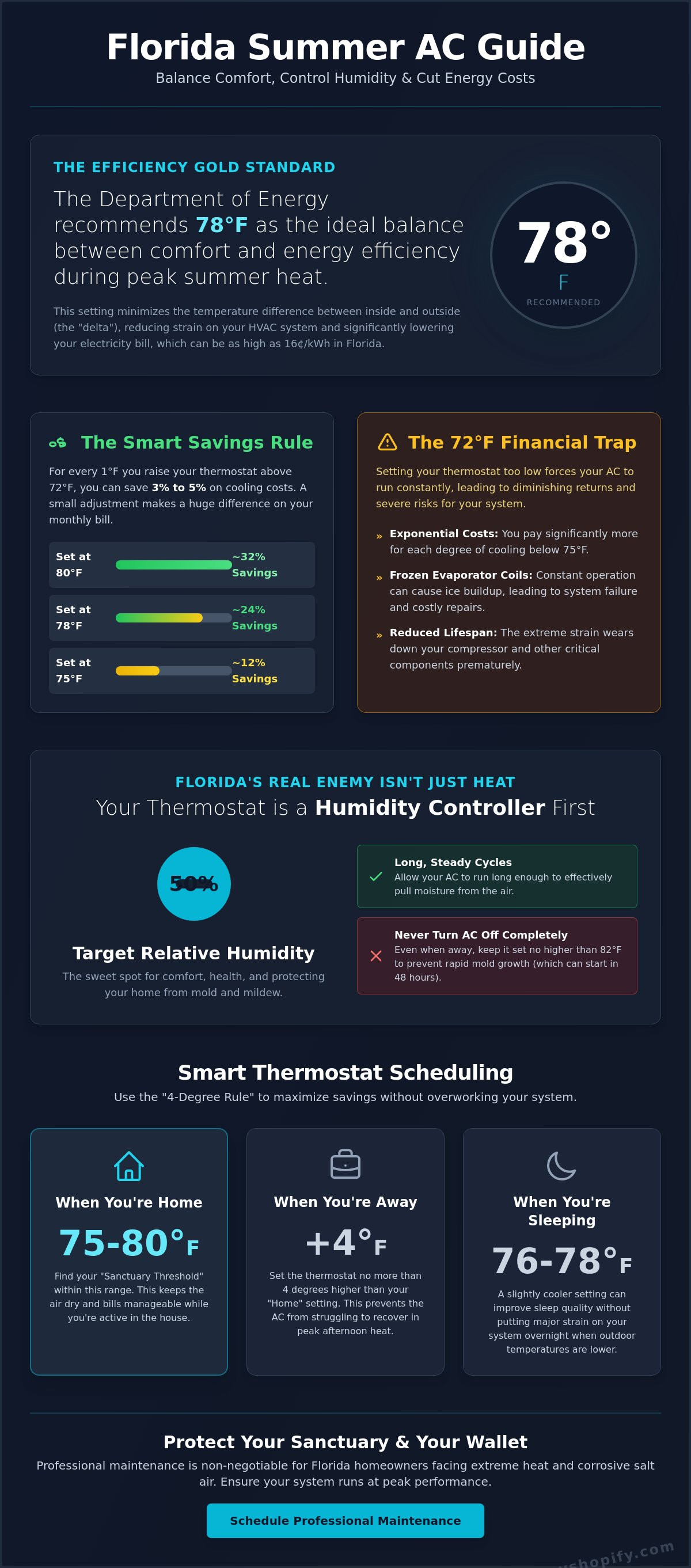
The Department of Energy (DOE) provides a gold standard that many find challenging: 78°F. While this number might seem high when the humidity outside is thick enough to wear, it is the most efficient setting for your equipment. We recommend the "1% Rule" as a guide for your wallet. For every single degree you raise your thermostat above 72°F, you save approximately 3% to 5% on your monthly cooling costs. In a state where the average monthly electric bill sits around $170, those percentages add up to significant annual savings.
Precision is even more critical now that the 8th Edition of the Florida Building Code has raised efficiency requirements. Modern systems using the new R-454B refrigerant are engineered for high performance, but they still obey the laws of physics. Your goal is to find your personal "Sanctuary Threshold," typically between 75°F and 80°F, where the air stays dry and the bills stay manageable.
The Science of 78 Degrees
Heat transfer physics dictates that the smaller the difference between the outdoor temperature and your indoor setting, the less work your AC performs. When it is 95°F in Sarasota, a 78°F setting creates a manageable 17-degree "delta." Modern HVAC systems are specifically designed to operate at peak efficiency within this range. Our professional recommendation is that the sweet spot for maximum efficiency is 78°F.
Why 72 Degrees is a Financial Trap
Setting your dial to 72°F might feel great for ten minutes, but it creates a massive strain on your compressor. In the Florida sun, your unit may never reach that target, causing it to run indefinitely. This constant operation leads to the "point of diminishing returns" where you pay exponentially more for very little actual cooling. It also risks "freezing" your evaporator coil, a common failure that can leave you stranded in the heat. Pushing a system this hard in 2026, when equipment prices have risen significantly, is a risk your budget shouldn't take. You should avoid these low settings to protect your system's lifespan and your bank account.
Beyond the Degrees: Why Humidity is the Real Enemy in Southwest Florida
In Florida, the heat isn't just a temperature; it's a weight. Even if you follow the recommended thermostat settings from the Department of Energy, your home might still feel like a swamp. This happens because moisture in the air prevents your body's natural cooling mechanism from working. When relative humidity (RH) climbs above 55%, your sweat cannot evaporate effectively. This "feels like" factor is what turns a manageable 78°F into a sticky, miserable 85°F. You aren't just fighting the sun; you're fighting the water in the air.
Your target for a healthy, comfortable sanctuary is 50% relative humidity. Anything higher invites mold and mildew to take root in your drywall, carpets, and upholstery. This is why you should never set your thermostat above 82°F, even when you're away for the weekend. Leaving the system off entirely allows moisture to saturate your home. It creates an environment where biological growth thrives in as little as 48 hours. Protecting your property requires keeping the air moving and the moisture out.
Finding the best temperature to set thermostat in summer florida is only half the battle. You must ensure your system runs long enough to actually dehumidify the space. If your home feels damp despite a low temperature reading, your equipment might be struggling with the heavy coastal air. We see this often in Sarasota, where the salt air and high moisture levels put immense pressure on residential systems.
The Role of the AC Dehumidification Cycle
Your air conditioner's primary job is heat removal, but its secondary job is pulling gallons of water out of your indoor air. This happens as warm air passes over the cold evaporator coil. For this to work, the system needs long, steady run times. Short bursts of cooling, known as short-cycling, don't allow the coil to stay cold long enough to condense moisture. We often see oversized units in local homes that cool the air so fast they leave the humidity behind. This results in a home that is "cold and clammy," which is neither comfortable nor safe. Using a simple hygrometer can help you monitor these levels daily to ensure your air stays within the safe 50% range.
BulletProof Solutions for Humidity
If your home stays sticky despite proper settings, you might need a more specialized approach. Whole-home dehumidifiers work in tandem with your HVAC system to maintain that 50% RH target without overworking the compressor. Many modern thermostats also offer a "Dry Mode." This setting slows down the blower fan to maximize moisture removal. However, use it sparingly, as it can be less energy-efficient for total cooling. For a professional assessment of your indoor environment, consider checking out HVAC services near me to schedule an air quality audit. Don't let moisture compromise your peace of mind or your family's health.
Smart Scheduling: Thermostat Settings for Away, Sleep, and Peak Heat
Turn off your AC when you leave for work? That is a recipe for disaster in our climate. While some online forums might suggest it, doing so allows heat and moisture to saturate your walls and furniture. When you return, your system will struggle for hours to recover. This is Why Humidity is the Real Enemy in Florida; once it settles in, your AC has to work double time to strip it back out. Protecting your sanctuary requires a schedule that respects the limits of your equipment.
The secret to efficiency is the "4-Degree Rule." Never ask your system to move the temperature more than 4 degrees at once. If your goal is 78°F while you are home, your "Away" setting should never exceed 82°F. This prevents the massive mechanical strain that leads to emergency repairs during the hottest months. Finding the best temperature to set thermostat in summer florida is about maintaining a steady baseline rather than forcing your compressor to play catch-up.
Strategic pre-cooling is another professional tactic for the 2:00 PM peak. The Florida sun hits its zenith in the early afternoon, putting maximum load on your home's envelope. By dropping your thermostat by two degrees at noon, you "bank" coolness in your home's structure. This prevents the unit from running non-stop during the most expensive peak-rate hours when electricity can cost up to 16 cents per kWh. You'll stay comfortable while your neighbors' systems are gasping for air.
How to Program Your Florida Summer Schedule
Follow these four steps to maximize your system's life and your comfort:
- Step 1: Set your "Home" temperature to 78°F for active hours.
- Step 2: Adjust to 82°F for "Away" periods. This is the absolute maximum limit to ensure mold prevention.
- Step 3: Drop to 74°F for "Sleep." Lower temperatures support your circadian rhythm and ensure deep rest without overworking the unit.
- Step 4: Use "Auto" fan settings. This ensures moisture drains properly from the evaporator coil instead of blowing back into your living space.
Smart Thermostats: Are They Worth It in 2026?
Technology has made precision easier than ever. Geofencing features now allow your AC to recognize when you are heading back to Lakewood Ranch or Sarasota. The system begins cooling just in time for your arrival, so you never walk into a hot house. Modern learning algorithms even adapt to our specific afternoon storm patterns, adjusting cycles before the rain-induced humidity spike hits. Many local residents can also take advantage of utility rebates for installing these smart devices. They aren't just gadgets; they are essential tools for a durable cooling strategy that protects your wallet and your peace of mind.
Maximizing Efficiency: How to Stay Cool Without Overworking Your AC
Your thermostat isn't the only tool in your cooling arsenal. To truly protect your sanctuary, you must reduce the thermal load on your home. Even when you've found the best temperature to set thermostat in summer florida, your system will struggle if your house is leaking cool air or absorbing direct solar radiation. Efficiency is about creating an environment where your AC doesn't have to fight an uphill battle against the Sarasota sun. You can achieve comfort at higher settings by using a few professional strategies to manage how heat enters and moves through your living space.
Ceiling fans are your most effective mechanical allies. They create a "wind chill" effect by moving air across your skin, which can make a 78°F room feel like 74°F. It's vital to remember that fans cool people, not rooms. They don't lower the actual temperature; they just help you tolerate a higher setpoint. Turn them off when you leave a room to keep your electric bill from climbing. Combined with blackout curtains, which block infrared energy before it heats your floors and furniture, these simple changes significantly reduce the pressure on your HVAC unit.
If your system still runs constantly despite these adjustments, your home's envelope might be the problem. A "heat load" audit can identify leaks around windows, doors, and attic hatches where your expensive cold air is escaping. Addressing these gaps ensures that the best temperature to set thermostat in summer florida actually results in a comfortable home rather than a wasted investment. Precision in your home's sealing is just as important as precision in your thermostat settings.
Mechanical Assists for Your Thermostat
Small changes in your daily habits can lead to big savings and better comfort. Ensure your ceiling fans are spinning counter-clockwise to push a cooling breeze directly downward. You should also audit your lighting; old incandescent bulbs act like small heaters. Switching to LED lighting eliminates this unnecessary heat source. In the kitchen and bathrooms, always use exhaust fans when cooking or showering. These fans vent heat and steam outside immediately, preventing your AC from having to process that extra moisture and warmth.
The Importance of Clean Airflow
A clogged air filter is like trying to breathe through a straw. It forces your system to work harder, adding what we call "5 degrees of effort" to the motor. This strain eventually leads to mechanical failure. If you notice a significant drop in airflow despite having the correct settings, it's time to seek professional ac repair to restore your system's performance. You can check your system's health using the "20-degree split" rule. Measure the air temperature at the return vent and compare it to the air coming out of a supply vent. If the difference is significantly less than 20 degrees, your AC isn't performing correctly. Don't wait for a total breakdown; visit our website to schedule a precision tune-up today.
Protecting Your Sanctuary: Professional Maintenance for Peak Performance
Finding the best temperature to set thermostat in summer florida is a vital first step, but even the most efficient setting fails if your hardware is compromised. In Sarasota, our environment is beautiful but brutal. The salt-laden air from the Gulf acts as a silent corrosive agent, eating away at your outdoor condenser coils. Without specialized cleaning, these coils lose their ability to shed heat effectively. This forces your system to run longer and hotter, regardless of what your thermostat says. A system struggling with salt-crust on its coils can easily spike your monthly electric bill well above the Florida average of $175.
Sometimes, the problem isn't the AC unit, but the brain behind it. Thermostats can lose calibration over time. If your display reads 78°F but the room feels like a sauna, your sensors might be failing. We call this a "lying thermostat." It leads to inconsistent cooling and unnecessary wear on your compressor. Precision in calibration ensures that your sanctuary remains protected and your energy dollars aren't wasted on phantom cooling. You need to know that when you set a temperature, your system actually delivers it.
The cost-benefit analysis of preventative maintenance is clear in 2026. With HVAC equipment prices increasing by another 5% to 10% this year, protecting your current investment is a financial priority. Emergency repairs during a 100-degree heatwave are not only more expensive but also come with the stress of a hot, unsafe home. A proactive maintenance plan identifies small issues, like a failing capacitor or a clogged drain line, before they turn into a total system shutdown. Don't wait for a breakdown to take action.
The BulletProof Air Maintenance Advantage
The BulletProof Air promise is built on the idea that your home should be a fortress against the intense Florida heat. We perform deep-level precision tuning that accounts for our region's specific high-demand summer season. Our technicians verify that your thermostat is communicating perfectly with your air handler to prevent energy waste. If you suspect your system is drifting or your bills are climbing without reason, contact us for ac repair in sarasota to get an immediate calibration check and performance audit.
When to Upgrade Your System
As we navigate 2026, keeping an old R22 system on life support is becoming a liability. These units simply cannot match the efficiency of modern SEER2-compliant systems. The mandatory industry shift to R-454B refrigerants means that older parts are becoming scarcer and more costly. Upgrading to a high-efficiency model in 2026 allows you to take advantage of the $200 FPL instant credit and federal tax credits up to $2,000. You'll gain peace of mind and a much lower monthly overhead. Restore your home’s sanctuary with a BulletProof Air tune-up today and ensure your system is ready for the peak of summer.
Reclaim Your Home’s Sanctuary Today
You now have the blueprint to survive the most intense Gulf Coast heat while keeping your energy bills under control. By maintaining the best temperature to set thermostat in summer florida at 78°F and respecting the 50% humidity threshold, you protect your home from mold and your system from mechanical failure. As we have explored, your HVAC unit is a precision machine that requires expert care to handle the unique salt air and extreme thermal loads of our region.
Our expert technicians serve Sarasota and Bradenton with customized maintenance plans designed specifically for Florida’s high-demand climate. We provide fast response times for high-heat emergencies to ensure your family stays safe and cool. Don't wait for your system to struggle during the next heatwave. Protect Your Sanctuary—Schedule Your BulletProof Air Summer AC Tune-Up Now. You can enjoy the peace of mind that comes with a high-performance system and a lower monthly overhead. Your home is your refuge, and we are here to keep it that way.
Frequently Asked Questions
Is 78 degrees really the best temperature for a Florida summer?
Yes, 78°F is the gold standard for balancing personal comfort with mechanical efficiency. It minimizes the "delta" between the scorching outdoor heat and your indoor sanctuary. Setting this as the best temperature to set thermostat in summer florida prevents your system from running 24/7. This reduces wear on the compressor and keeps your monthly electric bills manageable as utility rates climb toward 16 cents per kWh.
Will turning my AC up to 85 when I’m at work cause mold?
Yes, setting your thermostat to 85°F is dangerous because it allows indoor relative humidity to spike. We recommend a maximum "Away" setting of 82°F to ensure your AC runs enough to pull moisture from the air. High humidity levels above 60% can trigger mold growth on drywall and furniture in as little as 48 hours. Protecting your home requires consistent moisture removal even when you are not there.
Does a ceiling fan actually lower the room temperature?
No, ceiling fans do not lower the actual room temperature; they only cool people through the wind chill effect. A fan makes you feel about 4 degrees cooler by evaporating moisture from your skin. Always turn fans off when you leave the room. Running them in empty rooms is a waste of electricity and does nothing to help your HVAC system cool the house.
Why does my Florida home feel humid even when the AC is running?
This often happens if your AC unit is oversized or short-cycling. If the system cools the air too quickly, it shuts off before it can finish the dehumidification cycle. You might also have duct leaks or poor insulation in your Sarasota home. A professional audit can determine if your system is properly sized to handle the heavy Gulf Coast moisture and keep your air dry.
Should I leave my AC fan on "Auto" or "On" during the summer?
You should always leave your fan on "Auto" during the humid Florida summer. When the fan is set to "On," it runs continuously even when the compressor is off. This blows the moisture recently stripped from your air back into your home before it can drain away. The "Auto" setting ensures that water stays in the drain pan and out of your living space.
How much can I save by raising my thermostat by just 2 degrees?
You can save approximately 6% to 10% on your cooling costs by raising the temperature by 2 degrees. Since every degree above 72°F reduces energy usage by 3% to 5%, small adjustments make a big impact. With Florida utility rates reaching 16 cents per kWh in 2026, these savings can lower your monthly bill significantly over the course of a long summer.
What is the "20-degree rule" for air conditioning in Florida?
The 20-degree rule states that your AC is designed to drop the air temperature by a maximum of 20 degrees from the return vent to the supply vent. If it is 98°F outside, your system will struggle to reach 72°F indoors. Understanding this mechanical limit helps you set realistic expectations for your system during extreme July and August heatwaves to avoid overworking your compressor.
Can a smart thermostat really handle the Florida humidity better than a manual one?
Yes, smart thermostats provide superior humidity control through advanced learning algorithms and "Overcool to Dehumidify" features. These devices can trigger the AC to run specifically for moisture removal even if the temperature target is already met. Using a smart device is a proactive way to find the best temperature to set thermostat in summer florida while maintaining a dry, healthy environment for your family.
If you would like maintenance or repair assistance with your Florida Air Conditioner, contact BulletProof Air Or call: 941.599.9999 for more information about how we can help.