
![Cost to Run AC Per Hour in Florida [2026 Guide]](http://bulletproofair.com/cdn/shop/articles/cost-to-run-ac-per-hour-in-florida-2026-guide.jpg?v=1789519964&width=1100)
Cost to Run AC Per Hour in Florida [2026 Guide]
Imagine sitting in your Bradenton living room while the sun blazes outside, watching your electric meter spin like a treadmill on high speed. You set the thermostat to 72, but the unit hasn't turned off in three hours. It's frustrating to feel like your home sanctuary is being held hostage by an unpredictable power bill. You aren't alone in wondering if your system is actually efficient or just draining your bank account while you struggle to stay comfortable.
Understanding the cost to run ac per hour in florida is the first step toward taking back control of your comfort. With average residential rates sitting around 15.1¢/kWh in 2026, every minute your compressor cycles matters. This guide will show you exactly how to calculate your hourly expenses and provide professional strategies to slash those costs. We will break down current utility rates from FPL and Duke Energy, explain how the new 15.2 SEER2 standards impact your wallet, and reveal why a BulletProof, precision-tuned system is your best defense against the crushing Florida humidity.
Key Takeaways
- Master the exact mathematical formula to calculate the cost to run ac per hour in florida based on your system's wattage and the latest 2026 utility rates.
- Understand how Florida’s intense humidity creates "latent heat" that forces your compressor to run longer cycles and drives up your hourly expenses.
- Compare the efficiency of high-performance SEER2 central systems against ductless mini-splits to determine the most cost-effective way to cool your home.
- Discover five immediate, actionable steps to slash your power consumption, from simple filter changes to strategic thermostat adjustments.
- Learn to identify "vampire" power draws and red flags that indicate your system is malfunctioning and requires urgent professional repair to stop wasting money.
The Formula: Calculating Your Hourly AC Cost in Florida
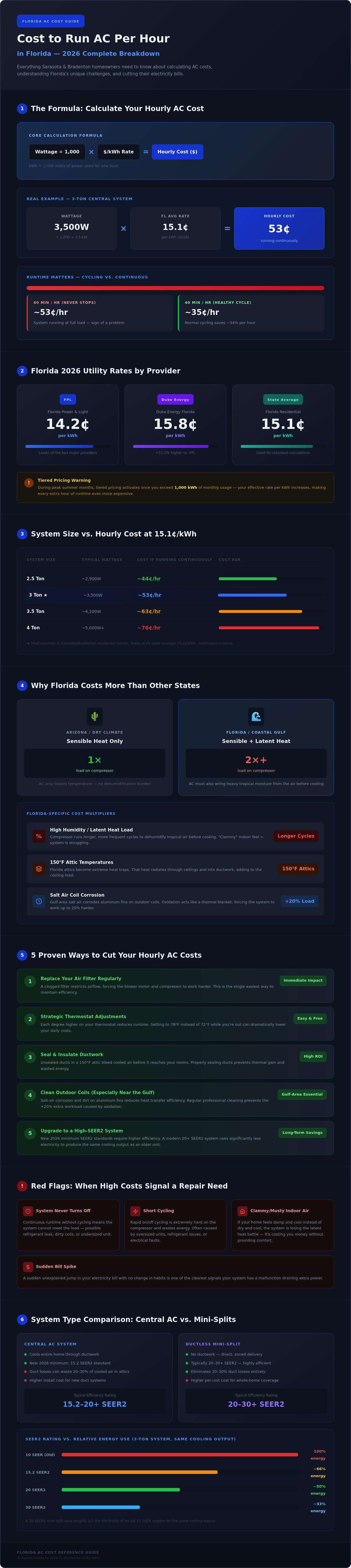
Calculating your cost to run ac per hour in florida isn't just about math; it's about peace of mind. When your system works hard to maintain your sanctuary, you deserve to know exactly where your money goes. The basic formula is straightforward: divide your unit's wattage by 1,000 to get kilowatts, then multiply that by your local utility rate. A kWh rate is the price paid for 1,000 watts of power used for one hour. This simple calculation reveals the direct impact your thermostat settings have on your monthly budget.
Understanding Your System's Tonnage and Wattage
Most residential systems in Sarasota and Bradenton range between 2.5 and 4 tons. You can find your tonnage by checking the model number on the outdoor condenser's nameplate. Look for a two-digit number divisible by 12; for example, "36" indicates 36,000 BTUs, which equals a 3-ton unit. A typical 3-ton central system draws about 3,500 watts, while a 4-ton unit can pull 5,000 watts or more. Understanding how air conditioning works helps you realize that older, less efficient units draw significantly more power to achieve the same cooling effect as modern SEER2 systems. Precision in these numbers is the difference between a rough guess and a BulletProof budget.
Florida Utility Rates in 2026
In 2026, Florida remains a regulated market where your provider is determined by your zip code. Florida Power & Light (FPL) customers currently see an average residential rate of roughly 14.2¢/kWh. If you live in a Duke Energy Florida service area, your rate is approximately 15.8¢/kWh. These figures include the base rate, fuel charges, and taxes that appear on your monthly statement. During peak summer months, tiered pricing can kick in. This means your cost to run ac per hour in florida actually increases once you exceed a certain threshold of energy use, usually 1,000 kWh. Monitoring these tiers is essential for avoiding surprise spikes in your bill.
It's vital to distinguish between "on" time and "cycling" time. Your AC shouldn't run at full capacity 24/7. If a 3-ton unit runs continuously for one hour at the state average of 15.1¢/kWh, it costs about 53 cents. However, a healthy, well-maintained system cycles on and off to maintain temperature. If it only runs for 40 minutes out of the hour, your actual hourly expense drops significantly. If your system never stops running, it's a clear signal that your home's comfort and your wallet are under unnecessary stress.
Why Florida Costs More: Humidity and the Heat Index
A 90-degree day in Sarasota hits your wallet much harder than the same temperature in a dry climate like Arizona. In the desert, your air conditioner only tackles "sensible heat," which is the temperature you read on a standard thermometer. In Florida, your system battles "latent heat." This is the heavy, energy-dense moisture trapped in our tropical air. Your AC must wring the water out of the air before it can effectively lower the temperature. This massive dehumidification task forces your compressor to run longer, more frequent cycles, which significantly inflates the cost to run ac per hour in florida.
For residents in Sarasota and Bradenton, the proximity to the Gulf adds another layer of expense. Salt air is highly corrosive. It eventually eats away at the delicate aluminum fins on your outdoor coils. This creates a layer of oxidation that acts like a thermal blanket, preventing efficient heat transfer. When your coils are corroded, the system might work 20% harder just to move the same amount of heat. Keeping these components clean and protected is the only way to ensure your system remains durable against the salty breeze.
The Cost of Dehumidification
Your air conditioner is essentially a high-powered dehumidifier for your home sanctuary. Removing water vapor from the air requires an immense amount of energy because the system must condense that vapor into liquid. According to data on air conditioning energy consumption, cooling and dehumidifying account for a massive portion of a home's total electricity use in humid regions. If you notice your home feels "clammy" or smells musty even when the air is cool, your system is likely struggling with the latent heat load. This struggle leads to "short cycling" or constant running, both of which drain your bank account.
Thermal Gain and Florida Home Construction
The environment outside isn't your only enemy. Florida attics are notorious heat traps where temperatures regularly climb to 150 degrees. This extreme heat radiates through your ceiling and warms the air inside your ducts. If your ductwork isn't sealed with precision, you're literally paying to cool the unconditioned space under your roof. High-quality insulation and radiant barriers are essential tools to keep that attic heat from driving up your hourly bill. If you suspect your system is running too long without reaching the set temperature, it might be time for a professional inspection of your cooling efficiency to stop the energy drain and restore your peace of mind.
Central AC vs. Mini-Splits: Comparing Hourly Operating Costs
Choosing between a central air system and a ductless mini-split is a decision that impacts your monthly budget for years. A modern 16 SEER2 central system is significantly more efficient than units built just a decade ago. However, the cost to run ac per hour in florida drops even further when you switch to variable-speed technology. Unlike traditional single-stage compressors that blast on at 100% power, variable-speed systems ramp up and down with precision. This avoids the "hard starts" that consume massive amounts of electricity and put unnecessary strain on your equipment's durability.
Don't be fooled by the low price tag of window units. While they seem like a quick fix, they are often the most expensive way to cool a Florida home. They lack the insulation and dehumidification power of a professional system. Because they struggle to seal against the window frame, they let in hot, humid air, forcing the small compressor to run indefinitely. This makes their hourly operating cost disproportionately high compared to a whole-home solution that maintains your sanctuary efficiently.
The SEER2 Advantage in 2026
SEER2 is the new gold standard for measuring efficiency under real-world conditions. As of 2026, Florida law requires a minimum SEER2 rating of 15.2 for new split-system installations. Upgrading from an old SEER 10 unit to a high-efficiency SEER2 18 system can slash your hourly cooling costs by nearly 50%. Achieving these savings requires more than just good equipment. A professional AC installation Sarasota FL ensures your system is sized correctly and your ductwork is airtight. This is critical for hitting those efficiency targets and protecting your home from the intense Gulf Coast heat.
Zoned Cooling and Mini-Split Efficiency
Ductless mini-splits offer a massive advantage through zoned cooling. A typical central air handler pulls between 3,000 and 5,000 watts to cool an entire house. In contrast, a single mini-split head usually draws between 800 and 2,000 watts. If you spend most of your time in a home office or master bedroom, cooling only that specific zone dramatically reduces your total hourly draw. For many Southwest Florida homeowners, a hybrid approach works best. You can use a central system for the main living areas and mini-splits for additions or bedrooms. This creates a durable and cost-effective cooling strategy that keeps your cost to run ac per hour in florida as low as possible.
5 Proven Ways to Reduce Your AC Running Costs Today
Lowering your cost to run ac per hour in florida doesn't always require a brand-new system. Small, strategic changes to your daily habits can lead to significant savings. Start with your thermostat. For every degree you raise the temperature, you can save between 1% and 3% on your cooling costs. If you typically keep your home sanctuary at 72 degrees, try 75. You might find that with the right air circulation, you don't feel the difference, but your wallet certainly will. Ceiling fans are your best friend here. They use a fraction of the energy of a compressor and create a wind-chill effect that makes a room feel up to four degrees cooler. Just remember: fans cool people, not rooms. Turn them off when you leave to avoid wasting electricity.
Smart thermostats are another essential tool for the modern Florida homeowner. These devices optimize run times by learning your schedule and avoiding peak utility rates when possible. They also provide precision control over dehumidification. By using a dehumidification mode, your system can focus on removing moisture without drastically lowering the temperature, which often feels more comfortable and costs less than traditional cooling. Consistency is key. The "set it and forget it" method is usually more efficient than making wild adjustments throughout the day.
Maintenance: The Secret to Low Hourly Costs
Neglecting your system is the fastest way to drive up your monthly bill. Dirty condenser coils are a major culprit; they can increase your system's power consumption by up to 30% because the unit can't shed heat effectively. A well-maintained system uses less amperage to achieve the same cooling output. This is why a professional HVAC maintenance plan is a strategic investment rather than an expense. Regular precision tuning ensures that every component, from the blower motor to the compressor, operates at peak efficiency. This prevents the "vampire" power draws that happen when a system struggles to keep up with the Sarasota heat.
Thermostat Strategies for the Florida Summer
Many people believe turning the AC off when they leave for work saves money. In Florida, this is a myth that can backfire. When you turn the system off, your home's thermal mass and humidity levels spike. When you return and flip the switch, your AC must work at maximum capacity for hours to "recover" the space. It's much more efficient to raise the temperature by 5 to 7 degrees while you're away. This keeps humidity under control and prevents your cost to run ac per hour in florida from skyrocketing during a long recovery cycle. To ensure your system is running at its absolute best, schedule a professional efficiency audit today and start protecting your sanctuary.
When High Hourly Costs Signal a Need for Repair
A system that "works" isn't necessarily a system that's efficient. Many Sarasota homeowners find themselves in a state of distress when they realize their unit is cooling but their electric bill is doubling. This is often the result of "vampire" power draws. When components like capacitors or fan motors begin to fail, they often pull significantly more amperage than they were designed for. This hidden drain quietly inflates your cost to run ac per hour in florida without providing any extra comfort. If you hear buzzing, clicking, or grinding from your outdoor unit, your system is crying out for professional attention.
If your AC never turns off, you're facing a critical red flag. In the intense Florida heat, a system that runs 24/7 is either undersized, low on refrigerant, or suffering from a mechanical failure. This constant operation is the fastest way to destroy your equipment's durability. You need a professional Sarasota AC repair to diagnose the root cause before the compressor fails entirely. It's about protecting your sanctuary from both the heat and the financial strain of a runaway power bill. Don't wait for a total breakdown to address a system that won't cycle off.
Warning Signs of Inefficiency
Look for the subtle clues that your system is struggling. Short-cycling, where the unit turns on and off every few minutes, is incredibly expensive. Every time a motor starts, it uses a surge of electricity that far exceeds its normal running wattage. This stop-and-go operation spikes your "demand" charges and wears out components prematurely. Uneven cooling is another symptom to watch for. If your master bedroom stays five degrees warmer than your kitchen, your ductwork might be leaking. You're effectively paying to cool the humid air in your attic. These problems don't fix themselves; they only get more expensive as the cost to run ac per hour in florida continues to climb with every wasted watt.
The BulletProof Solution for Florida Homeowners
BulletProof Air provides the definitive resolution to these high-stress situations. Our expert technicians use precision tools to find hidden energy leaks and mechanical friction that generic services miss. We focus on restoring your system to its peak performance, ensuring it uses the absolute minimum power required to maintain your comfort. There is a tipping point where the hourly cost of maintaining an old, failing unit simply justifies a replacement. If your system is over 12 years old and requires frequent repairs, a new SEER2 installation is a smart investment in long-term peace of mind. Contact BulletProof Air for an efficiency audit today and let us secure your home's comfort and your financial sanctuary.
Secure Your Comfort and Your Wallet
You now have the definitive tools to calculate your exact expenses and identify why the Florida climate is so demanding on your HVAC system. From mastering the SEER2 advantage to implementing smart thermostat strategies, you can take direct action to lower your monthly bills. Managing the cost to run ac per hour in florida is a continuous process of precision and care. Your air conditioner is the heart of your home sanctuary. Keeping it in peak condition isn't just about saving money; it's about ensuring your family's safety during the most intense heat waves.
Our expert technicians serve the Sarasota and Bradenton communities with a focus on durability and rapid response. Whether you need an urgent fix or a precision-focused maintenance plan, we are ready to help. We provide 24/7 emergency response for system failures to ensure you are never left in distress. Restore your home sanctuary; Schedule a BulletProof efficiency check today! Taking this simple step now will provide long-term peace of mind and keep your cooling costs under control for years to come.
Frequently Asked Questions
Is it cheaper to leave the AC on all day in Florida?
It's usually more cost-effective to leave your system on but at a slightly higher temperature while you're away. Turning it off completely allows humidity to saturate your home's thermal mass. When you return, the unit must run at full capacity for hours to recover. This long cycle spikes your cost to run ac per hour in florida. Aim for a 5 to 7-degree setback rather than a total shutdown to protect your sanctuary.
How much does a 3-ton AC unit cost to run per hour?
A typical 3-ton system uses approximately 3.5 kilowatts per hour of continuous operation. Based on the 2026 Florida average residential rate of 15.1¢/kWh, this equates to roughly 53 cents per hour. Your actual expense depends on your specific utility provider, such as FPL or Duke Energy. Keep in mind that a well-maintained system cycles off once it reaches the set temperature, lowering your total monthly expenditure compared to a unit that runs non-stop.
Does a higher SEER2 rating really lower my hourly electric bill?
Yes, a higher SEER2 rating significantly reduces your hourly power consumption. SEER2 measures how much cooling a system provides per watt of electricity used under real-world conditions. For example, upgrading from an old SEER 10 unit to a modern 18 SEER2 system can cut your electricity usage by nearly half. This efficiency is critical in the Southwest Florida climate, where systems face extreme heat and humidity for most of the year.
Why is my AC running for 20 hours a day in the summer?
Your AC runs for extended periods when it cannot remove heat fast enough to satisfy the thermostat. This often happens due to low refrigerant levels, dirty condenser coils, or failing ductwork. Florida's intense humidity also adds a massive "latent heat" load that requires longer cycles to manage. If your system runs for 20 hours a day, it's a major red flag for mechanical distress. You need a professional technician to diagnose hidden energy leaks immediately.
How much does humidity add to my air conditioning costs?
Humidity can account for a significant portion of your total cooling load. Your system doesn't just cool the air; it must condense water vapor into liquid to make the home feel comfortable. This process requires massive energy. High humidity levels force the compressor to work harder and run longer cycles. Without effective dehumidification, you'll likely lower the thermostat even further to compensate for the "clammy" feeling, which drives up your cost to run ac per hour in florida even more.
Can a dirty air filter actually increase my hourly running cost?
A dirty air filter is one of the most common causes of high utility bills. It restricts airflow, forcing the blower motor to work harder and use more amperage. When air can't move freely, the cooling cycles last longer to reach your desired temperature. This unnecessary strain can lead to frozen coils or a total system breakdown. Changing your filter every 30 days is the simplest way to maintain the durability and efficiency of your unit.
What is the most efficient temperature to set my AC at in Florida?
Most energy experts recommend setting your thermostat to 78 degrees when you are home. This provides a balance between comfort and manageable energy consumption. For every degree you raise the temperature above 72, you can save between 1% and 3% on your cooling expenses. If 78 feels too warm, try using a ceiling fan to create a wind-chill effect. This allows you to feel comfortable at higher temperatures while keeping your hourly costs as low as possible.
Should I use a ceiling fan while the AC is running to save money?
You should definitely use ceiling fans, but only in occupied rooms. Fans don't lower the room temperature; they cool people by evaporating moisture from the skin. This effect allows you to raise your thermostat by about 4 degrees without losing comfort. This strategic adjustment reduces the workload on your AC compressor. Just remember that fans use electricity too. Turn them off when you leave the room to ensure you are actually achieving a net savings on your bill.