

Florida Landlord AC Repair: 2026 Legal & Practical Guide
Imagine waking up at 2:00 AM drenched in sweat because your bedroom has hit a sweltering 90 degrees. You reach for the thermostat, but the screen is blank. In the intense Florida heat, your home can transform from a sanctuary into a furnace in just a few hours. It's a high-stress situation that affects your safety and well-being, not just your comfort.
We agree that you shouldn't have to suffer through a mechanical failure while wondering who's going to pay for the fix. Navigating the legalities of landlord responsibility for ac repair florida is often frustrating when you're dealing with vague legal language and rising indoor temperatures. You deserve a fast, dependable resolution that restores your peace of mind and your home's climate.
This 2026 guide provides the clarity you need to handle cooling emergencies with confidence. You'll learn the exact legal triggers for repairs under Florida Statute 83.51, the critical importance of written notice, and how to ensure a professional repair happens before the heat becomes a health risk. We'll walk you through your rights and the practical steps to get your system back online quickly and correctly.
Key Takeaways
- Master the specifics of Florida Statute 83.51 to understand why landlords must maintain any AC unit provided at the start of a lease.
- Identify the technical line between mechanical wear and tenant negligence to clarify landlord responsibility for ac repair florida and who pays the bill.
- Learn why a formal 7-day written notice is the essential legal trigger to start the repair clock and how to define emergency cooling standards.
- Follow a professional step-by-step response plan to troubleshoot immediate failures and document the situation for a fast, legal resolution.
- Discover how proactive maintenance plans safeguard rental investments and prevent the high costs of sudden, high-temperature system breakdowns.
Florida Rental Laws: Is Air Conditioning a Legal Requirement?
Florida heat isn't just uncomfortable; it's dangerous. In 2026, with temperatures regularly hitting record highs, a broken AC unit turns a rental into a health hazard. It's a high-stakes situation for both parties. While many states have clear mandates for heating, Florida's legal landscape for cooling is more nuanced. You need to know exactly where you stand before the mercury climbs any higher.
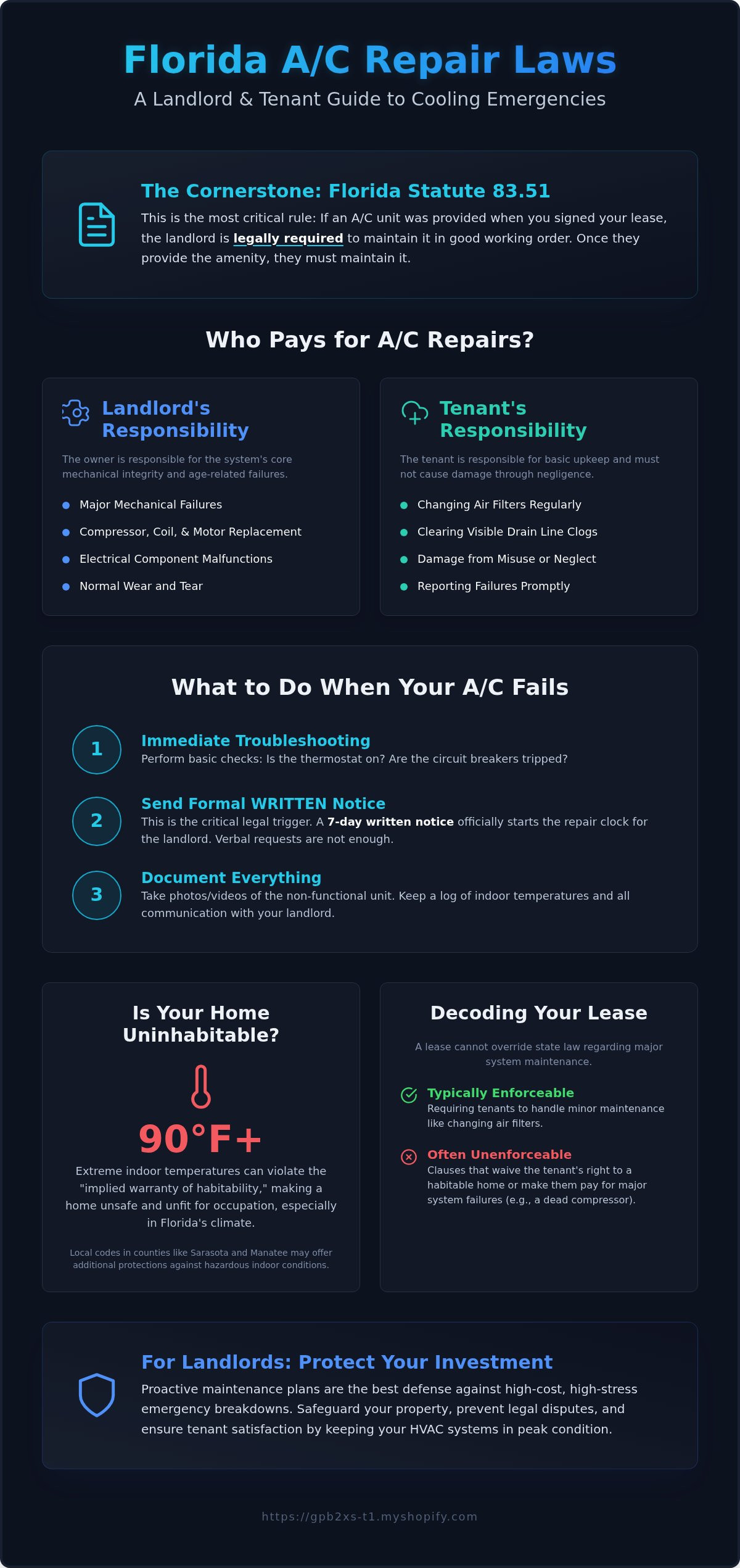
Under Florida Statute 83.51, the law doesn't strictly force a landlord to install an air conditioner before renting a unit. However, the "If Provided" rule is the cornerstone of landlord responsibility for ac repair florida. If an AC unit was in the home when you signed your lease, the landlord is legally bound to keep it running. Once they provide the amenity, they must maintain it. This applies whether you're in a high-rise in Sarasota or a single-family home in Bradenton.
Local codes in Sarasota and Manatee counties often emphasize safety and structural integrity. If a non-functional unit leads to secondary issues like mold growth or internal temperatures that exceed local safety standards, the landlord may be in violation of county housing codes. These local rules can sometimes offer more protection than state law alone, especially when a mechanical failure threatens the building's safety.
The Florida Residential Landlord and Tenant Act Explained
The core of the state's rental law focuses on keeping a property livable. When the heat inside a home reaches triple digits, it touches upon the implied warranty of habitability. This legal principle suggests a property must be fit for human occupation. In our local climate, "fit" almost always means "cool." Landlords are obligated to comply with all building, housing, and health codes. Florida Statute 83.51 mandates that landlords maintain all facilities and appliances supplied by the landlord in good working condition, which includes the air conditioning system if it was present when the tenant moved in.
When the Lease Overrides General Law
Lease agreements can sometimes be confusing or intentionally vague. A landlord might try to include an "as-is" clause or a waiver for HVAC repairs. In Florida, these are often legally shaky. If the landlord provided the system, they generally cannot contract away their duty to fix major mechanical failures like a dead compressor or a refrigerant leak. Understanding landlord responsibility for ac repair florida means knowing that a lease cannot override the basic requirement to maintain supplied appliances in good working order.
- Minor Maintenance: The lease can legally require tenants to handle simple tasks like changing air filters or clearing a visible drain line clog.
- Major Repairs: Replacing motors, coils, or entire systems remains the landlord's financial and legal burden.
- Invalid Clauses: Any clause that asks a tenant to waive their right to a habitable home is typically unenforceable in a Florida court.
Don't let a confusing lease document trick you into paying for a system you don't own. If the equipment was there on day one, the responsibility to keep it running stays with the owner.
Landlord vs. Tenant: Who Pays for the AC Repair?
Determining exactly who pays for a cooling failure often creates friction during a Southwest Florida summer. Clear communication is the best way to prevent a stressful situation from turning into a legal battle. Understanding the specific Florida Residential Landlord and Tenant Act is vital for both parties. Generally, the financial burden falls on the property owner unless the failure resulted from tenant misuse or neglect. This technical distinction is where most disputes begin.
The core of landlord responsibility for ac repair florida centers on mechanical integrity. If a compressor dies or an electrical component fries due to age, the owner must cover the fix. However, tenants have a duty to perform basic maintenance that keeps the system running. When a unit fails, you need an objective expert to identify the root cause immediately. A professional diagnosis from BulletProof Air provides the clarity needed to settle disputes and restore your home's comfort.
Common Landlord Responsibilities
Landlords are responsible for the structural and mechanical components of the property. This includes the major HVAC parts that naturally degrade over time. If a refrigerant leak develops in an aging coil or a fan motor burns out after years of service, that is a landlord expense. As of 2026, new installations in Florida must meet a minimum SEER2 rating of 15. Landlords must also ensure the system is sized correctly for the space. If a system failure leads to indoor air quality issues or mold, the owner is responsible for remediation.
When the Tenant Is Liable
Tenant liability usually stems from a failure to perform basic upkeep or from direct physical damage. Neglecting simple tasks can lead to massive repair bills. Consider these common scenarios where a tenant might be held responsible:
- Filter Neglect: Failing to change air filters every 30 to 90 days can choke the system, leading to frozen coils or a burnt-out blower motor.
- Physical Damage: Striking the outdoor condenser unit with a lawnmower or damaging the thermostat through rough use.
- Failure to Report: Ignoring a small, visible leak that eventually causes major water damage to the floors or walls.
Disputes often arise because neither side has the technical expertise to prove how a system failed. Our technicians act as neutral experts. We determine if a part failed because of its lifespan or because it was forced to work through a clogged filter for months. Clear documentation from an expert helps resolve arguments fast. If you're facing a cooling crisis, schedule an HVAC repair to get an authoritative diagnosis immediately.
Defining "Reasonable Time" for AC Repairs in the Florida Heat
The phrase "reasonable time" is perhaps the most debated term regarding landlord responsibility for ac repair florida. While Florida Statute 83.56 provides a general seven-day window for landlords to begin repairs after receiving written notice, the reality of a Sarasota summer demands much faster action. In our climate, a week without cooling isn't just an inconvenience. It's a period where indoor temperatures can easily climb into the 90s, creating a dangerous environment for anyone inside.
Industry standards in Southwest Florida are much stricter than the legal minimums. Most professional property managers and reputable service providers aim to resolve cooling failures within 24 to 48 hours. This rapid response protects the property from high-humidity issues like mold growth and ensures the safety of the residents. If your landlord is dragging their feet, you need to know how to escalate the situation legally and effectively.
Is No AC Considered a Legal Emergency?
While Florida law doesn't explicitly categorize every AC failure as an "emergency," the health risks associated with extreme heat are undeniable. Heat exhaustion and heatstroke are serious threats, particularly for vulnerable populations like the elderly or young children. When indoor temperatures exceed the 80 degree threshold, the home stops being a protected sanctuary and becomes a liability. The combination of high heat and Gulf Coast humidity makes a rapid AC repair an immediate priority for maintaining basic human safety.
The 7-Day Notice of Noncompliance
If a landlord fails to act, the legal clock only officially starts when you deliver a formal 7-Day Notice of Noncompliance. This document must be in writing; a text message or a phone call usually won't hold up in court. According to the Florida Renters Rights Guide, this notice informs the landlord that they're in breach of the lease. If the issue isn't addressed within those seven days, you may have the right to terminate the lease or seek a court-ordered rent reduction.
- Document Everything: Take photos of your thermostat showing the indoor temperature at different times of the day.
- Legitimate Delays: Be aware that parts backorders or peak-season technician shortages can legitimately slow down a fix, but the landlord must show they're actively working on the solution.
- Avoid "Repair and Deduct": Florida law is very restrictive regarding tenants paying for repairs and withholding that amount from rent. Doing this without a court's approval can put you at risk for eviction.
Communication is your best tool. Keep a log of every interaction, including the time and date of your requests and any promises made by the property owner. This documentation is vital if the situation requires legal intervention or a formal dispute resolution.
What to Do When the AC Breaks: A Step-by-Step Response Plan
When the cooling stops, your first priority is stopping the temperature from rising further. It's easy to panic when the heat hits, but a structured approach ensures you get results without damaging your legal standing. You must balance immediate troubleshooting with formal communication to protect your rights and your health. If you follow a clear plan, you'll move from a sweltering house to a cool sanctuary much faster.
Step 1: Verify the Issue and Notify
Before calling your landlord, perform three quick checks. First, verify the circuit breaker hasn't tripped. Second, ensure your thermostat has fresh batteries and is set to "cool." Third, check the outdoor unit for visible obstructions like overgrown weeds or debris. If these basic steps don't solve the problem, you need a professional diagnostic from air conditioning repair close to me to identify the exact mechanical failure.
Once you've confirmed a breakdown, notify the landlord immediately. While a quick text is good for speed, always follow it up with a professional email or certified letter. Clearly state the current indoor temperature and any health concerns for residents. This paper trail is essential because landlord responsibility for ac repair florida is often determined by the timing and clarity of your initial report. Don't wait until the house is 90 degrees to make your first formal request.
Step 2: Legal Escalation
If 24 to 48 hours pass without a meaningful response or a scheduled technician, it's time to move from friendly reminders to formal action. Drafting a 7-Day Notice of Noncompliance is your primary legal tool. This document tells the landlord that the lease is being breached. If the home becomes truly uninhabitable, which often happens when indoor temperatures exceed the 80 degree threshold for extended periods, you may need to discuss temporary housing options or rent abatement.
Check your renter's insurance policy, as many include "loss of use" coverage that helps pay for a hotel during major system failures. For low-income residents in Sarasota or Bradenton, organizations like Gulfcoast Legal Services offer guidance on navigating these disputes safely. While you wait for a fix, use portable fans or window units to mitigate the heat, but don't perform any permanent repairs yourself. Documenting every step of this process protects you if the dispute moves to a local court.
Don't let a slow response turn into a heat-related health crisis. If you need a definitive report to prove the system has failed and requires immediate attention, reach out to our team for a fast HVAC emergency service today.
Protecting Your Rental Investment with BulletProof Air
Owning rental property in Southwest Florida is a high-stakes investment. When the mercury rises, your HVAC system is the only thing standing between a profitable quarter and a legal nightmare. You've already learned that landlord responsibility for ac repair florida is a serious legal obligation. However, the most successful landlords don't just wait for a breakdown to occur. They take proactive steps to ensure their property remains a cool, safe sanctuary for their tenants year-round.
Precision maintenance isn't just a suggestion; it's a financial shield. By catching a failing capacitor or a clogged drain line before it causes a total system shutdown, you avoid the high costs of emergency service calls during a heatwave. This proactive approach also creates a documented history of care. If a dispute ever arises over tenant negligence versus mechanical wear, your maintenance records serve as definitive proof of your commitment to property habitability.
The Landlord’s Guide to HVAC Maintenance Plans
Biannual tune-ups are your best defense against legal disputes and unexpected capital expenditures. In our local climate, systems work twice as hard as those in northern states. Regular inspections ensure your equipment meets the 2026 SEER2 efficiency standards, which keeps utility bills lower and reduces strain on the compressor. For more detailed advice on keeping your system running at peak performance, check out our guide on AC repair in SW Florida.
Precision maintenance extends the life of your cooling systems by years. We focus on deep-cleaning coils, calibrating thermostats, and testing electrical connections. This level of detail prevents the small issues that lead to catastrophic failures. When you prioritize the health of your HVAC system, you're protecting your bottom line and fulfilling your landlord responsibility for ac repair florida with total confidence.
Choosing a Reliable HVAC Partner
Fast response times are critical for property managers in Sarasota and Bradenton. When a tenant calls at midnight because the air has stopped, you need a partner who treats the situation with the urgency it deserves. BulletProof Air acts as a dependable first responder for your property portfolio. We understand that a service failure isn't just an inconvenience; it's a threat to the sanctuary of the home.
We provide clear, honest communication and definitive recommendations. Our technicians diagnose the root cause of failures with total accuracy, eliminating the need for follow-up visits. This reliability builds trust with your tenants and ensures your property remains a safe, comfortable environment. Don't wait for the next heatwave to test your system's resilience. Schedule a BulletProof inspection for your rental today!
Take Control of Your Home's Climate and Comfort
Navigating the legal landscape of a rental cooling failure doesn't have to be overwhelming. You now understand that landlord responsibility for ac repair florida is clearly defined under Statute 83.51; if the system was there when you moved in, the owner must keep it running. By using formal written notices and documenting indoor temperatures, you can ensure a fast resolution even during the most intense heatwaves. Proactive maintenance remains the best way for landlords to avoid liability and for tenants to keep their sanctuary protected from the elements.
As emergency repair experts in Sarasota and Bradenton, we understand the unique climate challenges of Southwest Florida. We're highly experienced with the specific HVAC requirements for rental properties and act with the urgency your situation demands. Don't suffer through another sweltering night. Restore your peace of mind and your home's comfort with a team that values precision and speed.
Get Fast, Reliable AC Repair for Your Sarasota Rental and return to the cool, safe environment you deserve.
Frequently Asked Questions
Can I stop paying rent if my AC is broken in Florida?
No, you cannot simply stop paying rent without risking eviction. Florida law requires a specific legal procedure before you can withhold any funds. You must first provide your landlord with a formal seven day written notice of noncompliance. If the landlord fails to act within that window, you might have legal grounds to withhold rent, but it's often safer to deposit the money into a court registry to protect your tenancy.
How long can a landlord leave you without AC in Florida?
Landlords have seven days to begin reasonable repairs after they receive a formal written notice from the tenant. While the law provides this one week window, the extreme heat in Sarasota and Bradenton often makes a 24 to 48 hour response the industry standard for safety. Remember that the legal clock only starts with a physical written notice; a phone call or text message doesn't officially trigger the statutory repair period.
Does a landlord have to provide a portable AC unit if the central air is out?
No, Florida law does not specifically mandate that a landlord provide portable units or window air conditioners while central air is being repaired. However, providing temporary cooling is a common practice for proactive property managers to maintain habitability and tenant safety. If the home becomes truly dangerous due to high heat, the landlord might be liable for temporary housing costs instead of providing a portable unit.
What is the maximum indoor temperature allowed in a Florida rental?
There is currently no statewide law in Florida that sets a specific maximum indoor temperature. A proposed bill in late 2025 that would have capped temperatures at 82 degrees was withdrawn and never became law. However, extreme heat that threatens your health can still be considered a violation of the implied warranty of habitability. Local housing codes in Sarasota County may also have specific safety requirements regarding livable conditions.
Can a tenant be evicted for complaining about a broken AC?
No, Florida Statute 83.64 protects you from retaliatory eviction. If you've made a good faith complaint about landlord responsibility for ac repair florida, the owner cannot legally evict you or decrease your services in response. If you face retaliation after submitting a formal notice, you should document all communications and contact a legal aid organization in Southwest Florida immediately to protect your rights as a renter.
Who is responsible for AC refrigerant refills in a rental?
The landlord is generally responsible for refrigerant refills because a low level almost always indicates a leak in the system's mechanical components. Recharging a system is part of major mechanical maintenance, not routine tenant upkeep. Unless the landlord can prove that you caused direct physical damage to the coils or lines, the cost of the refrigerant and the necessary leak repair falls on the property owner.
Is a landlord responsible for AC repair if the tenant broke it?
No, the landlord is not financially responsible for repairs if the damage was caused by your misuse or neglect. If a tenant strikes the outdoor condenser with a vehicle or fails to change filters for several months, leading to a system failure, the repair bill is usually the tenant's burden. Our technicians can provide an objective diagnostic report to determine if the failure was due to equipment age or improper operation.
If you would like maintenance or repair assistance with your Florida Air Conditioner, contact BulletProof Air Or call: 941.599.9999 for more information about how we can help.