

Justifying an HVAC Upgrade to a Building Owner: The 2026 ROI Guide
What if your building's most expensive mechanical headache was actually your greatest opportunity for revenue protection? By mid-2026, the gap between "patching it up" and "powering up" will determine which properties thrive and which ones face a vacancy crisis. Justifying an HVAC upgrade to a building owner is no longer about fixing a broken machine; it's about defending the building's status as a comfortable sanctuary. We know the stress of managing tenant complaints about Sarasota's oppressive humidity while watching emergency repair costs drain your annual budget.
You're right to feel that the current "run-to-fail" approach is a gamble you can't afford to take. This guide gives you the tools to transform a costly capital expense into a strategic, data-driven investment. We'll show you how to beat the June 30, 2026, repeal of the Section 179D deduction and navigate the mandatory shift to A2L refrigerants. You'll learn how the 14% energy savings from ASHRAE 90.1-2022 standards can pay for the system itself. We'll preview how precision installation and high-durability equipment eliminate the need for follow-up visits and protect your property's long-term value.
Key Takeaways
- Identify "Zombie Systems" that appear functional while silently consuming 40% more energy than modern, high-efficiency alternatives.
- Build a compelling business case for justifying hvac upgrade to a building owner by leveraging the latest 2026 SEER2 minimums and energy performance standards.
- Understand how transforming your property into a climate-controlled sanctuary through superior Indoor Air Quality (IAQ) drastically reduces tenant turnover.
- Implement a precision building assessment and phased installation plan to replace equipment with zero downtime during Florida's peak heat.
- Learn why high-durability, salt-air resistant systems are the only way to protect your long-term investment in the Sarasota and Bradenton coastal environment.
Quantifying the Cost of Inaction: The 'Zombie System' Trap
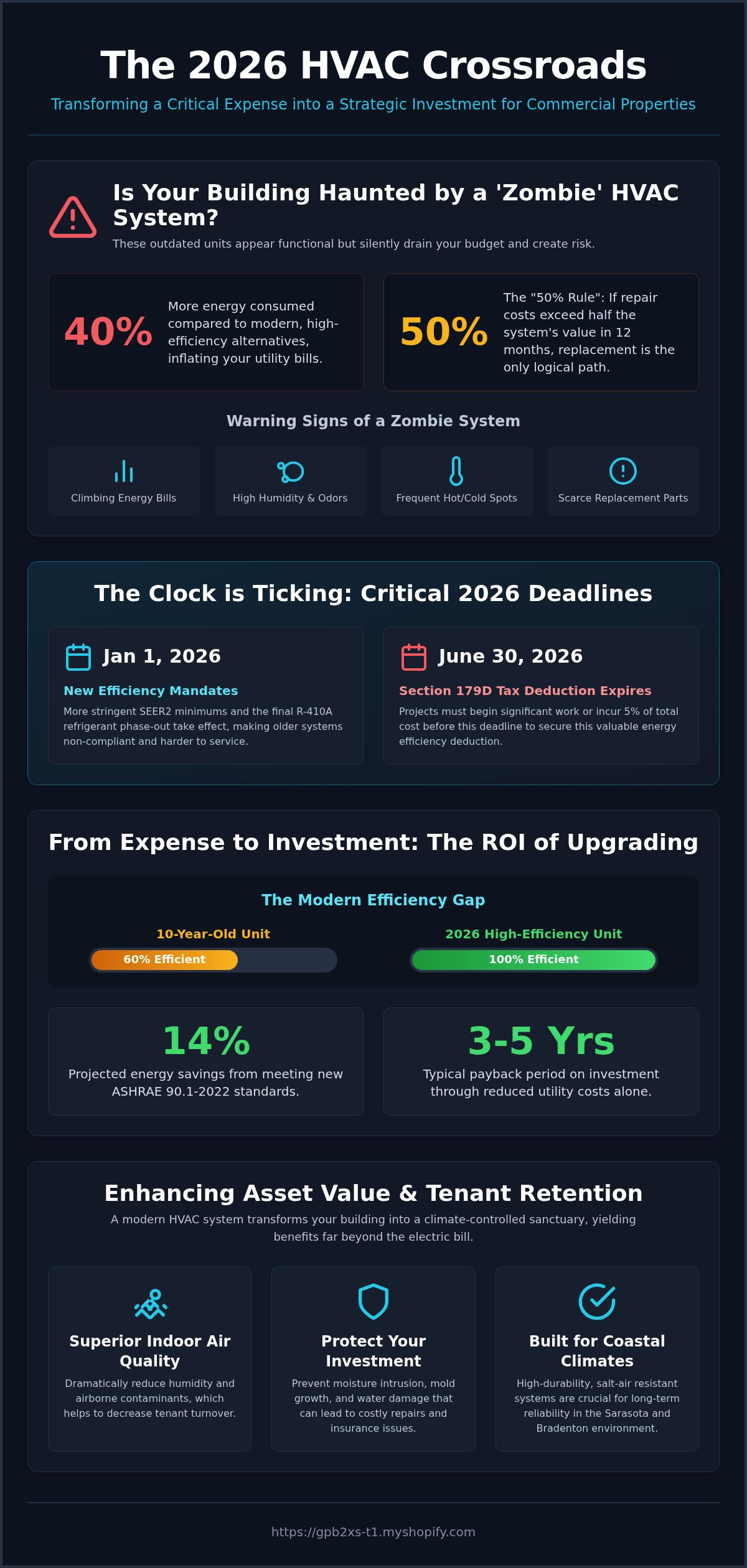
Many commercial properties in Sarasota and Bradenton are haunted by "Zombie Systems." These are HVAC systems that technically turn on every morning but are effectively dead to your balance sheet. While they continue to blow cold air, they often consume 40% more energy than modern alternatives. This invisible drain on resources makes justifying hvac upgrade to a building owner a matter of mathematical necessity rather than just comfort. You aren't just paying for a machine; you're paying for the waste it generates every hour it runs.
When assessing these units, we look for the "50% Rule." If a single repair or the cumulative maintenance costs over a rolling 12 month period exceed 50% of the system's total value, replacement is the only logical path forward. Continuing to patch a failing unit during a Florida July isn't just expensive; it's a gamble. Emergency repair fees skyrocket during peak heat, and the resulting downtime can force you to issue tenant credits or face the threat of lease terminations. Common signs your building is trapped by a Zombie System include:
- Energy bills that climb year-over-year despite steady occupancy.
- A noticeable increase in humidity and "musty" odors in common areas.
- Frequent "hot/cold" complaints that require manual thermostat overrides.
- Replacement parts that are increasingly difficult or slow to source.
The Escalating Maintenance Death Spiral
The financial trap tightens as older refrigerants become scarce and expensive. Every leak in an aged system represents a massive, recurring hit to the operating budget that offers zero long-term value. Beyond the invoices, consider the "distraction cost." Facility managers lose hours every week triaging tenant complaints and managing multiple repair visits. The Cost of Inaction is the sum of excess energy waste, emergency labor premiums, and lost tenant goodwill.
Impact on Building Insurance and Liability
In our local climate, a failing system is a direct invitation for moisture intrusion. High humidity leads to mold growth and water damage. These issues can spike your insurance premiums or even lead to coverage denials if the equipment is deemed past its useful life. Modern, high-durability systems act as a shield, maintaining the building as a protected sanctuary. Upgrading to precision-installed equipment significantly lowers the risk of catastrophic failure during a heatwave. This reliability is a key factor many insurers look for when underwriting commercial properties and assessing risk for justifying hvac upgrade to a building owner.
Financial ROI: 2026 Efficiency Standards and Energy Savings
The landscape for commercial energy efficiency shifted significantly on January 1, 2026. Florida building owners now face more stringent SEER2 minimums and the finality of the R-410A refrigerant phase-out. When justifying hvac upgrade to a building owner, the focus must remain on the widening delta between old technology and modern performance. A 10-year-old unit typically operates at roughly 60% of the efficiency of a 2026 high-efficiency heat pump. By investing in Energy-Efficient HVAC Systems, most Sarasota properties achieve a full payback on their investment in just 3 to 5 years through reduced utility costs alone. This isn't a speculative benefit; it's a calculated recovery of capital that would otherwise be wasted.
Maximizing the 179D Tax Deduction in 2026
Urgency is the defining factor for 2026 financial planning. The Section 179D Energy Efficient Commercial Buildings Deduction is scheduled for repeal for any projects beginning after June 30, 2026. To secure this deduction, owners must start significant physical work or incur at least 5% of the total project cost before this summer deadline. Professional commercial HVAC companies are essential partners in this process. They provide the precision energy modeling required to prove a building meets the ASHRAE 90.1-2022 standards. These updated standards are projected to provide 14% energy savings over the 2019 edition, making the tax benefit even more impactful when combined with 2026 inflation adjustments.
Operational Cost Reduction: Beyond the Electric Bill
True ROI extends far beyond the monthly electric bill. Modern variable-speed technology allows the system to scale its output to the exact needs of the building, which drastically reduces mechanical wear and tear. This precision extends the lifespan of the system and prevents the "start-stop" cycles that kill older compressors. Many owners are also prioritizing ESG (Environmental, Social, and Governance) goals to attract high-tier corporate tenants. A high-efficiency upgrade is the single most effective way to lower a building's carbon footprint. Additionally, smart sensors now enable predictive maintenance. These systems alert our technicians to minor calibration issues before they escalate into a $10,000 emergency failure. If you want to protect your asset's value, explore our commercial HVAC maintenance plans to ensure your new sanctuary remains efficient for years to come.
Enhancing Asset Value and Tenant Retention
In the competitive commercial corridors of Sarasota and Lakewood Ranch, a building's mechanical health is now a public-facing asset. By 2026, Indoor Air Quality (IAQ) has cemented its place as a top three priority for commercial tenants. They aren't just looking for a roof; they're looking for a productivity sanctuary. When you're justifying hvac upgrade to a building owner, you must frame the system as the heart of the building's environment. A well-cooled building is a sanctuary of focus. A failing one is a "Hot Zone" that drives high-value tenants toward your competitors. This environmental reliability is the foundation of a property's reputation.
High-efficiency buildings now command a "Green Premium," often achieving 10% to 15% higher lease rates compared to properties with aging, inefficient infrastructure. This isn't just about saving on electricity. It's about positioning the property as a premium, sustainable workspace that meets modern corporate standards. Modern HVAC systems allow for individualized tenant billing, ensuring that a high-usage retail tenant doesn't subsidize the low-usage office next door. This transparency builds trust and simplifies property management.
The Link Between Comfort and Lease Renewals
Tenant churn is the silent killer of property ROI. If a suite is humid or temperature inconsistent, tenants won't wait for the lease to expire before looking elsewhere. You can use a modern HVAC system as a powerful marketing tool to attract Grade A retail or office occupants who value precision and reliability. Comfort ROI is the value of a retained, satisfied tenant versus the devastating cost of a six-month vacancy and the subsequent build-out for a new occupant. Proactive upgrades eliminate the emergency failures that lead to "rent abatement" requests during a heatwave.
Smart Controls and Tenant Autonomy
Tenant expectations have evolved. They now demand the same level of control over their office suite as they have in their smart homes. Modern HVAC systems utilize app-based climate control for individual suites, allowing tenants to manage their own comfort levels. This autonomy doesn't just improve satisfaction; it slashes building-wide waste. Smart thermostats and sensors ensure you aren't wasting energy cooling unoccupied zones or storage closets. Integrating these systems into a Building Management System (BMS) allows for precision monitoring and rapid response. This level of oversight ensures your building remains a consistent sanctuary regardless of the intensity of the Florida sun. Justifying hvac upgrade to a building owner becomes simple when you show them how smart tech protects their bottom line from tenant turnover.
Planning the Upgrade: Minimal Disruption for Maximum Gain
Building owners often fear that a major mechanical overhaul will paralyze their daily operations. This perceived chaos is a primary barrier when justifying hvac upgrade to a building owner. However, a precision-planned execution replaces fear with confidence. We follow a four-step framework to ensure the transition is seamless. First, we conduct a precision building assessment to right-size the new system. Second, we develop a phased installation schedule that prioritizes off-peak or weekend work. Third, we provide an "Upgrade Roadmap" for tenants, framing the work as an investment in their comfort rather than an inconvenience. Finally, we execute the "BulletProof" swap. This is a high-speed, high-accuracy installation that eliminates the need for follow-up visits and ensures the system is operational when it matters most.
Execution speed is a hallmark of professional service. By coordinating logistics well in advance, we minimize the time a building spends without climate control. This proactive communication turns a potential source of tenant frustration into a reason for excitement. It shows occupants that the owner is dedicated to maintaining a high-performance workspace. If you're ready to secure your building's future, schedule a precision commercial assessment with our team today.
The 'Off-Season' Advantage in Florida
Timing is everything in the Southwest Florida climate. Sarasota's milder winter months offer a strategic "off-season" advantage for large-scale projects. Scheduling during this window prevents the "Emergency Premium" often associated with mid-summer failures when every contractor in the state is overbooked. It also allows for more flexible scheduling during tenant turnover periods. This proactive approach ensures the building remains a sanctuary before the first 90-degree day of May arrives. You save money on labor and avoid the stress of a total system collapse during peak heat.
Right-Sizing: Why Bigger Isn't Always Better
Many owners mistakenly believe that a larger unit provides better cooling. In our humid climate, an oversized system is a liability. It leads to short-cycling, where the unit turns on and off too rapidly. This prevents the system from properly dehumidifying the air, leaving the building damp and clammy. A new AC installation in Sarasota, FL requires specific load calculations that account for glass exposure, occupancy levels, and insulation. We also assess the existing ductwork to ensure it can handle the airflow of modern, high-efficiency equipment. Getting this precision right from the start is the only way to guarantee long-term durability and tenant satisfaction. Accurate right-sizing is a fundamental component of justifying hvac upgrade to a building owner because it directly impacts both the initial capital outlay and the long-term energy performance.
Selecting the Right Partner: The BulletProof Air Difference
Choosing the right mechanical partner is the final, most critical step in justifying hvac upgrade to a building owner. You can select the most advanced equipment on the market, but if the installation lacks precision, the investment will never reach its potential. BulletProof Air operates with the urgency and accuracy of a first responder. We don't just swap units; we restore the heart of your building's comfort sanctuary. Our technicians specialize in high-durability solutions designed specifically for the punishing Southwest Florida climate. We serve Sarasota, Bradenton, and Lakewood Ranch with a focus on speed that respects your business's need for zero downtime.
Our approach centers on creating a protected, high-performance environment. We understand that a mechanical failure in July isn't just a repair bill; it's a threat to your property's reputation and safety. By choosing BulletProof Air, you're securing a partner dedicated to eliminating the need for costly follow-up visits. We provide the technical authority needed to ensure your new system remains a reliable asset for its entire service life. Our goal is to provide a sense of calm and security through dependable mechanical performance.
Precision Installation to Protect the Warranty
Many owners don't realize that poor installation practices can immediately void manufacturer warranties. A system that isn't perfectly calibrated will work harder, consume more energy, and likely fail years before its time. BulletProof Air is committed to "Total Accuracy" on every visit. We use expert staging and rapid execution to minimize building downtime. This precision ensures that justifying hvac upgrade to a building owner includes the promise of a full, protected warranty and maximum equipment life. We get it right the first time so you can focus on your tenants.
Long-Term Resilience in a Salt-Air Environment
The coastal air in Sarasota and Bradenton is notoriously aggressive toward mechanical components. We specify equipment with specialized coastal-grade coatings to resist salt-air corrosion. This isn't an optional luxury in our region; it's a necessity for long-term resilience. Our commercial maintenance plans are engineered to protect your capital investment, ensuring the system hits its projected 15-year ROI target. We act as your dedicated partner in maintaining a safe, efficient building. If you're ready to transform your property's performance, contact BulletProof Air for a Commercial HVAC Assessment and let us build your definitive business case.
Secure Your Building's Future Performance
The transition from a "Zombie System" to a high-efficiency sanctuary is the most effective way to protect your commercial asset in 2026. By aligning with current SEER2 standards and leveraging tax incentives before the June deadline, you move from a cycle of distress to a position of strategic strength. Justifying hvac upgrade to a building owner is ultimately about proving that a high-performance environment is cheaper to maintain than a failing one.
Our team specializes in the unique climate challenges of Sarasota and Bradenton. We provide the rapid response and technical expertise needed to minimize tenant disruption while ensuring full compliance with new efficiency regulations. Don't wait for the next heatwave to force your hand. Precision installation and high-durability solutions are the only way to safeguard your property's long-term ROI. We are dedicated to restoring your building's status as a protected, efficient workspace.
Secure your building's sanctuary with a professional HVAC upgrade assessment from BulletProof Air.
Take control of your building's comfort and operational costs today.
Frequently Asked Questions
How do I calculate the ROI of a commercial HVAC upgrade?
Calculate ROI by subtracting the total project cost from the sum of annual energy savings, reduced maintenance expenses, and available tax incentives over the system's lifespan. Most Florida properties see a full payback within three to five years. Factoring in higher tenant retention and increased lease rates provides a more accurate long-term financial picture for your specific asset.
What are the 2026 SEER2 requirements for commercial buildings in Florida?
Commercial systems under 65,000 BTU/h must meet a minimum of 14.3 SEER2 according to the latest 2026 standards. Larger rooftop units are governed by the ASHRAE 90.1-2022 standards, which aim for a 14% increase in energy savings over previous editions. We verify these specific metrics during our precision building assessment to ensure your new system remains fully compliant.
Can an HVAC upgrade really increase my building's resale value?
Modern HVAC systems directly boost property appraisals by lowering Operating Expenses (OpEx) and improving the Net Operating Income (NOI). Buyers prioritize buildings with documented energy performance and modernized infrastructure. High-efficiency systems often lead to a 10% to 15% increase in lease rates, which significantly raises the overall market valuation of the asset during a professional sale.
What are the most common tenant complaints that signal a need for an upgrade?
Frequent "hot/cold" calls and complaints about high humidity or "musty" smells are the primary indicators of a failing system. When tenants start using desktop fans or space heaters, it proves the central system can't maintain a sanctuary environment. These complaints usually precede lease termination threats, making them critical data points when justifying hvac upgrade to a building owner.
Are there tax incentives for commercial HVAC upgrades in 2026?
The Section 179D deduction is a primary incentive, offering significant per-square-foot deductions for projects that meet ASHRAE 90.1-2022 standards. You must begin significant physical work or incur 5% of the project cost by the June 30, 2026, deadline to qualify. We help document these energy savings to ensure your project captures the maximum available benefit before these federal provisions expire.
How long does a typical commercial HVAC installation take?
Most commercial installations take between three to five days depending on the complexity of the building's infrastructure. We use a phased approach and off-peak scheduling to minimize disruption to your operations. Our "BulletProof" staging process ensures that the actual equipment swap happens rapidly, often restoring full climate control within a single weekend window to protect your tenants.
What happens if we only replace the most broken parts of the system?
Replacing only broken components creates a "Frankenstein system" where new parts are forced to work with aged, inefficient coils and blowers. This mismatched setup leads to premature wear on the new components and fails to capture the energy savings of a full upgrade. It's often a more expensive path because it requires constant emergency labor visits and higher utility bills.
How does modern HVAC improve indoor air quality for office buildings?
Modern systems utilize advanced filtration and dedicated outdoor air systems (DOAS) to provide a constant flow of purified air. These upgrades are essential for justifying hvac upgrade to a building owner because they reduce the spread of airborne contaminants and manage Florida's extreme humidity. High-quality air is a proven driver of employee productivity and a top requirement for "Grade A" tenants.