

How to Check If an AC Thermostat Is Bad: A 2026 Guide
What if the thermostat isn’t the reason your AC stopped cooling? A blank display, warm air, or a system that ignores the set temperature can point to a thermostat problem, but other issues can cause similar symptoms. If you’re trying to figure out how to check if ac thermostat is bad, start with a few safe, simple checks before assuming it needs replacement.
Choosing the wrong fix is frustrating, especially when Florida heat makes an hour without reliable cooling uncomfortable. This guide explains how to check thermostat settings and visible symptoms, rule out common alternatives, and recognize when it’s time for a professional diagnosis.
You’ll learn what you can safely inspect, what to leave alone, and which persistent symptoms may signal a problem elsewhere in the HVAC system. If basic checks don’t restore cooling, BulletProof Air’s trained technicians can diagnose and repair malfunctioning systems across Southwest Florida, helping you avoid replacing a thermostat that may still be working.
Key Takeaways
- An AC that ignores the thermostat setting doesn’t automatically mean the thermostat is faulty. Other system issues can cause similar symptoms.
- To learn how to check if ac thermostat is bad, start with safe basics: cooling mode, setpoint, fan setting, and schedule.
- Compare the symptoms with possible power, airflow, equipment, or thermostat placement problems before deciding what’s wrong.
- Stop troubleshooting if you find exposed wiring, repeated breaker trips, or a burning smell.
- If cooling problems continue, professional HVAC diagnosis can help identify the cause before you replace a working thermostat unnecessarily.
How to Check If an AC Thermostat Is Bad: Start With the Symptoms
An AC that ignores its settings doesn’t automatically have a bad thermostat. The thermostat might not be sensing room temperature accurately, sending a cooling request, or controlling the system as intended. But a power interruption, restricted airflow, or another HVAC fault can cause similar symptoms. The first step in learning how to check if ac thermostat is bad is to note exactly what the system does, rather than replacing a part based on one clue.
A thermostat monitors indoor temperature and signals the heating or cooling system when it needs to respond. For a simple overview of what a thermostat is and how it works, see Wikipedia. In practice, a suspected thermostat problem is a symptom to investigate, not a diagnosis.
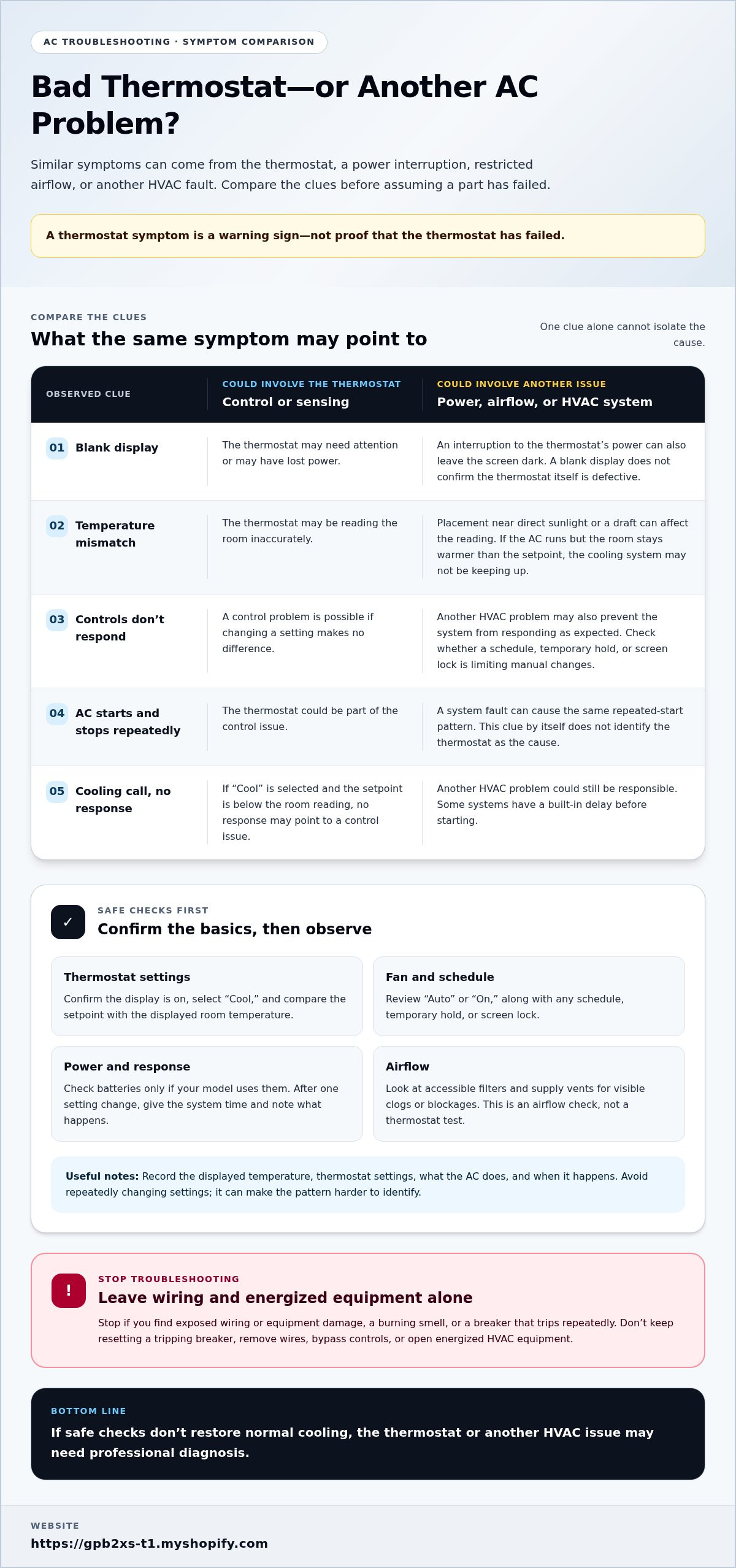
A thermostat symptom is a warning sign, not proof the thermostat has failed.
What are the most common signs of a bad AC thermostat?
Look for patterns such as a blank display, a room temperature that seems inaccurate, controls that don’t respond, or an AC that starts and stops repeatedly. A blank screen may mean the thermostat has lost power or needs attention, but it doesn’t confirm the thermostat itself is defective. A temperature mismatch can also reflect the thermostat’s location, such as placement near direct sunlight or a draft.
- Blank display: The screen is dark or unreadable. The cause could be the thermostat or an interruption to its power.
- Temperature mismatch: The displayed reading seems far from the room’s actual comfort level, or the AC runs without reaching the set temperature.
- Unresponsive controls: Changing a setting appears to make no difference to the display or system.
- Repeated starts: The AC switches on and off frequently instead of running steadily. A system fault can cause this pattern too.
These clues can help narrow down the possibilities, but none of them isolates the thermostat on its own.
When does the thermostat setting point to a control problem?
Compare the selected mode, set temperature, and room temperature shown on the thermostat. If cooling is selected and the setpoint is below the room reading, the system would generally be expected to call for cooling. If it doesn’t respond, that may point to a control issue, though another HVAC problem could still be responsible.
A steady temperature difference is different from no response at all. If the AC runs but the room stays warmer than the setpoint, the thermostat may be reading the room incorrectly, or the cooling system may not be keeping up. Note the displayed temperature, settings, what the AC does, and when it happens. Avoid repeatedly changing settings, which can make the pattern harder to identify. Clear observations make the next safe checks more useful.
Safe Checks to Try Before Calling an AC Thermostat Bad
Use this sequence to rule out simple setting and airflow issues before deciding the thermostat has failed. Limit your checks to controls and parts you can access normally. Don’t remove wiring, bypass thermostat controls, or open energized HVAC equipment.
Check thermostat settings, schedule, and power
- Check the display and mode. Confirm the screen is on and the thermostat is set to “Cool,” not “Heat” or “Off.”
- Compare the setpoint with the room temperature. Set the target below the displayed room temperature so the thermostat has a reason to call for cooling. Change it once, then observe the system instead of making a series of adjustments.
- Review the fan setting. “Auto” generally runs the fan with a heating or cooling cycle, while “On” may keep it running continuously. A fan that runs by itself doesn’t necessarily mean the AC is cooling.
- Check the schedule and controls. A programmed schedule, temporary hold, or screen lock may override or limit manual changes. Review the thermostat’s on-screen prompts or manual to confirm the active setting.
- Check batteries only if your model uses them. Replace them according to the manufacturer’s instructions. Don’t remove the thermostat faceplate if doing so exposes wiring.
Check the HVAC system without opening electrical components
With cooling selected and the setpoint below the room temperature, listen and observe whether the indoor system responds. Some systems have a built-in delay before starting, so give it time rather than repeatedly changing settings. Note whether air begins moving and whether it feels cool. These observations help describe the problem, but don’t prove the thermostat is at fault.
Separately, look at accessible air filters and supply vents. A visibly clogged filter or blocked vent can restrict airflow and affect comfort, but checking these is an airflow check, not a thermostat test. Follow the equipment’s normal instructions for filter access and replacement. Don’t reach into the unit.
Stop here if you see exposed wiring or equipment damage, or if a breaker trips repeatedly. Don’t keep resetting a tripping breaker. Never remove wires, bypass controls, or open energized HVAC equipment to test a thermostat. Those steps can expose you to electrical hazards and require professional diagnosis.
If these safe checks don’t restore normal cooling, the cause may need a closer HVAC diagnosis. Professional HVAC repair can help identify whether the thermostat or another system issue is responsible.
Bad Thermostat or Another AC Problem? Compare the Clues
A thermostat can display normally while the AC has a separate problem. The clues below can help you decide what to observe next, but they can’t confirm which part has failed. As you work through how to check if ac thermostat is bad, use the symptom pattern to guide your next step, not as a reason to replace parts based on guesswork.
| Observed clue | Possible thermostat issue | Other possible cause | Safe next step |
|---|---|---|---|
| The display is blank, or the system doesn’t respond | The thermostat may not be sensing or sending a cooling request | A power interruption may affect the thermostat or HVAC system | Check the display and settings. Don’t open equipment or inspect wiring. |
| The display works, but no air comes from the vents | The thermostat may not be communicating a cooling call | An HVAC system fault or airflow restriction may be involved | Observe whether the indoor system responds. Check accessible vents and the filter for obvious blockage. |
| The AC runs, but the air stays warm | A temperature reading or control issue is possible | The cooling system may not be cooling properly | Note the setpoint, room reading, and whether the air changes. Arrange diagnosis if the problem persists. |
| The system starts and stops repeatedly | The thermostat may be registering temperature or controlling cycles irregularly | Another system condition may be causing unusual cycling | Record when it happens and avoid repeated setting changes. |
| The displayed temperature seems off | The thermostat may be sensing the room inaccurately | Sunlight, drafts, or a nearby heat source may influence its reading | Check the thermostat’s surroundings and compare readings at different times. |
Confirm the cause before replacing parts. A symptom can point toward a thermostat, but it doesn’t establish that the thermostat is faulty. Accurate diagnosis helps avoid replacing a working control while overlooking another AC issue.
Which symptoms may point to an AC issue instead?
A lit display only shows that the thermostat is on, not that the cooling system is operating correctly. No airflow, persistent warm air, or unusual cycling can signal broader HVAC concerns. In Sarasota-area heat, persistent loss of cooling deserves prompt attention. Note what the system does and when, then share those observations during professional HVAC diagnosis.
Could thermostat location or settings affect the reading?
Yes. Direct sunlight, drafts, or heat from a nearby appliance can make the thermostat’s reading differ from the room’s overall comfort. A schedule or fan setting can also make normal operation seem like a control failure. Review the settings and observe the pattern before concluding the thermostat is bad. For broader troubleshooting context, see this guide to AC repair in Southwest Florida.
When to Stop Troubleshooting and Get Professional AC Diagnosis
Safe checks have limits. Stop troubleshooting and arrange professional HVAC diagnosis if you see exposed wiring, notice a burning smell, or the breaker trips repeatedly. Don’t touch wiring or keep resetting a breaker that trips again. Thermostat testing can involve electrical components, and diagnosing the full system may require checks beyond what’s safe to do at home.
Which thermostat or AC problems need prompt attention?
A burning odor, repeated shutdowns, or signs of electrical damage call for prompt attention, not more trial and error. Persistent cooling failure also matters in Southwest Florida, where indoor heat can become uncomfortable quickly. If the AC isn’t restoring comfort, stop changing settings and focus on getting the problem assessed. The cause and the right repair can’t be confirmed without inspecting the system.
What information helps a technician diagnose the problem?
Clear observations can help a technician narrow down whether the issue involves thermostat control or another part of the HVAC system. Before the visit, write down what you’ve noticed. Don’t open the thermostat or equipment to gather more information.
- Thermostat mode, set temperature, and displayed room temperature
- Whether the screen is blank, flickering, or responding normally
- What happens after cooling is selected, such as no airflow, warm air, or repeated starts and stops
- When the problem began and whether it happens constantly or intermittently
- Any breaker trips, unusual odors, or visible damage
These details are useful whether you’re trying to understand how to check if ac thermostat is bad or preparing to have a broader cooling problem diagnosed.
If the problem persists, schedule professional HVAC repair with BulletProof Air. Trained technicians can assess the symptoms and diagnose malfunctioning systems across Southwest Florida.
How BulletProof Air Can Help Confirm a Bad AC Thermostat
If safe checks haven’t restored cooling, the thermostat may not be the only cause. A control can appear faulty when the HVAC system isn’t responding for another reason. BulletProof Air’s trained technicians diagnose malfunctioning systems and provide residential HVAC repair across Southwest Florida, helping identify the source before parts are replaced based on a guess.
What happens during professional thermostat troubleshooting?
A technician can review the symptoms you’ve observed, assess thermostat operation, and consider how the rest of the HVAC system responds to a cooling request. That broader look matters: a thermostat setting that appears ineffective doesn’t, on its own, prove the thermostat has failed. The system may need diagnosis beyond the wall control.
Recommendations should follow the findings. Depending on what the evaluation shows, the issue may involve the thermostat or another part of the cooling system. Electrical testing and equipment checks can go beyond safe homeowner troubleshooting, so leave those steps to a professional. This helps avoid replacing a working thermostat without first understanding why cooling stopped or became inconsistent.
How to take the next step toward reliable cooling
You’ve already gathered useful information if you checked the visible display, mode, setpoint, schedule, and fan setting, then observed whether the AC responded. Share what you noticed, including when the symptoms began and whether the problem comes and goes. You don’t need to keep changing settings or open the equipment to prepare for a diagnosis.
It’s understandable to want a clear answer before replacing anything. Professional diagnosis can help determine whether the thermostat is actually at fault or whether another HVAC issue needs attention. If cooling problems keep returning, mention that pattern too, since it can help technicians assess the system as a whole.
For homeowners wondering how to check if ac thermostat is bad, safe observations are a useful first step, but they can’t replace a system diagnosis when the problem persists. Let BulletProof Air help you get to the cause and work toward reliable cooling in your home. Get help with AC repair from BulletProof Air.
Take the Next Step Toward Reliable Cooling
A thermostat that seems unresponsive isn’t automatically defective. Start with safe checks of the mode, setpoint, fan, schedule, and applicable batteries. Then consider the clues: a blank display, unusual cycling, or warm air can point to several issues, including problems beyond the thermostat. Knowing how to check if ac thermostat is bad means noticing symptoms without treating them as proof.
Stop troubleshooting if you encounter exposed wiring, repeated breaker trips, burning smells, or cooling that remains unreliable. Note what the thermostat displays, which settings you’ve checked, how the AC responds, and when the issue began. These observations can help a professional diagnose the system without guessing or replacing a working part unnecessarily.
BulletProof Air’s trained technicians diagnose and repair malfunctioning HVAC systems, including residential HVAC problems across Southwest Florida. If basic checks haven’t restored comfort, Get help diagnosing your AC problem from BulletProof Air. A clear diagnosis can help you take the next step toward dependable cooling and a more comfortable home.
Frequently Asked Questions
How can I tell if my AC thermostat is bad or the AC itself is broken?
You can narrow down the possibilities by checking whether the thermostat is powered, set to cooling, and calling for a temperature below the room reading. Then observe whether the indoor system responds and whether cool air reaches the vents. A thermostat that appears to work doesn’t prove the AC is operating correctly, and a blank screen doesn’t prove the thermostat is defective. Persistent symptoms need professional diagnosis before you replace parts.
Can a bad thermostat cause an AC unit not to turn on?
Yes. If a thermostat can’t sense the room temperature correctly or send a cooling request, the AC may not start when expected. First check that the thermostat is in cooling mode and the setpoint is below the displayed room temperature. A power interruption or another HVAC system problem can also prevent startup, so a nonresponsive AC alone doesn’t confirm thermostat failure. Avoid opening equipment or touching wiring to test the cause.
What are the most common signs of a faulty AC thermostat?
Common warning signs include a blank or erratic display, controls that don’t respond, temperature readings that seem inaccurate, frequent starts and stops, or cooling that doesn’t match the setting. These clues can help you describe the problem, but none proves the thermostat is faulty. Similar symptoms can result from power interruptions, airflow restrictions, thermostat placement, or other AC issues. Track the pattern before deciding what needs repair.
Can I test an AC thermostat myself without removing it?
Yes, you can perform basic checks without removing the thermostat. Confirm that it displays normally, select cooling, set a target below the room temperature, and observe whether the system responds. Review the schedule, hold, fan setting, and screen lock if available. If the model uses replaceable batteries, follow the manufacturer’s instructions. Don’t remove wiring, bypass controls, or open HVAC equipment. Leave electrical testing to a technician.
Why is my AC thermostat on but not cooling?
A lit thermostat can still be signaling a cooling request that the AC doesn’t fulfill. Check that cooling mode is selected, the setpoint is below the room temperature, and a schedule isn’t overriding your selection. Then note whether air comes from the vents and whether it feels cool. Restricted airflow or another HVAC fault may be involved. If warm air or poor cooling continues, arrange professional diagnosis rather than assuming the thermostat is bad.
Can dead thermostat batteries stop an AC from working?
They can, if your thermostat relies on replaceable batteries for power. Low or depleted batteries may cause a blank display or prevent the control from communicating a cooling request. Not every thermostat uses replaceable batteries, so check the model’s instructions before replacing them. If the display stays blank or the AC still won’t respond after the correct battery check, the cause may be elsewhere in the thermostat or HVAC system.
When should I call an HVAC technician for thermostat problems?
Call an HVAC technician if safe checks don’t restore cooling, the system repeatedly starts and stops, or the thermostat remains unresponsive. Stop immediately if you see exposed wiring, smell burning, or a breaker trips repeatedly. Don’t keep resetting the breaker or open energized equipment. BulletProof Air’s trained technicians diagnose and repair malfunctioning HVAC systems, including residential HVAC problems in Southwest Florida, helping determine whether the thermostat or another system issue needs attention.
If you would like maintenance or repair assistance with your Florida Air Conditioner, contact BulletProof Air Or call: 941.599.9999 for more information about how we can help.