

How to Convince Your Boss to Approve a New HVAC System in 2026
Waiting until your office cooling system finally dies in the peak of a Florida summer isn't just a maintenance gamble. It's a financial disaster waiting to happen. You're likely already exhausted from managing constant repair calls and hearing employees complain about "hot spots" while the energy bills climb higher every month. It feels like you're stuck in a loop of temporary fixes, but finding out how to convince boss to approve new hvac systems requires shifting the conversation from "broken parts" to "bottom-line profits." Your leadership needs to see that an aging system is an active liability to the company's productivity and safety.
You can secure a "yes" by presenting the hard data that makes a new installation the only logical choice for 2026. You will master the financial and operational arguments needed to turn a hesitant budget meeting into an approved project for a high-efficiency upgrade. We'll walk through the critical June 30, 2026, deadline for Section 179D tax deductions, the impact of new EPA refrigerant regulations, and how a reliable cooling solution pays for itself through lower operating costs and recovered employee output.
Key Takeaways
- Leverage the Section 179D tax deduction and 2026 refrigerant regulations to transform a maintenance expense into a strategic financial asset.
- Connect office climate directly to employee productivity and retention to show leadership the hidden costs of "hot spots" and humidity.
- Master a step-by-step framework on how to convince boss to approve new hvac by using utility bill audits and professional performance data.
- Identify why the Sarasota climate requires a specialized, high-durability installation rather than a standard "quick fix" that will fail in the salt air.
- Move from the stress of emergency repair cycles to a reliable, high-efficiency system that pays for itself through immediate energy savings.
The High Cost of Doing Nothing: Why "Wait and See" is a Risky Strategy
Many leadership teams fall into the trap of the "sunk cost fallacy." They believe that because they spent money on a compressor last year and a fan motor last month, they must keep the current unit running to "get their money's worth." This logic is dangerous. In reality, you're throwing good money after bad. When you're researching how to convince boss to approve new hvac upgrades, you have to frame the aging system as a financial leak. Every day that old unit runs, it's draining the company's maintenance budget and increasing the risk of a catastrophic failure that could shut down operations for days.
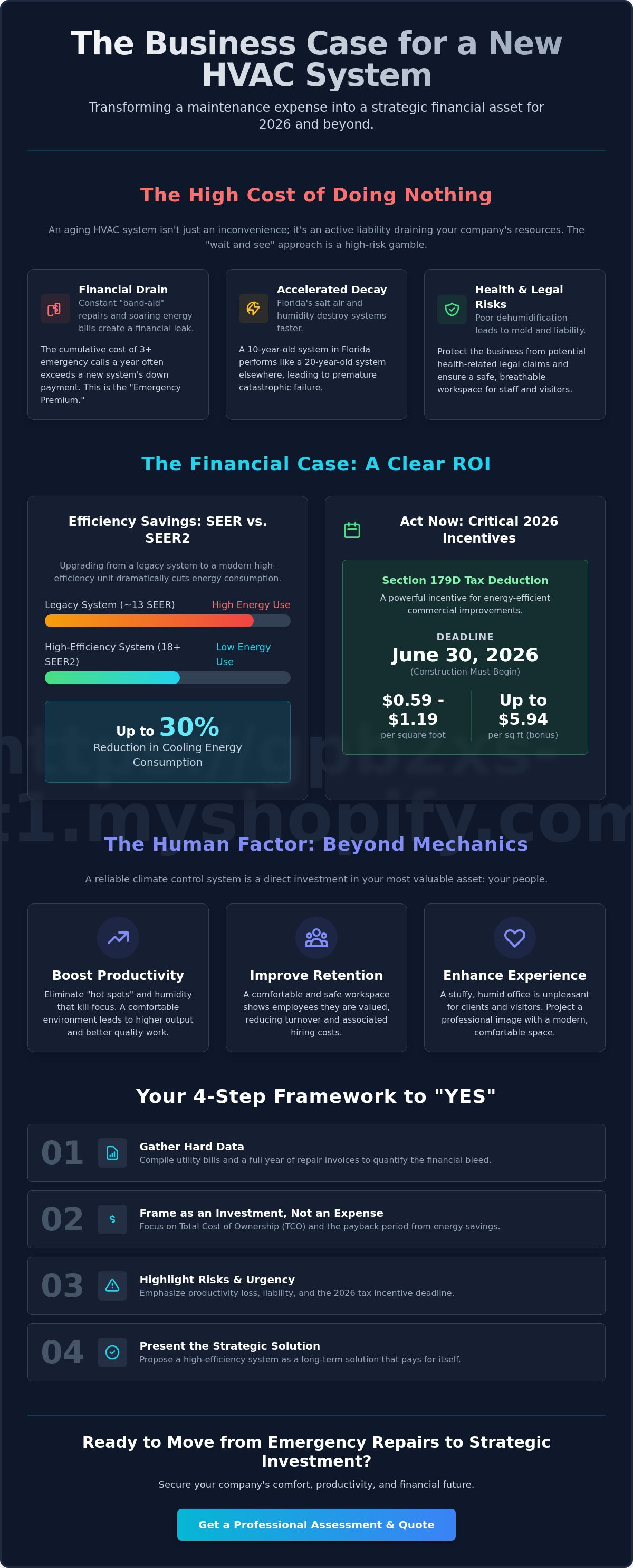
The environment in Sarasota and Bradenton is your system's worst enemy. Our intense salt air and relentless humidity accelerate the decay of copper coils and electrical components much faster than in inland states. A system that is ten years old in Florida often performs like a twenty-year-old system elsewhere. Think of your HVAC system as the "lungs" of your business sanctuary. If the lungs are failing, the entire body suffers. A "wait and see" approach usually means waiting for a total system collapse during a 95-degree July afternoon when every repair company in the region is booked solid.
The "Emergency Premium" on Band-Aid Repairs
Emergency repairs don't just cost more in labor; they cost more in lost time. If your office becomes a sauna, productivity doesn't just dip, it stops. When you calculate the cumulative cost of three or more emergency service calls in a single year, you'll often find the total exceeds a significant portion of a new system's down payment. Relying on emergency AC repair Lakewood Ranch is a temporary fix, not a strategy. These "band-aids" keep the lights on for today but do nothing to address the underlying inefficiency that is quietly killing your profit margins.
Humidity, Mold, and Regulatory Liability
Aging units eventually lose their ability to properly dehumidify the air. In Southwest Florida, this isn't just an afternoon annoyance. It's a major liability. Excessive indoor moisture leads to mold growth behind drywall and inside ceiling tiles, which can trigger health issues for staff and visitors alike. Modern systems are essential for maintaining high indoor air quality (IAQ) and meeting rigorous HVAC system efficiency standards. By upgrading now, you protect the business from potential health-related legal claims and ensure your workspace remains a safe, breathable sanctuary for everyone who enters.
Building the Financial Case: ROI, Energy Savings, and 2026 Incentives
When you're building a pitch, you must pivot the discussion from the "sticker price" to the Total Cost of Ownership (TCO). A new system isn't just an expense; it's a capital investment that generates monthly returns through lower utility bills and reduced maintenance spend. This shift in perspective is the most effective way regarding how to convince boss to approve new hvac upgrades. By showing that the "payback period"—the time it takes for energy savings to cover the initial cost—is often shorter than expected, you transform a mechanical request into a strategic business decision.
Modern Efficiency Standards (SEER2) vs. Legacy Systems
The gap between old technology and 2026 standards is massive. Most units installed a decade ago operate at a 13 SEER rating or lower. Today, the Southeast region requires a minimum of 14.3 SEER2 for new split systems. Upgrading to a high-efficiency 18+ SEER2 unit can reduce cooling energy consumption by up to 30%. Leading commercial HVAC companies now use precision load matching and variable-speed technology to ensure the system only uses the exact amount of power needed. This eliminates the "all-or-nothing" energy spikes common in older, single-stage units.
Tax Credits and Utility Rebates for 2026
Timing is everything for the 2026 budget. The Section 179D tax deduction offers a powerful incentive for energy-efficient commercial improvements, but there's a catch. To qualify for the current sliding scale of $0.59 to $1.19 per square foot—or bonus deductions up to $5.94 per square foot—construction must begin by June 30, 2026. When you combine these federal incentives with local Florida utility rebates for ENERGY STAR-certified equipment, you can effectively slash the initial capital expenditure by 20% to 30%. These savings vanish if the project is delayed into the second half of the year.
Beyond the immediate tax breaks, consider the impact on employee productivity and well-being. A reliable system prevents the costly downtime associated with office "heat waves" that send staff home early. To get a precise picture of your potential savings, you can schedule a professional system audit to document your current "efficiency bleed" and build a data-backed ROI forecast for your leadership team.
The Human Factor: Productivity, Retention, and Customer Experience
While the financial figures and tax breaks are compelling, your leadership team likely cares just as much about operational stability and employee performance. An uncomfortable office is a distracted office. When you look at how to convince boss to approve new hvac systems, you must highlight that the current system is actively sabotaging your team's focus. A struggling legacy unit creates inconsistent pockets of heat that lead to internal friction and constant complaints to HR. By upgrading, you aren't just buying a machine; you are investing in a recruitment and retention tool that keeps your best talent from looking for a cooler, more comfortable sanctuary.
Leadership often overlooks the "silent resignation" of employees who are tired of working in a sweltering environment. If your staff is spending their afternoon adjusting desk fans or complaining about the humidity, they aren't focusing on their core tasks. This environmental stress builds up over time. A new HVAC system eliminates these distractions entirely. It creates a seamless background of comfort that allows your team to perform at their peak without even thinking about the air around them. This quiet reliability is a hallmark of a professional workspace, much like how fleet-dependent businesses use mobile tire installation Birmingham AL to remove the friction of vehicle maintenance from their daily operations.
Temperature and the Bottom Line
Research indicates that productivity drops by approximately 1% for every degree the office temperature rises above 72°F. In a large office, those percentages add up to thousands of dollars in lost output. Older systems often cycle on and off aggressively, causing wild temperature swings that make it impossible for staff to settle into a deep work state. A modern variable-speed system maintains a precise, consistent temperature, ensuring the environment remains conducive to high performance. This direct link to the bottom line provides a powerful return on investment (ROI) that goes beyond simple energy bills.
Indoor Air Quality (IAQ) as a Corporate Benefit
Indoor Air Quality has become a top priority for modern professionals. Advanced commercial ac unit installation today includes medical-grade filtration and UV-C light systems that neutralize pathogens. This translates to fewer sick days and a healthier workforce. In our local climate, superior humidity management is the difference between a crisp, clean-smelling office and one that feels heavy and damp. A new system restores the sanctuary effect of your workspace, making it a place where employees want to be and where customers feel immediately at ease. Noisy, clanking units and stale air leave a poor impression on clients; a quiet, fresh environment signals that your business is high-functioning and professional.
How to Present the Pitch: A Step-by-Step Framework
Data Collection: The Evidence Locker
Start by gathering every repair invoice from the last 24 months. These receipts prove the "sunk cost" of keeping a failing unit alive. Next, pull 12 months of utility bills to document the "efficiency bleed." Compare these to the projected energy consumption of a modern SEER2 unit. You should also document employee or tenant complaints regarding comfort and air quality. These aren't just gripes; they represent lost productivity. Finally, note the age and refrigerant type of your current units. As of January 1, 2026, the EPA has lowered the leak repair threshold for systems containing high-GWP refrigerants like R-410A from 50 pounds to 15 pounds. This means your aging system is now under much stricter federal oversight, which increases your regulatory liability.
When you present your findings, offer a three-option proposal. This gives your boss a sense of control and makes the high-efficiency choice look like the logical middle ground between a risky "do nothing" approach and a standard replacement. Your options should include:
- Option 1: Repair. Highlight the high risk of total failure and the lack of tax incentives.
- Option 2: Standard Replace. Meet basic 2026 compliance but miss out on maximum energy savings.
- Option 3: High-Efficiency Replace. Focus on the June 30, 2026, Section 179D tax deadline and the fastest payback period.
The Meeting Strategy: Speaking "Boss" Language
Lead with the ROI and tax benefits rather than technical specs. Most decision-makers care about "Avoided Costs" more than "New Expenses." Use a "Problem-Solution-Impact" structure for every point. For example: "The current unit has leaked three times this year (Problem). We can install a high-efficiency system before the June tax deadline (Solution). This eliminates emergency repair bills and cuts energy costs by 30% immediately (Impact)." Emphasize the peace of mind that comes with a BulletProof Air maintenance plan, which ensures the new investment stays protected for years to come.
To move from a "maybe" to a signed contract, you need an expert to verify your data. You can request a professional BulletProof assessment to get a detailed report on your system's current performance and a precise forecast of your potential savings.
Partnering for Success: Why BulletProof Air is the Strategic Choice
You have gathered the data and built a solid financial case. Now, you need a partner who can deliver on the promise of a "bulletproof" sanctuary. Choosing the right contractor is the final, critical piece of the puzzle regarding how to convince boss to approve new hvac upgrades. Leadership needs to know that the installation won't just be "done," but executed with total precision to ensure the maximum lifespan of the investment. BulletProof Air provides that certainty. We specialize in high-durability solutions designed to withstand the brutal Southwest Florida environment, ensuring your new system remains a reliable asset rather than a recurring headache.
Our brand promise is built on strength and resilience. We understand that a commercial HVAC system is a major capital expenditure. You aren't just looking for a quick fix; you're looking for a definitive solution that eliminates the need for follow-up visits and emergency repairs. We approach every project with the mindset of a first responder, acting quickly to restore comfort while maintaining the self-assurance of subject matter experts. By partnering with us, you show your leadership that you've chosen a team dedicated to total accuracy and long-term performance.
Precision Installation and Local Reliability
A standard unit won't cut it in our region. Our localized expertise in Sarasota, Bradenton, and Lakewood Ranch means we understand how salt-air corrosion eats through standard coils in record time. When performing AC installation Sarasota FL, our team uses specialized hardware and techniques that resist the unique coastal elements of the Gulf Coast. We prioritize fast response times and low-disruption workflows because we know your business can't stop just because we're on the roof. Whether it's a complex commercial retrofit or a new construction project, we coordinate every detail to minimize downtime and protect your daily operations.
Next Steps: Get Your Professional Assessment
The best way to secure that final budget approval is to let the experts present the evidence. Invite your leadership to a professional consultation where we can walk through the data together. We provide a comprehensive commercial HVAC audit that leaves no room for doubt. This isn't just a quote; it's a strategic roadmap to a more profitable, comfortable workspace. When you schedule an assessment, your boss will receive:
- A detailed ROI report showing projected monthly energy savings.
- A summary of applicable 2026 tax credits and local utility rebates.
- A precision load calculation to ensure the new system is perfectly sized.
- A customized maintenance plan to protect the system's "bulletproof" status.
Don't wait for the next emergency repair call to force your hand. Secure your building's future and your team's productivity today. Contact us for the most reliable commercial HVAC services Bradenton and let us help you turn that "maybe" into an approved budget.
Secure Your Business Sanctuary with a BulletProof Strategy
Transitioning from a reactive repair cycle to a proactive installation protects your bottom line and your team's comfort. You have seen how an aging system acts as a financial leak, draining resources through inefficiency and emergency service fees. By leveraging the 2026 tax incentives and focusing on avoided costs, you provide leadership with a clear path to long-term profitability. Mastering how to convince boss to approve new hvac upgrades means presenting the system as a durable asset rather than a maintenance burden.
Our team serves Sarasota and Bradenton with precision engineering that stands up to the local climate. We deploy expert technicians trained in high-efficiency SEER2 standards to deliver customized commercial solutions for maximum durability. You don't have to wait for the next catastrophic failure to take action. Use the data-backed framework we have provided to turn a hesitant "maybe" into a definitive approval.
Take the first step toward a more reliable workspace today. Request a Professional Commercial HVAC Audit & ROI Report to give your leadership the evidence they need. You have the tools to restore your office sanctuary and ensure your operations remain cool, quiet, and compliant for years to come.
Frequently Asked Questions
How long does a typical commercial HVAC installation take?
Most commercial installations take between one and three days to complete. The exact timeline depends on the complexity of your building and whether we need to modify existing ductwork. We prioritize speed and precision to ensure minimal disruption to your daily operations. A well-planned project allows your team to return to a comfortable workspace quickly.
Can we get a tax credit for a new HVAC system in 2026?
Yes, but your business must act before the June 30, 2026, deadline for the Section 179D tax deduction. This federal incentive provides a sliding scale of savings based on the energy efficiency improvements made to the building. Waiting until the second half of the year could mean losing out on significant deductions that directly lower your initial investment costs.
Is it better to repair or replace a 10-year-old commercial unit?
Replacement is usually the smarter strategic choice for a decade-old unit in Florida. The salt air and humidity in Sarasota accelerate mechanical decay, often making a 10-year-old system perform like a much older one. When you research how to convince boss to approve new hvac upgrades, point to the rising cost of emergency repairs and the immediate 30% jump in efficiency available with new SEER2 equipment.
How much can a new HVAC system really save on monthly energy bills?
Upgrading to ENERGY STAR-rated equipment can reduce cooling energy consumption by up to 30%. Modern systems use variable-speed technology to match the cooling load of your building with total accuracy. This eliminates the expensive energy spikes caused by older units that cycle on and off constantly. These monthly savings contribute to a much faster payback period for the company.
What is the most common reason a boss rejects an HVAC upgrade?
High upfront capital expenditure is the primary reason for rejection. Leaders often view HVAC as a "hidden" expense rather than a productivity tool. To overcome this, focus your pitch on "avoided costs" like emergency repair premiums and the productivity loss caused by office hot spots. Show them a data-backed ROI report to shift the focus from the sticker price to long-term gains.
Does a new HVAC system improve indoor air quality for employees?
Absolutely, as modern installations include superior humidity control and advanced filtration options. High-efficiency systems are designed to manage the intense moisture levels of the Gulf Coast, which prevents the mold growth that leads to health liabilities. Cleaner air creates a healthier sanctuary for your staff, which can lead to fewer sick days and higher employee retention rates.
Are there financing options available for commercial HVAC systems?
Business owners should check with their local financial institutions or equipment partners for current commercial leasing and financing programs. Many organizations use these options to preserve cash flow while still benefiting from immediate energy savings. We recommend reviewing these possibilities during your professional assessment to find a solution that fits your 2026 budget requirements.
What happens if we keep using an R-22 refrigerant system?
Continuing to use R-22 is a high-risk strategy because the refrigerant is no longer produced or imported. Repair costs for these obsolete systems have skyrocketed as reclaimed supplies dwindle. Additionally, new EPA leak repair and reporting requirements now apply to smaller systems down to 15 pounds. Sticking with an outdated system increases your risk of a total, unrepairable failure during a peak summer heatwave.
If you would like maintenance or repair assistance with your Florida Air Conditioner, contact BulletProof Air Or call: 941.599.9999 for more information about how we can help.