

How to Reduce Humidity in Your House with AC: A Florida Homeowner’s Guide (2026)
Last Wednesday, a homeowner named Sarah in Bradenton discovered that even with the thermostat set to 72 degrees, her indoor humidity had spiked to 68 percent. You likely know that feeling; your sheets feel damp, your skin stays sticky, and you start worrying about mold growth. If you are struggling with these issues, learning how to reduce humidity in house with ac is the fastest way to reclaim your comfort and protect your home.
We agree that no one should feel "clammy" inside their own house, especially when you are counting on your HVAC system for relief. This 2026 guide provides the exact steps to master your equipment and lower your indoor relative humidity below 50 percent. We will explore specific thermostat settings, drainage maintenance, and professional tips that restore your home into a crisp, dry sanctuary while keeping your energy bills under control.
Key Takeaways
- Understand how your AC’s cooling cycle naturally removes moisture and why the evaporator coil is the heart of your home’s comfort.
- Learn why the "Auto" fan setting and "Dry Mode" are your best tools for preventing re-evaporation and keeping indoor air crisp.
- Master simple maintenance tasks and learn how to reduce humidity in house with ac to keep your system performing at its peak.
- Identify the warning signs of dirty coils or low refrigerant that can leave your home feeling muggy even when the air is cold.
- Explore professional-grade solutions like whole-home dehumidifiers to permanently transform your Florida house into a crisp, BulletProof sanctuary.
Understanding the Link Between Your AC and Indoor Humidity
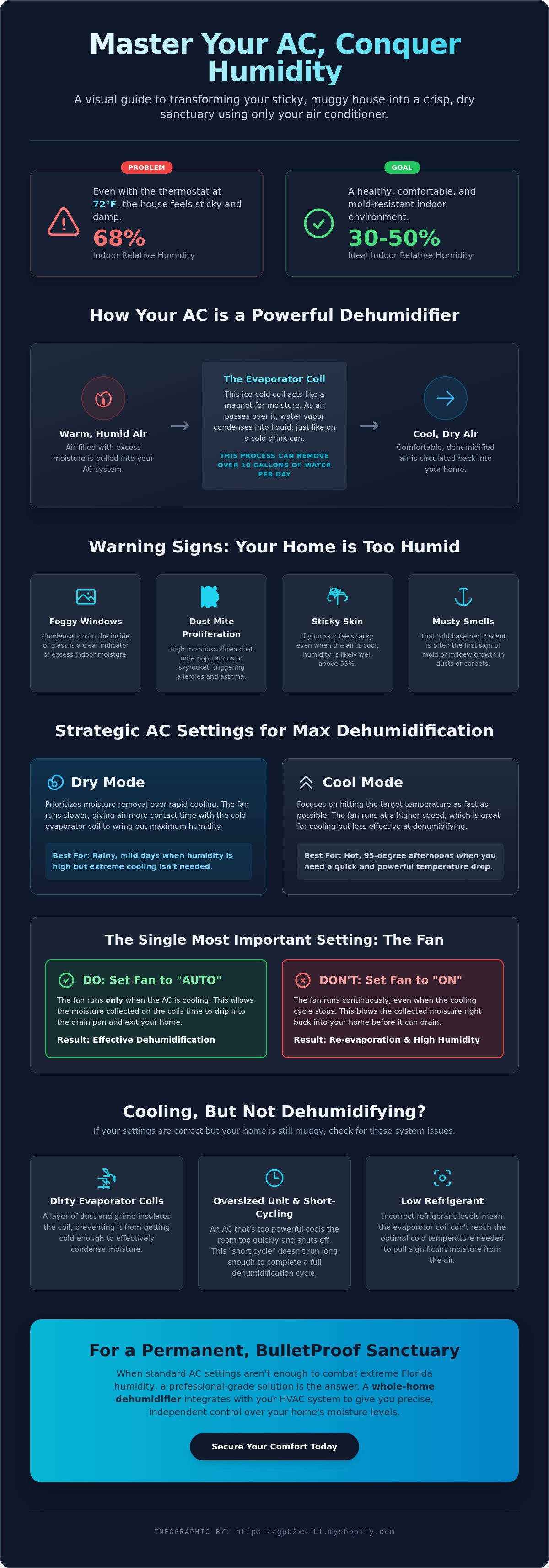
Florida doesn't just serve heat; it plates it up sizzling. When the outdoor humidity regularly climbs above 80% in Southwest Florida, your home needs to be a dry, cool sanctuary. Most homeowners focus strictly on the thermostat setting, but the real secret to true comfort lies in moisture control. Your air conditioner isn't just a cooling machine; it's actually a powerful dehumidifier. Moisture removal is a natural byproduct of the cooling cycle, and understanding this relationship is the first step in learning how to reduce humidity in house with ac systems effectively.
The Science of the Evaporator Coil
Think about a cold soda can sitting on a porch in Bradenton during July. Water beads up on the outside of the can almost instantly. This is exactly how your evaporator coil functions inside your air handler. As refrigerant circulates through the coil, it absorbs heat from your indoor air, causing moisture to condense on the cold metal surface. Latent heat removal is the specific process of stripping this moisture from the air to improve comfort levels. Once the water condenses, it drips into a primary drain pan and travels through the condensate drain line to be deposited outside your home. This process can remove over 10 gallons of water from your indoor air every single day when the system is running correctly.
How Air Conditioners Remove Humidity depends heavily on the system running for a sufficient amount of time. This is why "oversized" units are a major problem for Florida homeowners. If a unit is too large for the space, it reaches the target temperature too quickly and shuts off. This is called short-cycling. Because the system doesn't run long enough to complete a full dehumidification cycle, you're left with a home that's 72 degrees but feels clammy, heavy, and damp.
Signs Your Humidity Levels are Too High
In Southwest Florida, you should target an indoor humidity level between 30% and 50%. Once your indoor air crosses the 60% threshold, your home becomes a breeding ground for biological growth. You'll notice several red flags when your AC is failing to keep up with the moisture:
- Foggy Windows: Condensation on the inside of your glass panes indicates a massive imbalance between indoor and outdoor moisture.
- Musty Smells: That "old basement" scent is often the first sign of mold or mildew thriving in your ductwork or carpets.
- Sticky Skin: If your skin feels tacky or "heavy" even when the air is cold, the humidity is likely well above 55%.
- Dust Mite Proliferation: High moisture levels allow dust mite populations to skyrocket, often triggering allergies or asthma.
At BulletProof Air, we know that a functioning AC is your first line of defense against the relentless Gulf Coast climate. If you are struggling with how to reduce humidity in house with ac units that seem to be underperforming, it's time to look at your system's calibration. We're here to ensure your equipment is sized perfectly to restore your home to a comfortable, dry sanctuary the first time, every time.
Optimizing AC Settings for Maximum Moisture Removal
Florida doesn't just serve up heat; it plates it up sizzling with a side of thick, heavy moisture. If your home feels like a sauna even when the air is blowing, your settings are likely working against you. Learning how to reduce humidity in house with ac requires more than just lowering the temperature. It requires a strategic approach to how your system cycles air through your home's sanctuary.
AC Dry Mode vs. Cool Mode
Most modern units installed after 2022 feature a "Dry Mode" represented by a water drop icon. While Cool Mode focuses on hitting a specific temperature as fast as possible, Dry Mode prioritizes moisture removal. It slows the internal fan speed significantly. This allows air to spend more time in contact with the freezing evaporator coil, which pulls more water out of the air. You can learn the technical specifics in our guide on AC Dry Mode vs. Cool Mode: What’s the Difference?
Use Cool Mode during 95-degree afternoons when you need a rapid temp drop. Switch to Dry Mode during those "sticky" rainy days when the temperature is mild but the humidity is 80% or higher. Proper moisture management is vital for health, as highlighted in the EPA Guide to Moisture Control, which notes that keeping indoor humidity between 30% and 50% is key to preventing mold growth.
The "Fan Auto" Rule
One of the biggest mistakes Florida homeowners make is setting the thermostat fan to "On" instead of "Auto." When you select "On," the fan blows 24/7, even when the cooling compressor is off. This is a recipe for disaster. As the compressor rests, moisture that just condensed on the coil doesn't have time to drip into the drain pan. Instead, the constant airflow re-evaporates that water and blasts it back into your rooms. This can spike indoor humidity by 15% in a single hour.
If you have a modern variable-speed blower, your system handles this automatically by ramping speeds up and down. If you're still using an older single-stage unit, the "Auto" setting is your best defense against the Florida swamp. If your system still struggles to keep things dry, it might be time to consult trusted HVAC experts to check your refrigerant levels.
Thermostat Calibration and Smart Sensors
Your AC can't fix a problem it can't see. Industry data shows that roughly 20% of manual thermostats are miscalibrated by at least 3 degrees. If your sensors are off, your system might shut down before it has finished the 15-minute runtime required to effectively dehumidify. Upgrading to a smart thermostat with built-in humidity sensors allows you to set a "dehumidification setpoint." This tells the AC to keep running at a lower fan speed until the air feels crisp, regardless of the exact temperature on the wall.
Maintenance Tasks That Boost Your AC’s Dehumidification Power
Living in Southwest Florida means your air conditioner works harder than almost anywhere else in the country. If you want to know how to reduce humidity in house with ac, you must treat maintenance as a non-negotiable priority. A neglected system doesn't just run longer; it loses its ability to pull moisture from the air, leaving your home feeling like a swamp even if the temperature is 72 degrees. Follow these four steps to restore your home to a cool and comfortable sanctuary. Our team at BulletProof Air sees these issues daily, and most are preventable with a little proactive care.
The Critical Air Filter Connection
A clogged filter is the #1 cause of "cooling but not drying" complaints we see in Bradenton and Sarasota homes. When the filter is dirty, it restricts airflow across the evaporator coil. This causes the coil temperature to drop too low, which eventually leads to the unit freezing over. A frozen coil cannot remove moisture from your air; it simply acts as a block of ice. We recommend changing your filters every 30 days during the peak of the Florida summer. For the best balance of filtration and airflow, choose a MERV 8-11 rated filter. According to the Department of Energy on Central AC, proper maintenance can improve your system's efficiency by 5% to 15%.
Clearing the Condensate Drain Line
Your AC removes gallons of water from your home every day. This water travels through a PVC pipe called the condensate drain line. If this line gets backed up with algae or sludge, it can lead to standing water in the drain pan, which spikes indoor humidity levels instantly. A clogged drain line is a common Florida HVAC problem that can lead to expensive water damage if ignored. You can perform a DIY flush by pouring a quarter cup of distilled white vinegar down the access port or using a wet/dry vac to suction out debris from the exterior exit point. If the water doesn't clear quickly or your safety float switch keeps tripping, stop immediately and call an expert to avoid flooding your home.
Outside your home, the condenser unit needs room to breathe. Florida vegetation grows fast, and palm fronds or grass clippings can quickly choke the unit. Ensure you have at least 2 feet of clear space around the entire perimeter to allow for proper heat release. Finally, inspect your ductwork for any visible gaps. Leaks in the attic can pull in 150-degree, moisture-laden air, forcing your AC to work twice as hard. Sealing these gaps is a vital part of learning how to reduce humidity in house with ac while keeping your energy bills under control. We provide fast, reliable inspections to ensure your ductwork isn't working against you.
Troubleshooting Why Your AC is Cooling But Not Dehumidifying
It is a common frustration for Florida homeowners: the air coming from the vents is cold, yet the indoor environment feels like a swamp. When you are trying to figure out how to reduce humidity in house with ac, you must look beyond the thermostat reading. If your system cools but fails to dry the air, several mechanical or design flaws are likely at play. A properly functioning system should keep your indoor humidity between 45% and 55%.
- Dirty Evaporator Coils: Dust, pet dander, and debris act as a thermal insulator. Even a thin layer of grime prevents the refrigerant from absorbing heat and moisture effectively. According to industry data, a 1/16th-inch layer of dust can reduce efficiency by 21%.
- Low Refrigerant Levels: If your system has a leak, the coil will not get cold enough to reach the dew point. Without that specific temperature drop, water vapor stays suspended in your air rather than condensing and draining away.
- Leaky Return Ducts: If your return ducts have cracks or disconnected joints, they pull in "sizzling" humid air from your attic or crawlspace. Attic temperatures in Southwest Florida can exceed 130 degrees, easily overwhelming your AC unit.
The "Short-Cycling" Dilemma
In the Florida market, many believe a larger AC unit is a better investment. This is a myth. An oversized system cools your home too quickly, satisfying the thermostat in under 10 minutes. Because the system shuts off so fast, it never runs long enough to remove significant moisture. A properly sized unit must run for at least 15 to 20 minutes per cycle to effectively strip humidity from the air. At BulletProof Air, we perform rigorous Manual J-load calculations for every new construction project. This ensures your system is sized perfectly for your home's unique footprint and sun exposure, preventing the heavy, wet air caused by short cycles.
Refrigerant and Coil Issues
If you notice ice forming on the copper lines or hear a faint hissing sound, you likely have a refrigerant leak. This is a critical issue that requires immediate attention to prevent total compressor failure. Additionally, if you skipped your "right the first time" maintenance last year, your coils may require a professional chemical cleaning to restore their dehumidification capacity. Understanding how to reduce humidity in house with ac starts with a clean system. For an expert diagnosis, you can book Fast & Reliable AC Repair in Sarasota to restore your sanctuary immediately.
Don't let a "sticky" house ruin your comfort and risk mold growth. If your AC is failing to keep you dry, schedule a service call with BulletProof Air today for a comprehensive humidity evaluation.
Professional Indoor Air Quality Solutions for a BulletProof Sanctuary
Florida's climate is relentless, and sometimes a standard air conditioner isn't enough to battle the 90% outdoor humidity. If you're struggling with how to reduce humidity in house with ac, professional indoor air quality (IAQ) upgrades offer the most reliable path to a dry, healthy home. A whole-home dehumidifier is the ultimate solution for homeowners who want to set their comfort levels and never think about them again. These systems integrate directly into your existing ductwork, removing up to 120 pints of moisture per day before the air even reaches your living space.
Advanced Dehumidification Technology
Modern HVAC systems have evolved to prioritize moisture removal over simple cooling. Variable-speed compressors from industry leaders like Daikin and Lennox excel here because they don't just turn on and off. They operate at precise speeds to maintain a consistent 45% humidity level. This prevents the "clammy" feeling caused by short-cycling units that fail to run long enough to dehumidify. Our experts specialize in Sarasota AC Installation, ensuring your new high-performance system is calibrated for the specific demands of the Gulf Coast. When your AC runs longer at a lower speed, it spends more time pulling water out of the air, which is exactly how to reduce humidity in house with ac during the peak of summer.
- Whole-Home Dehumidifiers: These units work alongside your AC to maintain ideal moisture levels even when the cooling cycle isn't running.
- Variable-Speed HVAC Upgrades: Systems from Daikin and Lennox provide superior control, running at 10% to 100% capacity to match your home's exact needs.
- BulletProof Air Maintenance Plan: Regular inspections catch clogged condensate lines and failing sensors before they turn into a humid nightmare.
The BulletProof Guarantee
We don't just fix machines; we restore your home to a cool and comfortable sanctuary. When humidity levels spike, it isn't just an inconvenience. It's a health risk that invites mold and allergens into your family's space. BulletProof Air provides 24/7 emergency availability because we know Florida heat doesn't follow a schedule. We're committed to doing the job right the first time so your comfort isn't interrupted by recurring issues or sloppy repairs. Our technicians arrive on time, diagnose the root cause of your moisture problems, and provide honest recommendations that fit your budget.
Don't let the Florida swamp move into your living room. Our team is ready to provide a professional IAQ assessment to identify the exact cause of your moisture problems. Whether you need a precision tune-up or a full system upgrade, we deliver lasting solutions that stand up to the heat. Call us today to schedule your service and reclaim your sanctuary.
Build Your BulletProof Sanctuary Against Florida Humidity
Florida heat doesn't take days off. Neither should your comfort. Maintaining indoor humidity between 30% and 50% is essential for preventing mold growth and protecting your family's health. You have already learned that setting your thermostat to Auto instead of On prevents moisture from blowing back into your living space. Regular maintenance like clearing condensate drain lines and cleaning evaporator coils ensures your system stays efficient. Learning how to reduce humidity in house with ac is the first step toward a healthier home, but you don't have to tackle the Sarasota humidity alone.
Our expert technicians specialize in Florida climate control and are ready to help. We provide 24/7 emergency AC repair in Sarasota and Bradenton to ensure you never have to suffer through a sticky night. We do it right the first time; that's our satisfaction guarantee. Don't let the 2026 summer heat turn your home into a swamp. Restore your home to a cool, dry sanctuary; Schedule your IAQ assessment with BulletProof Air now!
You deserve a home that feels refreshing the moment you walk through the door. We're here to make that happen.
Frequently Asked Questions
Why is my house humid even though the AC is set to 72 degrees?
Your AC unit is likely oversized for your square footage or cycling too quickly to remove moisture effectively. An air conditioner needs long run cycles to condense water from the air; if it reaches 72 degrees in under 10 minutes, the air remains damp. In Southwest Florida, we often find units that are 1 ton larger than necessary, which causes this short-cycling. This prevents the system from restoring your home to a dry sanctuary.
Does "Dry Mode" on my AC actually use more electricity?
Dry mode typically uses 20 percent less electricity than standard cooling because it slows the fan speed to prioritize moisture removal. This setting allows the compressor to focus on condensing water vapor rather than moving large volumes of air. It’s a highly efficient way to learn how to reduce humidity in house with ac without causing your power bill to spike. Our expert technicians recommend this setting during the rainy season in Sarasota.
How long does it take for an AC to lower the humidity in a house?
A properly sized system should reduce indoor humidity by 10 to 15 percent within 30 to 45 minutes of continuous operation. If your home starts at a sticky 70 percent humidity, you'll see it drop below 55 percent after one hour of steady running. If levels don't drop after 60 minutes of run time, your system might have a refrigerant leak. We provide fast, reliable inspections to resolve these issues the first time.
Can a dirty air filter cause high humidity indoors?
Yes, a clogged air filter restricts airflow by 30 percent or more, which prevents the AC from pulling moist air across the evaporator coils. When air can't move freely, the coils can't extract water vapor, leaving your home feeling heavy and damp. You should replace your pleated filter every 30 days during a Bradenton summer to maintain performance. This simple step ensures your cooling system works as a dependable dehumidifier.
Is 60% humidity too high for a house in Florida?
60 percent humidity is the absolute upper limit because mold spores can begin to colonize surfaces within 48 hours at this level. The EPA suggests keeping indoor humidity between 30 and 50 percent for optimal health and comfort. In our humid climate, staying at 45 percent prevents dust mites from breeding and protects your furniture. If your hygrometer consistently reads above 60 percent, you need a professional to check your system's calibration.
What is the best thermostat setting for humidity control in the summer?
Set your thermostat between 72 and 78 degrees and always keep the fan setting on "Auto" rather than "On." When you set the fan to "On," the system blows air over wet coils even when it isn't cooling, which pushes 5 to 10 gallons of moisture back into your rooms. Using the "Auto" setting is a critical part of how to reduce humidity in house with ac because it allows water to drain outside. This ensures your home remains a cool, comfortable sanctuary all year.
If you would like maintenance or repair assistance with your Florida Air Conditioner, contact BulletProof Air Or call: 941.599.9999 for more information about how we can help.