

HVAC Not Working? 5 Emergency Steps to Restore Your Florida Sanctuary
It is 3:00 PM on a humid Tuesday in Sarasota, and the outdoor thermometer just hit 94 degrees. You step inside, expecting your cool sanctuary, but instead, you are met with a wall of heavy, stagnant air. When you realize your HVAC Not Working is more than a minor glitch, the panic sets in. Within 45 minutes, your living room temperature can climb into the high 80s, creating genuine health risks for your children or elderly family members. You deserve a home that remains a reliable refuge from the brutal Florida sun.
We understand that a broken AC feels like an emergency, and the last thing you need is the stress of potential predatory pricing. You will discover the most common reasons systems fail in our coastal climate and learn five exact troubleshooting steps to take right now. This guide walks you through the immediate actions that could save you a $150 service call and restore your cooling before the sun goes down.
Key Takeaways
- Perform a quick "Don't Panic" audit of your thermostat and circuit breaker to see if a simple fix can restore your cooling immediately.
- Identify common regional culprits like humidity-clogged drain lines and the hidden damage caused by Sarasota’s coastal salt air.
- Discover the essential troubleshooting steps to take when your HVAC Not Working to determine if you can resolve the issue before calling the pros.
- Recognize the critical "Red Line" where DIY repairs become dangerous, protecting your home from high-voltage hazards and refrigerant risks.
- Learn how to access 24/7 emergency support to restore your Florida sanctuary with a diagnostic process designed to get it right the first time.
Immediate DIY Troubleshooting: The 'Don't Panic' Checklist
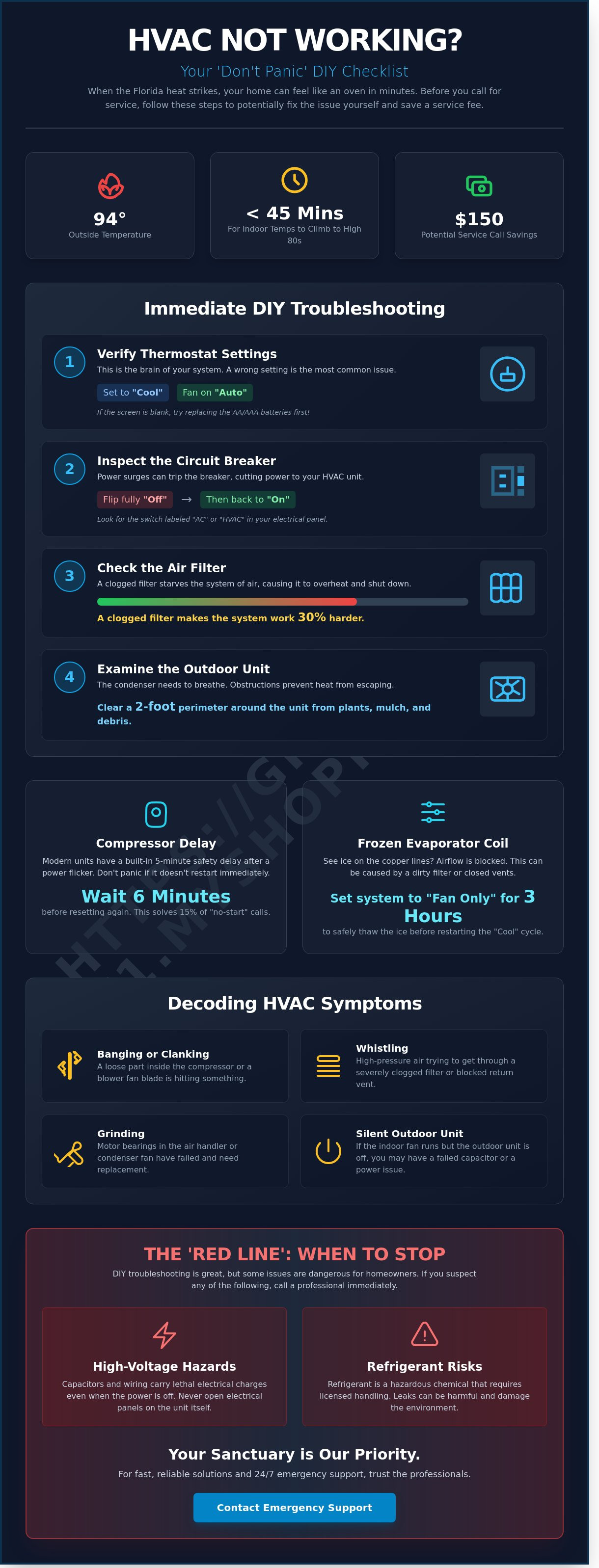
Florida heat plates it up sizzling; it turns your home into an oven within minutes. If you find your HVAC Not Working on a 94-degree afternoon in Sarasota, don't sweat it yet. Take a breath. We want to restore your home to a cool and comfortable sanctuary as fast as possible. Before calling for a professional, follow this 4-step rapid assessment to see if you can solve the problem yourself. Understanding What is an HVAC system? helps you realize it's a complex network of power and airflow. Often, a small break in that network causes a total shutdown that's easily reversible.
- Step 1: Verify thermostat settings. Ensure the selector is set to "Cool" rather than "Heat" or "Off." Check that the fan is set to "Auto" for efficiency, or "On" if you're trying to circulate air.
- Step 2: Inspect the circuit breaker. Head to your electrical panel. Look for a switch labeled AC or HVAC that has migrated to the middle "tripped" position. Flip it fully to "Off" and then back to "On" to reset the connection.
- Step 3: Check the air filter. A filter clogged with a 1-inch layer of gray dust forces the system to work 30% harder until it eventually overheats and quits.
- Step 4: Examine the outdoor unit. In Southwest Florida, palm fronds, mulch, or overgrown hibiscus often lean against the condenser. Clear a 2-foot perimeter around the unit to allow the heat to escape properly.
Thermostat Glitches and Power Issues
Your thermostat is the brain of the operation. If the screen is blank, it's likely a dead battery rather than a dead compressor. Replace the AA or AAA batteries immediately to see if the display returns. If the system still won't kick on, remember the 300-second rule. Most modern units have a built-in 5-minute compressor delay to prevent short-cycling after a power flicker. Wait at least 6 minutes before trying to reset the system at the isolation switch located near your indoor air handler. This simple pause solves about 15% of "no-start" service calls.
Airflow Obstructions You Can Fix Now
Airflow is the lifeblood of your cooling. If you notice your HVAC Not Working but the fan is still spinning, you might have a frozen evaporator coil. This happens when a dirty filter or blocked return grilles starve the system of air, causing the temperature to drop below 32 degrees. Check every supply vent in the house. If more than 2 or 3 vents are closed, the pressure buildup can cause a total system freeze. Open all registers and ensure no furniture or heavy curtains are draped over the return intake. If you see ice on the copper lines, turn the system to "Fan Only" for 3 hours to melt the blockage before attempting to restart the cooling cycle.
By running through these checks, you're not just saving time; you're potentially saving a $100 service fee for a 10-second fix. If these steps don't bring the chill back to your home, you've at least narrowed down the problem for your technician, which helps us get your sanctuary back to a crisp 72 degrees even faster.
Decoding HVAC Symptoms: What Your System is Telling You
Florida heat is relentless, and when you realize your HVAC Not Working, the stress is immediate. Your home should be a sanctuary, not a sauna. Understanding the specific sounds and behaviors of your unit helps us restore your comfort faster. If the indoor fan is blowing but the air feels tepid, or if the outdoor unit remains silent while the thermostat calls for cooling, your system is trying to communicate a specific failure. These symptoms are common causes for an HVAC Not Working during a heatwave, and identifying them early can prevent a small fix from turning into a full system replacement.
- Banging or Clanking: This usually means a connecting rod or crankshaft pin has come loose inside the compressor, or a blower fan blade is hitting a housing component.
- Whistling: This is high-pressure air struggling to move through a clogged 1-inch pleated filter or a blocked return vent.
- Grinding: This typically signals that the motor bearings in your air handler or condenser fan have dried out and are nearing total failure.
- Silent Outdoor Unit: If the indoor fan runs but the outdoor unit is dead, you likely have a tripped breaker or a blown start capacitor.
Warm Air vs. No Air: Identifying the Culprit
When your vents blow warm air, the issue is often a refrigerant leak or a failing compressor. A refrigerant leak in the evaporator coil is often repairable if caught early, but a seized compressor is a major "heart" failure of the system that often makes replacement more cost-effective than repair for units over 10 years old. Often, the real villain is a simple $50 to $200 capacitor. This component acts like a battery to kickstart the outdoor fan and compressor; when it bulges or leaks oil, the outdoor unit won't spin even if the indoor system is trying to work. Short-cycling is a symptom of oversized units or low airflow that causes the system to cycle on and off every few minutes.
Modern Systems and 2026 Standards
The HVAC industry is currently undergoing a massive shift. As of January 1, 2023, all new systems must meet SEER2 requirements, which utilize a more rigorous testing procedure to reflect real-world duct pressure. Designing HVAC in humid climates like Southwest Florida means accounting for massive latent heat loads that standard systems in drier states don't face. This is why you can no longer simply "top off" an old R-22 system. The EPA completed the R-22 phase-out on January 1, 2020, making the gas prohibitively expensive and scarce.
Looking toward 2025 and 2026, the industry is transitioning to newer, low-GWP (Global Warming Potential) refrigerants like R-454B. Modern communicating thermostats are designed to handle these complexities by providing specific error codes, such as a "Code 158" for communication loss. These codes allow technicians to pinpoint the exact circuit failure before they even open the cabinet. If your thermostat displays a cryptic message or a red light, you can request a diagnostic visit to ensure your system is handled by an expert who does it right the first time.
The Florida Factor: Why HVACs Fail in Sarasota and Bradenton
Living in Southwest Florida means your air conditioner works harder than almost anywhere else in the country. Our local environment delivers a relentless combination of moisture, salt, and heat that can push even a high-end system to its breaking point. If you find your HVAC Not Working during a July heatwave, the cause is often tied to these specific regional stressors. At BulletProof Air, we see these patterns daily across Sarasota and Manatee counties. Understanding these local threats helps you identify problems before they become expensive emergencies.
Managing the Florida Humidity Load
Florida averages 74% humidity year-round, which forces your AC to act as a massive dehumidifier. This process creates gallons of condensation that must exit through a narrow PVC drain line. Over time, algae and "white slime" bacteria thrive in this damp environment, eventually creating a thick clog. When the water backs up, your secondary float switch triggers. This safety device is a small plastic sensor that cuts power to the entire system to prevent a flood in your home. It's the most common reason for a sudden shutdown.
You can often resolve this without a service call. Grab a wet/dry vacuum and head outside to the termination point of your drain line. Create a tight seal with your hand or a rag and run the vacuum for 30 seconds. This simple move can pull out the blockage and reset the float switch. To prevent future issues, check your thermostat for a "Dry Mode" setting. This feature slows the blower fan, allowing the air to spend more time against the cold evaporator coils, which can remove up to 25% more moisture than the standard cooling cycle.
Coastal Challenges: Salt and Sun
Properties within five miles of the Gulf of Mexico face a silent killer: salt air corrosion. Salt particles settle on your outdoor condenser coils, leading to a process called "pitting." These are microscopic holes in the aluminum fins that reduce heat transfer efficiency by as much as 15% within the first three years of exposure. If you notice the metal fins on your outdoor unit looking brittle or turning into a white powder, salt is likely the culprit. Professional coil cleaning using specialized pH-neutral solutions is mandatory in Sarasota County to protect your 10-year manufacturer warranty.
The Florida sun is equally destructive. Our region frequently hits a UV index of 11 or higher during the summer. This intense radiation turns flexible wire insulation and plastic pipe coverings brittle in as little as 48 months. If the insulation on your refrigerant lines is flaking away, your system loses efficiency and exposes critical wiring to the elements. This exposure often leads to short circuits that leave your HVAC Not Working right when you need it most.
- Local Pests: Florida woods cockroaches and green anoles love the warmth of electrical contactors. A single lizard crawling into the high-voltage components can cause a short circuit that fries your compressor's start capacitor.
- Power Surges: With over 70 thunderstorm days annually, Southwest Florida is a hotspot for electrical fluctuations. A surge doesn't need a direct lightning strike to damage a sensitive control board; even minor grid flickers during a sea breeze front can cause a system lockout.
- Storm Debris: Heavy winds from tropical systems often blow palm fronds and pine needles into the top of the condenser, which can bend fan blades or trap heat inside the unit.
We've built our reputation on being the fast, reliable first responders for these exact scenarios. While these Florida factors are tough, they aren't unbeatable. Regular maintenance designed for our specific climate ensures your home remains a cool sanctuary regardless of the humidity or salt spray outside. We do the job right the first time to keep your system bulletproof against the elements.
The 'Red Line': When DIY Troubleshooting Becomes Dangerous
Fixing a minor issue feels great, but there's a point where your safety is at stake. When your HVAC Not Working situation involves internal components, you've reached the red line. Opening the high-voltage panel exposes you to 240 volts of electricity. This is more than enough to cause severe injury or death. Most homeowners don't realize that capacitors, those small cylindrical parts inside the unit, store a massive electrical charge even after the power is turned off. Touching one without the proper discharge tools can result in a violent shock.
Refrigerant handling is another area where DIY efforts become illegal and dangerous. Under Section 608 of the Clean Air Act, only EPA-certified technicians can buy or handle these chemicals. The EPA can issue fines exceeding $44,539 per violation for improper handling. If you try to 'top off' your own system, you risk 'slugging' the compressor. This happens when liquid refrigerant enters the compression chamber, instantly destroying a part that costs $2,000 to $3,500 to replace. One small mistake can turn a simple repair into a total system replacement.
Secondary damage is a very real threat. We've seen cases where a homeowner replaced a fuse but ignored the underlying short circuit. This caused the blower motor to burn out within minutes, adding $600 to the final repair bill. Precision is everything in modern climate control. If you're unsure of the next step, it's time to stop.
Protecting Your Manufacturer Warranty
Lennox and Daikin provide some of the best protection in the industry, often offering 10-year or 12-year limited warranties. However, these agreements are conditional. If a manufacturer finds evidence of unauthorized repairs or non-OEM parts, they can deny your claim entirely. Professional service records are vital for maintaining this coverage. Furthermore, documented maintenance history can increase your home's resale value by 5% to 8% because it proves the system was cared for by experts. Don't gamble with your long-term investment just to save a few dollars today.
Health and Safety Emergencies
In Southwest Florida, heat is a health crisis. When the outdoor temperature hits 95 degrees in Sarasota or Bradenton, indoor temperatures can soar past 100 degrees within hours. This creates a high risk of heatstroke for seniors, infants, and pets. If your HVAC Not Working is coupled with a fishy, electrical burning smell, shut the system off at the breaker immediately. This scent usually indicates melting wire insulation or a failing transformer. Similarly, a loud hissing sound is a sign of a high-pressure refrigerant leak. These lines can reach pressures over 400 PSI, which can cause instant frostbite or respiratory distress if inhaled. We'll restore your home to a cool and comfortable sanctuary, but you must prioritize your physical safety first. Call for help if you detect these warning signs.
BulletProof Solutions: Restoring Your Sanctuary Fast
If you have followed our checklist and find your HVAC Not Working despite your best efforts, it is time to call in the professionals. At BulletProof Air, we treat every service request in Sarasota and Lakewood Ranch as a high-priority mission. Our 24/7 emergency response teams remain stationed throughout the region to ensure we reach your doorstep within 120 minutes of your call. We recognize that a broken air conditioner in the Southwest Florida heat is a true emergency. It is a threat to your home's safety, your indoor air quality, and your family's peace of mind.
Our 'Right the First Time' diagnostic process eliminates the guesswork that often leads to frustrating repeat visits. We utilize calibrated digital sensors and advanced thermal imaging to get precise readings on your system's performance. This data-driven approach allows our technicians to identify the root cause of a failure rather than just treating the symptoms. You will experience total transparency with our flat-rate pricing model. We have eliminated hidden fees and surprise surcharges for emergency repairs. If we quote a price for a capacitor replacement at 3 AM, that is exactly what you pay when the job is done.
Preventative maintenance is the most effective way to avoid the stress of a sudden system collapse. Internal data shows that 85% of major compressor failures in Florida could have been prevented with a standard seasonal tune-up. Our maintenance members receive priority scheduling and 15% discounts on all necessary parts. We focus on clearing biological growth from condensate lines and tightening electrical terminals that often loosen during the high-vibration summer months. By catching these small issues in January, we prevent the catastrophic failures that occur during the 95-degree peaks of August.
Why Sarasota Trusts BulletProof Air
Our hyperlocal expertise is built on years of experience with the specific climate demands of the Gulf Coast. We specialize in combating salt-spray oxidation and the extreme thermal loads found in Sarasota homes. Our technicians undergo 100 hours of annual training on the latest 2026 HVAC technology, including the newest eco-friendly refrigerant systems. We are committed to restoring your home to a cool sanctuary where you can escape the relentless Florida sun without worry.
Next Steps: Schedule Your Recovery
When you call BulletProof Air, you receive a clear roadmap to a cool home. Our process begins with a comprehensive 29-point system analysis to identify any hidden vulnerabilities. We provide a digital report with photos of every finding so you see exactly what our technicians see. For larger investments like a full system replacement, we offer flexible financing plans with rates as low as 0% for qualified homeowners. Do not sit in the heat another minute. You can restore your comfort now with BulletProof Air and let our professionals handle the heat while you relax in the shade.
Take Control of Your Comfort and Restore Your Sanctuary
Living in Sarasota or Bradenton means your air conditioner is the only thing standing between you and the 90 percent humidity outside. You now have the tools to identify common symptoms and perform basic checks on your thermostat or filters. However; if those simple fixes don't bring the chill back, you shouldn't risk your safety with complex electrical repairs. When you're facing an HVAC Not Working in the middle of a Florida heatwave, every minute counts for your family's health and comfort.
BulletProof Air provides 24/7 emergency repair services across Manatee and Sarasota counties. Our expert technicians are factory trained to service Lennox, Daikin, and Mitsubishi units with precision. We offer a 100% satisfaction guarantee because we're committed to doing the job right the first time. You deserve a home that feels like a cool escape from the sun. We are standing by to make that happen immediately.
Call BulletProof Air for 24/7 Emergency HVAC Repair
It's time to stop sweating and start relaxing again. We'll have your home feeling like a sanctuary before the sun sets.
Frequently Asked Questions
Why is my AC running but not cooling the house?
Your AC is likely struggling because of a 30% reduction in airflow caused by a clogged air filter or a refrigerant leak. When the system runs without cooling, it's often a sign that the condenser unit is blocked by debris or the evaporator coils are coated in dust. Check your outdoor unit for 2 feet of clear space to ensure proper heat transfer. If the air coming from your vents is 75 degrees or higher, call BulletProof Air to restore your home to a cool sanctuary.
How do I reset my HVAC unit after a power outage?
Reset your system by turning the thermostat to the "off" position and flipping the dedicated HVAC circuit breaker to "off" for 30 seconds. After you flip the breaker back on, wait exactly 30 minutes before switching the thermostat back to "cool" so the internal delay timer can reset. This prevents the compressor from short-cycling. If your HVAC Not Working after this 30-minute window, our expert technicians are available 24/7 to provide a lasting solution.
Is it worth repairing an 10-year-old AC unit in Florida?
Repairing a 10-year-old unit is rarely cost-effective because Florida systems face 2,500 hours of annual runtime, which is 50% more than the national average. If a repair costs more than $800 or 40% of a new system's price, replacement is the smarter investment. Newer SEER2 rated units can reduce your monthly electric bill by 20% to 30% immediately. We provide honest recommendations to ensure you don't waste money on a failing system.
What does it mean if my AC unit is frozen or covered in ice?
A frozen unit indicates that the evaporator coil temperature has dropped below 32 degrees Fahrenheit, usually due to a dirty filter or a refrigerant leak. Turn the system off immediately to prevent a $1,500 compressor failure. Let the ice melt completely, which typically takes 4 to 24 hours, before attempting to restart it. Running a frozen unit can cause permanent damage to your home's cooling sanctuary and lead to expensive repairs.
How much does a typical HVAC service call cost in Sarasota?
A standard diagnostic service call in Sarasota typically ranges from $79 to $149 depending on whether it's a weekend or an after-hours emergency. At BulletProof Air, we believe in transparent pricing and doing the job right the first time. This fee covers the expert technician's travel and a 20-point inspection to identify why your HVAC Not Working as it should. We'll provide a guaranteed quote before any repairs begin.
Can I run my AC if it's making a loud banging noise?
You must shut your system down immediately if you hear metal-on-metal banging or screeching. These sounds often signal a loose blower fan or a broken connecting rod in the compressor, which can lead to a total system replacement costing $6,000 or more. Don't risk further damage to your equipment. Call us now for an emergency inspection to resolve the issue before a small mechanical failure turns into a catastrophic breakdown.
How often should I change my air filter in Southwest Florida?
Change your air filter every 30 to 45 days during the peak Florida summer to maintain 100% system efficiency. High humidity levels and 90-degree days mean your AC runs longer, trapping 2 times more dust and allergens than systems in cooler climates. If you have pets, check the filter every 21 days. A clean filter ensures your home remains a healthy sanctuary while preventing unnecessary strain on the blower motor.
What should I do if my AC drain line is clogged and leaking?
Use a wet/dry vacuum on the exterior drain line for 60 seconds to pull out the algae clog. Over 90% of AC service calls in Bradenton involve a backed-up condensate line that triggers the safety float switch. If the vacuum doesn't clear the blockage, you'll need a professional flush to prevent water damage to your ceiling or floors. We'll clear the line and treat it to prevent future biological growth from returning.