

Air Conditioner Not Cooling? 7 Troubleshooting Steps for Florida Homeowners
Imagine it’s a Tuesday afternoon in Bradenton and the outdoor thermometer just hit 96 degrees. You walk inside expecting a cool sanctuary, but instead, you’re met with a wall of stagnant, humid air. Finding your Air Conditioner Not Cooling isn’t just an inconvenience in Southwest Florida; it’s a household emergency that can send your indoor humidity levels soaring above 65% in less than three hours. We understand that immediate spike in anxiety. You’re likely staring at the thermostat, dreading a potential $1,200 repair bill and wondering if you have the tools to fix the problem yourself.
Sometimes the fix is electrical or plumbing-related. The capacitor is a small, silver cylinder that acts like a high-powered battery to kickstart your compressor and fan motor. In the intense heat of Bradenton and Sarasota, these parts often fail after 4 to 6 years of heavy use. If you hear a humming sound from your outdoor unit but the fan isn't spinning, a blown capacitor is the likely culprit. Additionally, your system removes gallons of water from the air every day. If your condensate drain line clogs with algae, a safety float switch will trigger once just 1/4 inch of water backs up, cutting power to the unit to prevent a flood. If you suspect a more serious mechanical failure, it is time to call for professional Air Conditioning Repair to restore your home's comfort safely.
The good news is that you don't always need a service van in the driveway to get the air moving again. You can often restore your home's comfort without spending a dime on professional labor. This guide will help you identify exactly why your system is running but failing to chill your living space. We’ve compiled 7 professional troubleshooting steps that can lead to an immediate drop in your indoor temperature. From checking your drainage to inspecting the outdoor condenser, you’ll learn how to handle the basics before you decide to call in a trusted expert for the heavy lifting.
Key Takeaways
- Learn how to perform immediate DIY checks on your thermostat and air filter to resolve the most common causes of an Air Conditioner Not Cooling.
- Understand why Sarasota’s extreme humidity and salt air require specific maintenance strategies to prevent frozen coils and coastal corrosion.
- Use the "5,000 Rule" to calculate exactly when it becomes more cost-effective to replace your unit with a high-efficiency SEER2 system than to keep repairing it.
- Identify the "technical culprits" like refrigerant leaks and evaporator issues that demand professional intervention to protect your family’s health and comfort.
- Discover how to restore your home to a cool sanctuary quickly with 24/7 emergency services and our "Right the First Time" guarantee.
Immediate DIY Checks: Why Your AC is Running but Not Cooling
Florida doesn't just serve heat; it plates it up sizzling, like the sun decided to open a year-round pop-up shop in your backyard. When you realize your Air Conditioner Not Cooling your home, the panic sets in fast. Your house should be a sanctuary, not a sauna. Before you call BulletProof Air for an emergency repair, check these four common culprits. You might save yourself a service fee with a 30 second fix that restores your comfort immediately.
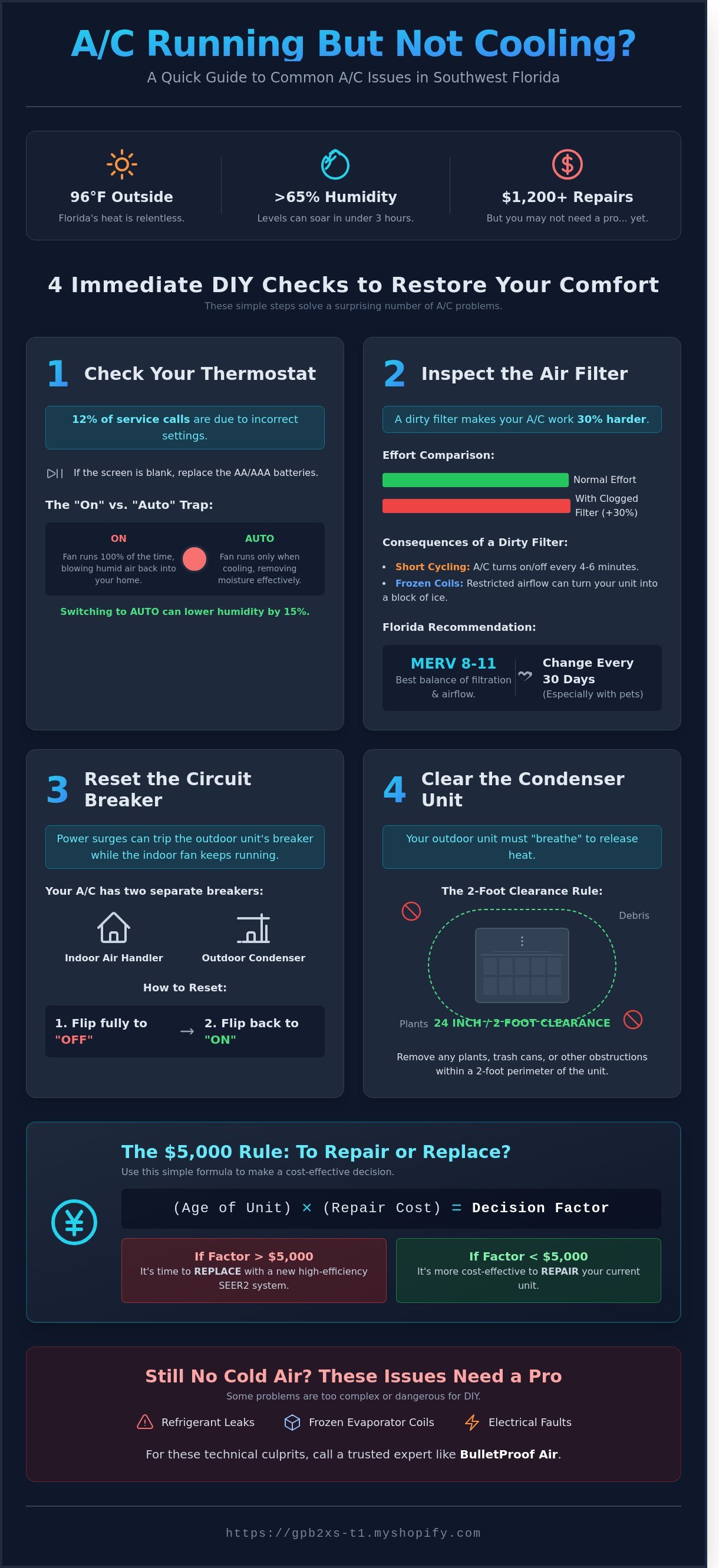
Start by walking to your thermostat. It sounds simple, but 12% of our service calls in Sarasota involve a thermostat that was bumped or set incorrectly by a guest or child. If the screen is blank, replace the batteries immediately. Most modern units require two AA or AAA batteries to maintain a signal to the control board. If the display is active but the air feels humid, the "Fan" setting is likely the reason why your Air Conditioner Not Cooling the air effectively.
The "On" vs. "Auto" Thermostat Trap
Many homeowners mistake the "On" setting for a way to get maximum cooling. It actually tells your indoor fan to run 100% of the time, even when the outdoor compressor is resting. This results in unconditioned, humid air blowing through your vents during the "off" cycles. You'll know your thermostat is losing its signal or calibration if the display flickers or the temperature reading stays 4 degrees above the actual room temperature. Auto mode is the primary setting for moisture removal.
Using the "Auto" setting ensures the fan only blows when the refrigerant is actually cold. This prevents the moisture that was just removed from your air from being blown right back into your living room. If you notice your home feels "sticky" despite the temperature being 72 degrees, check this setting first. A simple flip of this switch can lower your indoor humidity by 15% within a few hours.
Air Filter Red Flags
A dirty filter is the top cause of restricted airflow and system failure. When dust blocks the return, your unit works 30% harder to pull in air, which leads to "short cycling." This is where the AC turns on and off every 4 to 6 minutes without ever reaching your set temperature. If left unaddressed, the evaporator coil will drop below freezing, turning your unit into a block of ice. Check out our guide on No AC? What to Check Before You Call for Service to see if your system needs a professional thaw.
For Florida homes, we recommend a MERV 8 or MERV 11 filter. These provide the best balance of filtration and airflow without putting undue stress on the motor. If you have pets, change these every 30 days during the peak of summer. A filter that looks gray or "fuzzy" is already past its expiration date and is actively costing you money on your electric bill.
Look at your electrical panel next. Your AC system uses two separate breakers: one for the indoor air handler and one for the outdoor condenser. It's common for the outdoor breaker to trip due to a local power surge while the indoor fan keeps spinning. If the outdoor unit isn't humming, flip the switch all the way to "Off" then back to "On." This resets the connection and can often kickstart the cooling process instantly.
While you're outside, inspect the condenser unit for Sarasota sand buildup or overgrown landscaping. Understanding how air conditioning works requires knowing that the outdoor unit must release heat into the atmosphere to function. If plants, trash cans, or debris are within 24 inches of the unit, that heat stays trapped. Clear a 2 foot perimeter around the base to ensure your BulletProof Air system can breathe and deliver the cold air your family deserves.
The Technical Culprits: From Frozen Coils to Refrigerant Leaks
When the Florida sun is beating down at a relentless 95 degrees, your home should be a cool sanctuary. If your Air Conditioner Not Cooling is the primary issue, the problem often lies deep within the mechanical heart of the system. While some fixes are as simple as a battery change, these technical hurdles require a deeper understanding of how your unit breathes and moves heat. At BulletProof Air, we see these specific failures daily across Southwest Florida, and knowing what to look for can save you from a total system meltdown.
Why Do AC Coils Freeze in the Heat?
It seems like a contradiction to find a block of ice on your unit when it is sweltering outside. This happens because of a breakdown in the heat exchange process. Your evaporator coil needs a steady stream of warm indoor air to keep the refrigerant from getting too cold. If airflow is restricted by a filthy filter or blocked returns, the refrigerant temperature drops below 32 degrees. Moisture in the air then hits those freezing copper lines and turns instantly to ice. Regular maintenance of your air conditioner, including checking your coil for dust buildup, is the best way to prevent this icy disaster.
- Turn the system off at the thermostat immediately to stop the cooling cycle.
- Switch the fan setting to "On" to circulate air and help the ice melt naturally.
- Never run the unit in "Heat" mode to speed up thawing; this can cause extreme pressure changes that damage your compressor.
- Check your air filter; if it's gray and caked with dust, replace it once the ice has melted.
The Truth About Refrigerant Top-offs
There is a common myth that AC units simply "use up" refrigerant over time. In reality, your air conditioner is a closed-loop system. If your refrigerant levels are low, you have a leak that needs a permanent repair. Adding more "Freon" without fixing the hole is like trying to fill a bucket with a hole in the bottom. If your unit was manufactured before January 1, 2010, it likely uses R22 refrigerant, which has been phased out and is now extremely expensive to source. Newer units use R-410A, which is more environmentally friendly but still requires a sealed environment to function.
Signs of a leak include a noticeable hissing sound near the indoor or outdoor unit. You might also spot a greasy, oily residue on the copper lines, as refrigerant is mixed with oil to lubricate the compressor. If you notice these signs, your Air Conditioner Not Cooling won't get better with a quick fix. You need an expert to find the leak, seal it, and recharge the system to factory specifications.
Capacitors and Clogged Drains
Sometimes the fix is electrical or plumbing-related. The capacitor is a small, silver cylinder that acts like a high-powered battery to kickstart your compressor and fan motor. In the intense heat of Bradenton and Sarasota, these parts often fail after 4 to 6 years of heavy use. If you hear a humming sound from your outdoor unit but the fan isn't spinning, a blown capacitor is the likely culprit. Additionally, your system removes gallons of water from the air every day. If your condensate drain line clogs with algae, a safety float switch will trigger once just 1/4 inch of water backs up, cutting power to the unit to prevent a flood. If you suspect a more serious mechanical failure, it is time to consult with a professional technician to restore your home's comfort safely.
The Florida Heat Factor: Why SW Florida AC Units Fail Differently
Living in Southwest Florida means your cooling system faces a set of environmental stressors that northern units never encounter. While a system in Ohio might run for 1,000 hours a year, a unit in Sarasota or Bradenton often clocks between 2,500 and 3,500 run hours annually. This constant operation means your components age 2x faster than the national average. If you find your Air Conditioner Not Cooling during a July heatwave, it is often because the mechanical parts have simply reached a point of exhaustion from these relentless cycles.
The intensity of the sun isn't the only culprit. Our local climate forces systems to work overtime to manage latent heat, which is the energy required to strip moisture from the air. When humidity levels hover at 90 percent, your AC spends nearly 30 percent of its energy just dehumidifying your home before it can even begin to lower the actual temperature. This creates a massive strain on the compressor and fan motors, leading to premature failures that leave homeowners in a sweat.
Coastal Corrosion in Sarasota & Bradenton
Salt air acts as a silent killer for HVAC systems located within 5 miles of the Gulf. Sodium chloride particles accelerate galvanic corrosion, a chemical reaction that eats away at aluminum fins and copper coils. Residents near Siesta Key or Longboat Key often see their outdoor condensers literally crumble into white powder after just 5 or 6 years. Our "BulletProof" maintenance protocols include specialized coil rinsing and protective coatings to neutralize these salts. Without this specific care, your unit's heat exchange efficiency can drop by 20 percent in a single season.
The Humidity-Cooling Connection
If your home feels "heavy" or damp even though the vents are blowing, your system is failing its primary Florida job: moisture removal. A standard 3-ton unit in a 2,000-square-foot Sarasota home can pull up to 20 gallons of water from the indoor air every 24 hours. This liquid must exit through a narrow 3/4-inch PVC drain line. Because our environment is so warm and damp, these lines frequently become clogged with "algae bloom" or biological slime, causing the system to shut down entirely to prevent a flood.
Biological growth also contributes to "Dirty Sock Syndrome," where bacteria build up on the evaporator coils and release a pungent, musty odor. This growth acts as an insulator, preventing the refrigerant from absorbing heat effectively. When your system struggles against this buildup, you face a difficult decision regarding Repairing Your AC vs. Replacing It, especially if the coils are pitted or leaking. A system that cannot breathe cannot cool, and in Florida, that quickly turns your home from a sanctuary into a sauna.
Don't ignore the warning signs of a struggling unit. A spike in your FPL bill or a Air Conditioner Not Cooling the way it used to are clear indicators that the Florida elements are winning. Your system requires a professional touch that understands the specific chemistry of our coastal air and the mechanical demands of our 10-month summers. We focus on restoring your comfort quickly because we know that in this heat, every hour counts for your family's safety and health.
The Cost of Waiting: When to Repair vs. Replace Your HVAC System
If you've reached the point where your Air Conditioner Not Cooling is a recurring nightmare, you face a difficult decision. Do you sink more money into a failing unit or invest in a new one? At BulletProof Air, we help homeowners use the 5,000 Rule to make an objective choice. You simply multiply the age of your unit by the estimated repair cost. If the result exceeds $5,000, a replacement is the smarter financial move. For example, an 11 year old system requiring a $600 motor replacement equals $6,600. That money is better utilized as a down payment on a system that won't leave you sweating next week.
Florida heat is relentless. When temperatures hit 100 degrees in July, an aging system often lacks the mechanical stamina to keep up. Most units manufactured before 2015 were designed for lower efficiency standards; they struggle to maintain a 20 degree difference between the outdoor air and your indoor sanctuary. Beyond comfort, safety is a primary concern. Electrical components that have weathered ten years of Southwest Florida humidity can become fire hazards. Refrigerant leaks in older R-22 units are also a "money pit" because that specific gas was phased out by the EPA in 2020, making repairs exorbitantly expensive.
The SEER2 Advantage in 2026
The Department of Energy updated efficiency standards in 2023, moving the industry to the SEER2 rating system. In Florida, the minimum requirement for residential systems is now 14.3 SEER2. Upgrading from a 10 year old 10 SEER unit to a modern 16 or 18 SEER2 system can slash your monthly electric bills by 30% immediately. These modern units utilize variable-speed compressors. Unlike older single-stage units that are either "all on" or "all off," variable-speed technology adjusts to the exact cooling needs of your home. This provides superior humidity control, which is vital when Bradenton humidity levels hover at 90%.
Emergency Repair vs. Scheduled Replacement
Waiting for a total compressor failure is the most expensive way to manage your home. When your Air Conditioner Not Cooling becomes a midnight emergency in the middle of August, you are at the mercy of "breakdown" pricing and limited inventory. A planned replacement allows you to choose the best system for your budget without the stress of an overheated home. You can take advantage of seasonal rebates and manufacturer incentives that aren't available during emergency calls.
- Predictable Budgeting: Scheduled installs avoid the 24/7 emergency service premiums.
- Financing Flexibility: We offer "BulletProof" financing options that turn a major investment into a low monthly payment.
- Reliability: A new installation ensures your home remains a cool sanctuary for the next 12 to 15 years.
- Warranty Protection: Most new systems come with 10 year parts warranties, eliminating the fear of surprise repair bills.
We believe in doing the job right the first time. If your current unit requires frequent "band-aid" fixes, it's time to stop the cycle of stress. Our expert technicians provide honest recommendations based on the actual condition of your equipment, not just its age. We want to ensure your family stays safe and comfortable regardless of how high the Florida sun climbs.
Don't wait for the next heatwave to leave you stranded. Schedule your professional system evaluation now and discover how affordable a high-efficiency upgrade can be.
Fast, Reliable AC Repair in Sarasota: Restoring Your Sanctuary
Florida summers don't just feel warm; they feel like a physical weight. When you realize your Air Conditioner Not Cooling as it should, your home stops being a refuge and starts being a hazard. BulletProof Air provides a shield against this heat for every resident across Southwest Florida. We don't just swap parts. We deliver a "Right the First Time" guarantee that ensures your system returns to peak performance after a single visit. Our team treats every service call with the urgency it deserves because a 90-degree indoor temperature isn't just uncomfortable; it's a risk to your family's health and your home's integrity.
Our 24/7 emergency response team operates on the reality that HVAC failures rarely happen during a convenient 9-to-5 window. Whether it's 2:00 AM on a Tuesday or mid-afternoon on the Fourth of July, our technicians are dispatched immediately. We've spent over 15 years refining our diagnostic process to identify the root cause of a failure within the first 30 minutes of arrival. You won't find guesswork here. We provide honest recommendations and lasting solutions that prevent the same component from failing again next month. We believe in transparency, which is why we explain every repair before we turn a single wrench.
Every technician on our roster undergoes rigorous brand-specific training to stay ahead of evolving HVAC technology. We specialize in high-efficiency systems from industry leaders like Lennox, Daikin, and Mitsubishi. These complex machines require more than general knowledge; they require precision calibration and specialized diagnostic tools that many general handymen simply don't carry. By maintaining these high standards, we ensure that your manufacturer warranty remains intact while your home returns to the cool sanctuary you deserve. We focus on the technical details, from checking static pressure to verifying subcooling levels, so your system runs at the efficiency levels promised by the manufacturer.
Why Lakewood Ranch & Bradenton Trust BulletProof Air
Local homeowners in Lakewood Ranch and Bradenton require a service partner who understands the unique demands of high-end residential systems. We maintain a fleet of fully stocked "rolling warehouses" stationed throughout Manatee and Sarasota counties to ensure we arrive in under 60 minutes for most emergency calls. Our experts are specifically trained to handle the intricate ductwork and multi-zone configurations common in these newer developments. We know the local codes and the local climate better than anyone else in the region. Schedule Your Emergency AC Repair in Lakewood Ranch Now to experience the BulletProof difference.
Join the Maintenance Plan for Year-Round Peace of Mind
The most effective way to handle an Air Conditioner Not Cooling is to stop the problem before it starts. Our BulletProof Maintenance Plan includes two comprehensive 21-point inspections annually to catch worn capacitors, pitted contactors, or clogged drain lines before they cause a total system shutdown in the middle of a heatwave.
- Priority Scheduling: Plan members move to the front of the line, even during the record-breaking heat of August.
- Significant Cost Savings: Enjoy a 15% discount on all parts and labor for any necessary repairs identified during your tune-up.
- Extended Equipment Lifespan: Regular cleaning and professional tuning can add 3 to 5 years to the life of your condenser and air handler.
Membership isn't just about repairs; it's about the security of knowing your equipment is being watched over by professionals. Protect your home and your wallet with a BulletProof Maintenance Plan and enjoy the confidence of a system that's ready for the relentless Florida sun.
Restore Your Cool Sanctuary Today
Your home shouldn't feel like a sauna when the Florida sun hits its peak. While checking your thermostat settings or replacing a clogged 1-inch air filter can resolve basic issues, an Air Conditioner Not Cooling often points to serious technical failures like frozen coils or low refrigerant levels. In Southwest Florida, these components work twice as hard to combat 90 percent humidity, making professional intervention vital to prevent a total system breakdown. Our certified Lennox and Daikin technicians are stationed across Sarasota and Bradenton to provide 24/7 emergency support when you need it most. We back every repair with a 100 percent satisfaction guarantee because we believe in doing the job right the first time. Don't risk your family's comfort by waiting for the heat to intensify. We're ready to bring the chill back to your living room right now.
Need Emergency AC Repair? Call BulletProof Air 24/7!
You can breathe easy knowing your comfort is in expert hands.
Frequently Asked Questions
Why is my AC running but not blowing cold air?
Your air conditioner is likely suffering from a clogged condenser unit or a frozen evaporator coil. Statistics show that 85% of these cooling failures stem from restricted airflow caused by dirt and debris. This buildup prevents the system from releasing heat, which forces the unit to run constantly without lowering the temperature. Check your outdoor unit for grass clippings or leaves that might block the fins. If the exterior is clear, you likely have an internal issue that needs a professional touch to restore your sanctuary.
How long can I run my AC if it is not cooling?
You shouldn't run your system for more than 15 to 20 minutes if you notice the air conditioner not cooling. Operating a malfunctioning unit for a full 24 hour cycle can lead to a total compressor burnout, which costs upwards of $2,500 to replace in 2024. Turn the system off at the thermostat immediately to prevent permanent mechanical damage. Our team provides 24/7 emergency support to diagnose these issues quickly and keep your repair costs manageable.
Should I turn off my AC if it is not blowing cold air?
Yes, you must turn the system off immediately to prevent the motor from overheating or the coils from icing over. When a unit runs without cooling, it wastes 100% of the energy it consumes and risks a catastrophic mechanical failure. Switching the system to "off" allows any frozen components to thaw, which typically takes 4 to 12 hours in the Florida humidity. Call us now to schedule a fast repair before the indoor heat becomes a serious health risk for your family.
How much does it cost to fix an AC that is not cooling in Florida?
Repair costs in Southwest Florida generally range from $150 to $600 for common fixes like capacitor or fan motor replacements. A standard service call in the Bradenton and Sarasota area starts at $89 plus the cost of parts. While a simple fix is affordable, ignoring the problem can lead to a full system replacement costing $6,000 or more. We provide honest recommendations and guaranteed pricing so you know exactly what to expect before we start the work.
Can a dirty air filter really stop my AC from cooling?
A dirty air filter is the primary cause of cooling failures in 70% of residential service calls. When dust blocks the airflow, the evaporator coil temperature drops below 32 degrees and freezes solid. This ice creates a thermal barrier that stops all heat exchange and leaves your home sweltering. Change your 1 inch pleated filters every 30 days during the peak Florida summer to keep your system running at peak performance and avoid unnecessary breakdowns.
How do I reset my central air conditioner?
Reset your system by turning off the AC at the thermostat and then flipping the dedicated circuit breaker to the "off" position for 30 seconds. This 30 second pause clears the internal logic board and resets the safety sensors that might have tripped. Flip the breaker back on and wait exactly 5 minutes before turning the thermostat back to "cool." If the system doesn't start, it is time for an expert technician to do the job right the first time.
What are the signs of a refrigerant leak?
Look for ice buildup on the copper refrigerant lines or listen for a distinct hissing sound coming from the indoor air handler. A 10% loss in refrigerant levels can spike your monthly energy bill by 20% while the air conditioner not cooling makes your home uncomfortable. You might also notice a faint, sweet chemical smell near the supply vents. These leaks require specialized tools to find and seal, so contact us for a reliable and lasting solution.
Why is my AC blowing warm air after a power outage?
Your compressor likely tripped its internal safety switch or the start capacitor failed during the initial power surge. Florida storms and grid fluctuations cause 35% of these electrical failures, which prevent the outdoor unit from starting even if the indoor fan is blowing. Check your main electrical panel for a tripped breaker and reset it once. If the warm air persists, our expert technicians are available 24/7 to restore your home to a cool and comfortable sanctuary.