

What is Emergency Heat? A Homeowner’s Guide to Thermostat Settings
Imagine waking up at 3:00 AM to a house that feels like an icebox. You check your thermostat and see a blinking light you have never noticed before. Panic sets in as you wonder if your HVAC system is broken. In that moment of distress, you likely find yourself asking, "what is emergency heat," and whether flipping that switch will save your home or skyrocket your electric bill. It is a high-stress situation that leaves many homeowners in Sarasota and Bradenton feeling vulnerable and confused.
We understand that your home is your sanctuary. A heating failure is more than just a minor inconvenience, it is a direct threat to your comfort and safety. You likely believe that keeping your family warm is the only priority, but you also want to avoid the anxiety of a damaged compressor or a massive utility bill. This guide provides the professional clarity you need. We will explain the technical function of EM heat, reveal the three specific scenarios where you should actually use it, and show you how to avoid unnecessary energy costs while keeping your system running with precision.
Key Takeaways
- Understand exactly what is emergency heat and why it functions as a "spare tire" for your home's comfort system during a total mechanical failure.
- Learn the critical difference between "AUX" and "EM" settings to avoid accidentally triggering high-cost heating when your system is just performing a standard defrost cycle.
- Identify the specific mechanical emergencies, such as a seized compressor or physical damage to the outdoor unit, that require you to manually override your system.
- Discover how the efficiency gap between heat pumps and electric resistance strips can impact your Sarasota utility bill if left running unnecessarily.
- Master simple troubleshooting steps, like checking airflow and inspecting for debris, to restore your home's sanctuary before calling for professional repair.
What is Emergency Heat? Defining the Backup System
When the temperature drops and your home feels a sudden chill, you might notice a specific setting on your thermostat labeled "EM Heat" or "Emergency." So, what is emergency heat exactly? At its core, this is a manual setting designed to activate a secondary heating source when your primary system can no longer keep up. It is not an automatic feature that your HVAC system chooses on its own. It is a deliberate override that you, the homeowner, must engage to maintain a safe environment.
Think of emergency heat as the spare tire for your home's comfort. Just as you wouldn't drive on a temporary "donut" tire for a cross-country trip, you shouldn't rely on emergency heat for daily use. It exists specifically for those moments when the main unit is physically broken or unable to function. In most Sarasota and Bradenton homes, this secondary source consists of electric resistance coils located inside your air handler. In some hybrid systems, it might be a backup gas furnace. Regardless of the hardware, flipping this switch tells the system to ignore the outdoor unit entirely and rely solely on this backup. While this guide focuses on heat pumps, homeowners with different heating setups like boilers can find specialized support at ssboilerinstallation.co.uk.
The Role of the Secondary Heat Source
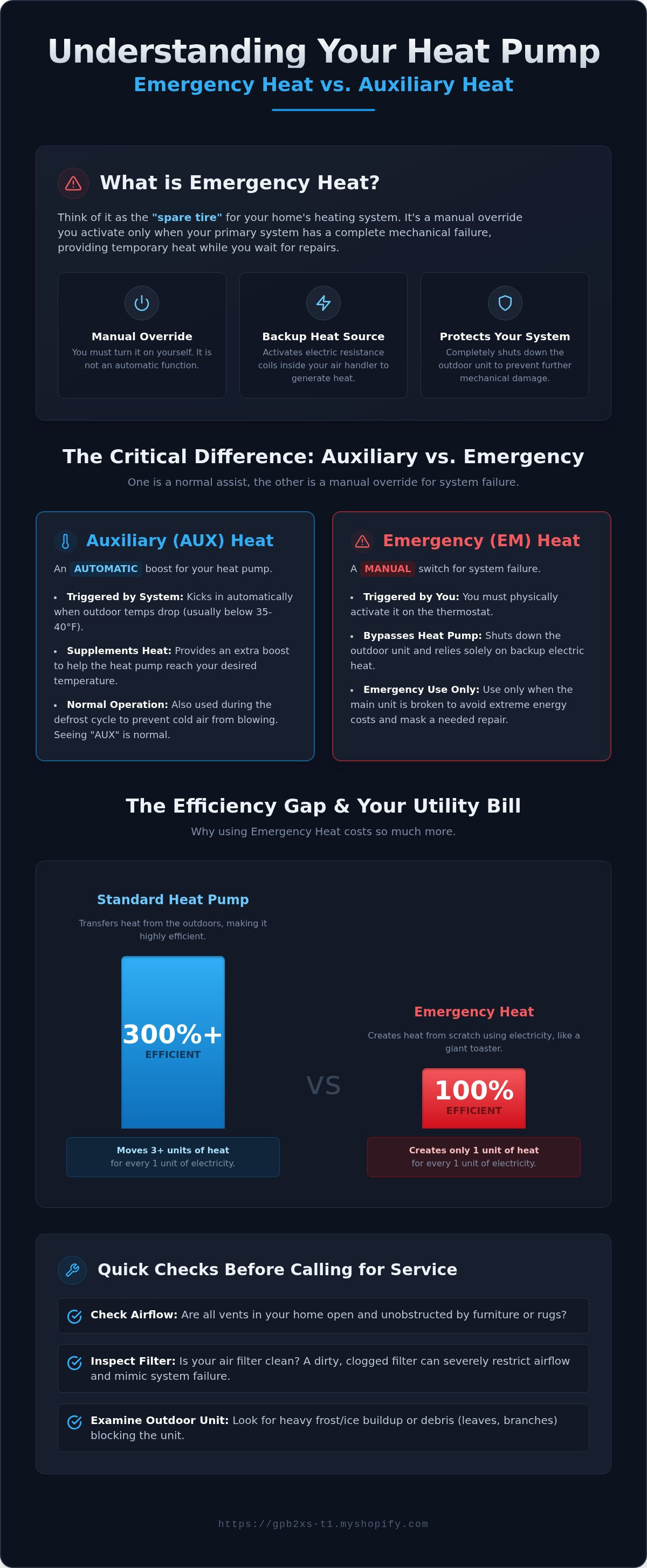
Most modern heat pump systems work by moving heat from one place to another. In the winter, they extract warmth from the outside air and move it indoors. However, when the outdoor unit fails, the system needs a way to create heat from scratch. This is where electric resistance coils come in. These coils work like a giant hair dryer. Electricity passes through the metal, causing it to glow red hot and warm the air passing over it.
- Heat Generation vs. Heat Transfer: Your heat pump is highly efficient because it moves heat. Resistance coils are less efficient because they must create it.
- Freezing Protection: While rare in Southwest Florida, if temperatures stay near freezing for extended periods, the coils provide the necessary boost to protect your pipes and your family.
- Mechanical Bypass: Selecting EM heat shuts down the outdoor compressor completely to prevent further mechanical damage.
Identifying the EM Heat Setting on Your Thermostat
Locating this setting depends on the age of your equipment. On older, manual thermostats, you will often see a physical switch or a button labeled "EMER" or "EM Heat." Many of these models also feature a red indicator light that glows when the setting is active. This light serves as a visual warning that you are using your backup system.
Modern smart thermostats often hide this setting within a "System Mode" or "Settings" menu to prevent accidental activation. When you engage this mode, you are mechanically bypassing the outdoor unit. The system immediately stops trying to communicate with the compressor and sends all power to the backup heat strips. This provides an instant, albeit expensive, solution to a cold house while you wait for a professional technician to arrive and restore your sanctuary.
Emergency Heat vs. Auxiliary Heat: Clearing the Confusion
Seeing "AUX" or "EM" flash on your thermostat can cause immediate anxiety. You might worry your system is failing or that your electric bill is about to spike. While these terms are often used interchangeably by some sources, they represent very different operational modes. Understanding the distinction is the first step toward maintaining a comfortable, efficient home sanctuary during a cold snap.
When Your System Chooses: Auxiliary Mode
Auxiliary heat is an automatic function. Your system triggers this mode when the outdoor temperature drops below a certain threshold, usually between 35 and 40 degrees. At this point, the heat pump can no longer extract enough warmth from the air to meet your indoor setpoint. The system brings on the secondary heat strips to provide a "boost" and keep your home at the desired temperature.
This mode is also essential during the defrost cycle. When frost builds up on the outdoor coils, the system temporarily reverses its operation to melt the ice. To prevent cold air from blowing through your vents during this process, the auxiliary heat kicks in. Seeing "AUX" on your screen for 10 to 15 minutes is a normal part of heat pump operation and isn't a cause for alarm. Craighead Electric Cooperative explains the efficiency of heat pumps and why these supplemental sources are necessary when the primary unit loses its competitive edge in the cold.
When You Choose: Emergency Mode
Unlike the automatic nature of AUX, emergency mode is a choice you make. When you ask, "what is emergency heat," you are looking at a manual override that completely disconnects the outdoor unit. This sends a specific mechanical signal to the air handler to engage the heating strips while simultaneously locking out the compressor. The system stops trying to move heat from the outside and relies entirely on the internal backup source.
This "lockout" feature is critical. It ensures that if your compressor is seizing or physically damaged, the system won't try to run it. This protects your expensive outdoor equipment from further destruction. If your system seems to be struggling even in mild temperatures, it might be time to schedule HVAC repair to ensure your primary heat source is functioning with precision. By choosing EM mode only when the outdoor unit has failed, you maintain control over your home's safety without wasting energy on a daily basis.
When to Use Emergency Heat (and When to Avoid It)
Deciding when to engage your backup system is a critical choice for any homeowner. Because this mode bypasses your primary equipment, you should only use it during a genuine mechanical crisis. If you find yourself asking "what is emergency heat" during a typical Florida cold snap, remember that your system is designed to handle mild temperature drops automatically. Using the emergency setting when your heat pump is healthy only leads to unnecessary wear and inflated costs. Reserve this switch for the following specific scenarios.
- Physical Damage: If a heavy palm frond or fallen branch has struck your outdoor unit, shut it down immediately. Engaging EM heat allows you to keep your home warm while preventing the fan or internal components from grinding against debris.
- Total Compressor Failure: If your system is running but blowing cold air, the compressor may have seized. Switching to emergency mode provides immediate relief while you wait for a technician.
- Persistent Icing: While some frost is normal, a unit completely encased in a thick block of ice that won't melt after a defrost cycle indicates a problem. EM heat protects the unit from further strain until the ice can be professionally cleared.
Never activate this setting simply because the house feels chilly. Modern heat pumps are incredibly resilient. Let the system manage its own auxiliary heat cycles to maintain your sanctuary's temperature with precision and efficiency.
Signs Your Heat Pump Has Failed
Recognizing a failure before it becomes a total breakdown can save you from a long night in the cold. Listen for odd noises coming from the outdoor cabinet. Grinding, shrieking, or loud metal-on-metal clanging are clear signals of distress. If you hear these sounds, turn off the heat pump and switch to EM heat right away. Another red flag is a stationary outdoor fan. If the thermostat calls for heat but the fan blades aren't spinning, your primary system isn't moving heat. Finally, check for ice buildup. If the coils have been buried under a solid layer of white for several hours without clearing, your unit needs professional attention.
Accidental Activation: The Silent Budget Killer
Accidental activation is a common reason for skyrocketing utility costs. Children or guests often fiddle with thermostat settings and inadvertently switch the system to EM mode. In Sarasota, where the average monthly electricity bill is already around $241, running electric resistance heat unnecessarily can cause that number to double. Always check your thermostat display if you notice a sudden, unexplained jump in your energy usage. Most modern smart thermostats allow you to set "lockouts" or PIN codes. Use these features to prevent accidental changes. This simple step ensures your system only uses high-cost backup heat when a true emergency threatens your home's comfort.
The Efficiency Gap: Why EM Heat Costs So Much
When that red light glows on your thermostat, it isn't just a signal of mechanical failure; it's a warning for your wallet. Understanding what is emergency heat requires looking at the massive energy gap between your standard heat pump and the backup coils. While your primary system is an engineering marvel designed for efficiency, the emergency setting is a brute-force method of keeping you warm. It works, but it comes at a steep price that many homeowners don't realize until the utility statement arrives.
The "Hair Dryer Analogy" is the best way to visualize this consumption. Imagine turning on every hair dryer in your house and leaving them running for hours on end. A typical emergency heat strip uses roughly the same amount of power as 20 hair dryers running at once. This massive electrical draw is why using this setting for even a few days can lead to severe "bill shock" at the end of the month. It is a high-cost solution to a high-stress problem.
Calculating the Cost of Comfort
The Coefficient of Performance (COP) is the ratio of energy consumed to the amount of heat produced. Heat pumps are incredibly efficient because they move existing heat from the outdoors into your home, often achieving a COP of 3.0 to 4.0. This means for every dollar of electricity you spend, you get three to four dollars worth of heat. Moving heat is always cheaper than creating it from scratch.
In contrast, electric resistance heat has a COP of exactly 1.0. It creates heat by forcing electricity through metal coils, meaning every dollar spent equals exactly one dollar of warmth. With Sarasota electricity rates reaching up to $0.18 per kWh for some residents, relying on this 1:1 ratio is a recipe for financial distress. If your system is stuck in this mode, contact our team for Residential HVAC Services to restore your home's efficiency and your peace of mind.
Environmental Impact and System Strain
Beyond the financial cost, emergency heat places a significant burden on your home's electrical infrastructure. Most Florida homes are wired to handle the modest draw of a heat pump compressor, not the intense load of multiple 10kW heating elements. This sudden surge can lead to tripped breakers, especially if you are running other heavy appliances like a clothes dryer or water heater simultaneously.
Relying on these backup systems for long periods also causes excessive wear on your air handler's electrical components. These strips are designed for short bursts of activity during a defrost cycle, not continuous operation. By prioritizing a professional repair, you protect your home's electrical sanctuary and ensure your system remains durable for the long term. Using EM heat is a temporary bridge, not a permanent solution for the unique climate challenges we face in Sarasota and Bradenton.
Troubleshooting Your Heating System in Sarasota
Before you commit to the high energy costs of backup heating, perform a few rapid checks. Many comfort issues stem from simple maintenance lapses rather than total mechanical failure. If you are still wondering what is emergency heat and why your system won't turn off that red light, your first step should be the air filter. A clogged filter restricts airflow. This forces the system to work harder and can trigger auxiliary heat warnings even when the outdoor unit is healthy. Replace your filter monthly during peak usage to maintain total precision in your home's climate control.
Next, step outside and inspect your outdoor unit. Sarasota and Bradenton storms often blow debris, palm fronds, or mulch into the cabinet. Clear away any obstructions that might prevent the fan from spinning or the coils from breathing. If the outdoor unit isn't responding at all, check your electrical panel. A tripped breaker is a common culprit during a sudden cold snap. Reset the breaker once. If it trips again immediately, stop. At this point, relying on EM mode is only a temporary bridge. If EM heat is your only source of warmth, your primary system needs expert attention to restore its durability and efficiency.
When to Call for Professional AC Repair in Sarasota
A failing heat pump compressor is a serious issue that requires a dependable first responder. Waiting to address a grinding noise or a seized fan only leads to more expensive repairs or a total system replacement. You need fast and reliable air conditioning repair to protect your investment. BulletProof Air technicians specialize in the unique climate challenges of Southwest Florida. We act quickly to diagnose the root cause, whether it's a refrigerant leak or a mechanical failure. Our goal is to restore the sanctuary of your home with the accuracy you deserve, ensuring your family stays comfortable without the fear of a broken system.
Preventing Heating Emergencies with Maintenance
The best way to avoid the stress of a cold house is through proactive care. Searching for HVAC services near me before the temperature drops ensures your system is ready for the rare Florida cold snap. A pre-season checkup focuses on critical components like the defrost control board. This board manages the transition between primary and auxiliary heat. If it fails, your system might get stuck in high-cost modes unnecessarily. BulletProof Air maintenance plans provide year-round peace of mind. We inspect your system for wear and tear, clean the coils, and verify that your backup heat only runs when absolutely necessary. This keeps your system resilient and your electric bills predictable.
Restore Your Home's Sanctuary with Confidence
Understanding exactly what is emergency heat empowers you to make the right choice when your system struggles. You now know that while EM heat provides a vital safety net during mechanical failures, its high operational cost makes it a temporary bridge rather than a permanent solution. Protecting your home and your budget requires a primary heat pump that operates with total precision. Don't let a cold house or a skyrocketing electric bill disrupt your peace of mind.
If your outdoor unit is failing or your thermostat is stuck in emergency mode, take action now. Restore your home's comfort with BulletProof Air’s 24/7 Emergency HVAC Repair. As a locally owned and operated business in SW Florida, we provide fast response times for Sarasota emergencies. Our expert technicians use precision diagnostics to avoid unnecessary parts, ensuring your system is fixed right the first time. We are ready to help you reclaim your comfortable environment and keep your family safe.
Frequently Asked Questions
Is it okay to run emergency heat all night?
Yes, it is safe to run emergency heat through the night if your primary system has failed. This setting ensures your home remains a sanctuary during cold snaps. However, you should only do this while waiting for professional repair. Because it relies on electric resistance strips, it consumes significantly more power than your heat pump. Think of it as a temporary safety measure rather than a standard heating mode for your home.
Why is my emergency heat light on when it's not that cold?
Your emergency heat light may be on because someone accidentally bumped the thermostat switch or selected the wrong mode in a digital menu. In some cases, a wiring fault or a failing sensor can also trigger this indicator. If the light stays on during mild Florida weather, check your thermostat settings immediately. Understanding what is emergency heat helps you realize that this light means your outdoor unit is currently bypassed and inactive.
Does emergency heat use more electricity than regular heat?
Emergency heat uses significantly more electricity than your standard heat pump cycle. While a heat pump moves warmth from the outside air, EM heat creates it using high-draw resistance coils. This process is roughly three to four times less efficient than normal operation. If you leave this setting active for several days, you will likely see a substantial increase in your next Sarasota utility bill due to the massive energy consumption.
Can I turn off emergency heat manually?
You can turn off emergency heat manually by changing the mode on your thermostat back to "Heat" or "Auto." Simply navigate your thermostat's interface or flip the physical switch away from the "EMER" position. Once you do this, your outdoor compressor should restart and take over the heating duties. If the house remains cold after switching back, your primary system likely requires professional diagnostics to restore its proper function and efficiency.
What happens if I leave emergency heat on by accident?
Leaving emergency heat on by accident primarily results in "bill shock" at the end of the month. Because the system ignores the efficient outdoor unit, it relies entirely on expensive electrical strips. Prolonged accidental use can also place unnecessary strain on your air handler's electrical components. Always double-check your thermostat display if you notice your vents blowing much hotter air than usual or if your outdoor fan has stopped spinning entirely.
How do I know if my heat pump is actually broken or just in defrost mode?
A defrost cycle is a normal, temporary process that usually lasts between 10 and 15 minutes. During this time, you might see "AUX" on your thermostat or notice steam rising from the outdoor unit. If your system stays in a backup heating mode for hours or if the outdoor unit makes grinding noises, it is likely broken. Realizing what is emergency heat helps you distinguish between these brief maintenance cycles and a total mechanical failure.
Will emergency heat work if the power is out?
No, emergency heat will not work during a total power outage. Both your thermostat and the electric resistance coils in your air handler require a consistent supply of electricity to function. If you lose power in Sarasota or Bradenton, your entire HVAC system will shut down. You would need a large-scale home generator capable of handling the massive electrical load of the heating strips to run EM heat without grid power.
Why does my air smell like it's burning when I turn on EM heat?
A faint burning smell is common when you first activate emergency heat after a long period of disuse. This odor is usually caused by dust and debris burning off the electric resistance coils as they heat up for the first time. The smell should dissipate within 20 to 30 minutes. However, if the smell persists, or if you see smoke or hear crackling, turn the system off immediately and call for an emergency inspection.
If you would like maintenance or repair assistance with your Florida Air Conditioner, contact BulletProof Air Or call: 941.599.9999 for more information about how we can help.