

Whole-Home Air Filtration System Installation: A Homeowner’s Guide
What if a higher-rated filter makes your HVAC system work harder instead of making your home feel fresher? It’s a reasonable concern. Central HVAC can work with added filtration, but the right setup depends on the equipment, airflow, and your household’s priorities. Whole home air filtration system installation isn’t simply a matter of choosing the strongest filter and fitting it in place.
The practical first step is to identify what you want to address, then match the filtration approach to your home. Filter ratings compare how effectively filters capture certain particles, but a higher rating isn’t automatically the best fit for every system. The filter’s dimensions, location, and compatibility with your equipment also matter.
In this guide, you’ll learn how whole-home filtration works with central HVAC, what a technician evaluates, and how to compare options without expecting a filter to capture everything. BulletProof Air provides indoor-air-quality solutions for homes in Sarasota and across Southwest Florida, helping homeowners consider a setup suited to their equipment, home, and occupants.
Key Takeaways
- Whole-home filtration works alongside central HVAC to treat circulating air, but it doesn’t control temperature or moisture.
- Filter size and compatibility matter. The right choice should suit your equipment and avoid unnecessary airflow strain.
- Compare central HVAC filtration and portable units based on your goals, home setup, and upkeep needs.
- During whole home air filtration system installation, a technician assesses your HVAC equipment, ducts, available space, and household priorities.
- BulletProof Air provides indoor-air-quality solutions tailored to homes and existing systems in Sarasota and Southwest Florida.
What Does Whole-Home Air Filtration System Installation Do?
Whole-home air filtration connects air treatment to a home’s central HVAC system, where a filter captures some airborne particles as air circulates through the equipment and ductwork. Unlike a portable purifier that treats air in one room or zone, a central setup treats air moving through compatible equipment before it travels through the supply ducts to the rooms they serve.
Filtration has a specific job. It doesn’t heat or cool your home, and it doesn’t directly manage indoor moisture. Those functions depend on other parts of the HVAC system or separate solutions. A well-planned whole home air filtration system installation starts by defining your concern and understanding how your existing system moves air.
Whole-home filtration versus portable air purifiers
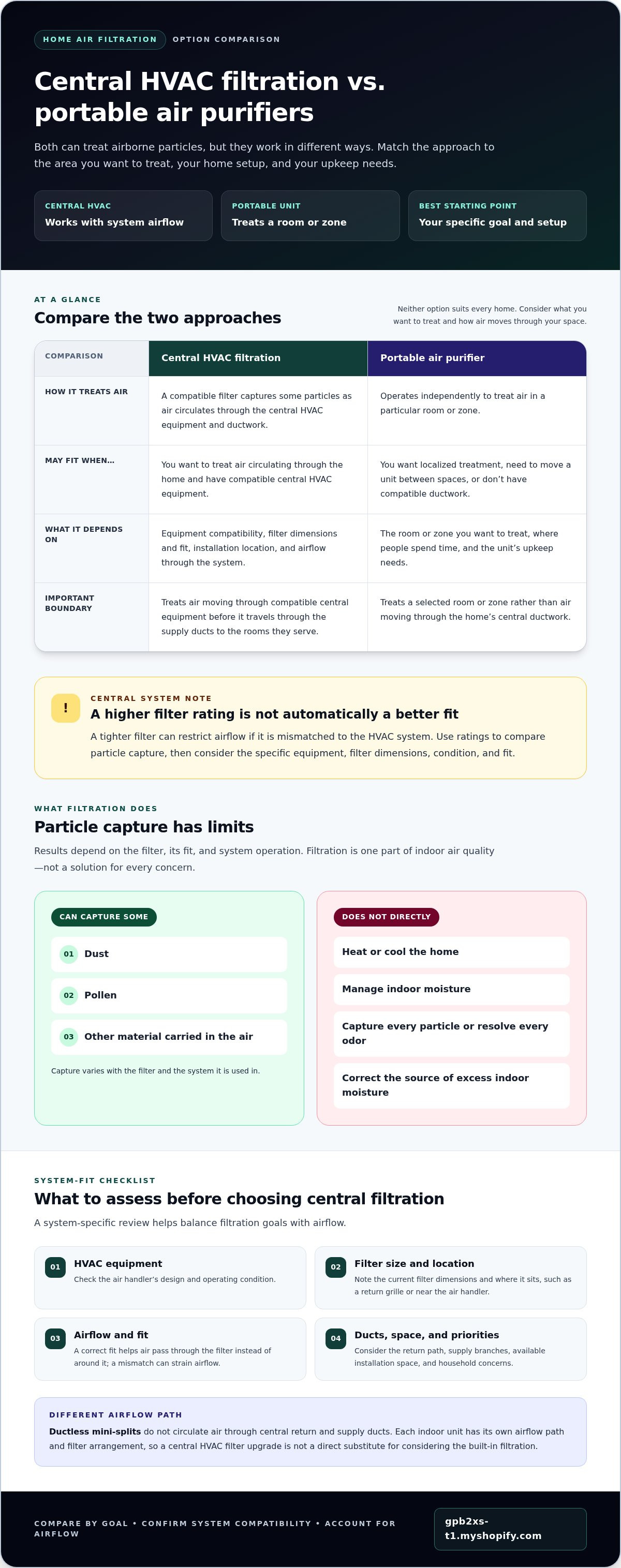
A central system works with the HVAC airflow and ductwork, making it a possible fit if you want to treat air circulating through the home. A portable purifier operates independently in a particular room or zone. It may make more sense if you want localized treatment, need to move the unit between spaces, or don’t have compatible ductwork. Compare the area you want to treat, where people spend time, and the upkeep involved. Neither approach suits every home.
How filtration treats circulating air
As the HVAC system runs, air returns from the home to the equipment. A compatible filter intercepts some particles before the air continues through the system and into the supply ducts. Filter materials and designs vary, and the types of air filters differ in how they capture particles. The filter needs to fit the system’s designated space and work with its airflow. If it doesn’t fit correctly, air can bypass it, so selecting filtration isn’t just a matter of choosing a filter by appearance or rating.
What filtration can and cannot address
Depending on the filter and system, filtration can capture some airborne particles, such as dust, pollen, and other material carried in the air. It doesn’t remove every particle. Results depend on the filter, its fit, and system operation. Matching filtration to the HVAC equipment is more useful than assuming one filter choice will suit every home.
When a broader indoor-air-quality assessment helps
Persistent odors or moisture concerns may need a different response. Particle filters alone don’t resolve every odor, and they don’t correct the source of excess indoor moisture. In Southwest Florida, homeowners may have several comfort and air-quality priorities, so it helps to consider the full picture. A technician can assess the HVAC system, ductwork, and household concerns together instead of treating filtration as a stand-alone fix.
How Whole-Home Air Filtration Works With Your HVAC System
To choose filtration that works with central HVAC, follow the air’s route. Air from the rooms enters the return duct, passes through a filter, and moves through the HVAC equipment. The system then sends conditioned air through supply ducts to the rooms. Depending on the system design, the filter may sit in a return grille or near the air handler. Its location and dimensions must match the equipment so air passes through the filter rather than around it.
A tighter filter can restrict airflow when it’s mismatched to the HVAC system, so stronger filtration isn’t automatically a better fit. Whole home air filtration system installation should account for the equipment and airflow, not just the filter’s rating.
How filter ratings relate to particle capture and airflow
MERV, or Minimum Efficiency Reporting Value, is a scale used to compare how effectively filters capture particles of different sizes under test conditions. A higher rating generally indicates greater capture of certain smaller particles, but it doesn’t promise identical results in every home. Filter construction, dimensions, condition, and fit all matter. The EPA’s guide to air cleaners discusses filtration options, including filters used with central HVAC. Use ratings to compare filters, then base your selection on the specific system rather than a universal recommendation.
Why ducts, equipment, and household needs matter
An air handler’s design, filter slot, and operating condition can affect which filtration options make sense. Duct layout matters too: the return path, supply branches, and available installation space shape how air moves through the home. A technician can assess these details alongside your priorities, such as dust concerns in frequently used rooms. This system-specific review helps balance filtration goals with airflow instead of treating a rating as the whole answer.
Ductless mini-split systems need a different filtration discussion. They don’t circulate air through the home’s central return and supply ducts. Each indoor unit has its own airflow path and filter arrangement, so a central HVAC filter upgrade isn’t a direct substitute for considering how a mini-split’s built-in filtration fits the household’s needs.
Before an assessment, note the current filter’s dimensions and where it sits. Don’t assume a larger or denser replacement will work. A technician can inspect the air handler and ductwork, then explain compatible options and their trade-offs. For Southwest Florida homes, the assessment can also consider how the existing system serves different rooms. If you’re planning HVAC work as well, explore BulletProof Air HVAC installation as part of a system-focused approach.
How to Compare Whole-Home Air Filtration Options for a Florida Home
Start with the concern you want to address, then compare options against your home’s layout and HVAC equipment. A stronger filter isn’t automatically a better choice. If it isn’t suited to the system, it may impede airflow or fail to deliver the result you expect. Use the comparison below to identify trade-offs, not to declare one approach the winner for every household.
| Option | System fit | Filtration goal | Airflow impact | Upkeep |
|---|---|---|---|---|
| Central HVAC filtration | Works with compatible central equipment and ductwork | Treats air moving through the HVAC system | Depends on filter choice, fit, and system capacity | Check and replace the filter according to system and filter guidance |
| Portable room purifier | Operates independently in a selected room or zone | Focuses treatment where the unit is placed | Doesn’t add filter resistance to central HVAC airflow | Maintain the unit’s filter and follow its care instructions |
Which filtration priorities should guide the comparison?
Be specific about what you notice. Dust settling on surfaces, seasonal pollen, pet-related particles, and other household concerns may call for different approaches. Consider where the concern occurs, whether you want to treat one room or air circulating through the home, and how much routine filter care fits your household.
Filtration options don’t capture every particle equally, and no choice should be treated as a promise of disease prevention, allergy treatment, or perfectly clean air. Use your priorities to guide a system assessment. A concern limited to one occupied room, for example, may lead to a different comparison than a goal involving air distributed through multiple rooms.
What Florida’s climate means for indoor-air planning
In Sarasota and across Southwest Florida, heat and humidity make reliable air conditioning an important part of home comfort through much of the year. Particle filtration and moisture management are separate considerations, however. A filter isn’t a substitute for addressing indoor humidity or its source. If your concern involves both airborne particles and dampness, consider the HVAC system and indoor-air conditions together rather than expecting one filter to solve both.
Whole home air filtration system installation should reflect the existing air handler, duct layout, filter space, and household priorities. Central filtration may suit a home with compatible ducted equipment and a whole-home goal. A portable unit may offer more flexibility for focused room treatment. A technician can assess the setup and explain trade-offs, including how a filter choice may affect airflow and ongoing upkeep. That comparison helps you choose a practical approach for your home, not simply the most intensive-sounding filter.
What to Expect During Whole-Home Air Filtration Installation
Whole-home air filtration system installation should begin with an assessment, not a filter choice made in isolation. The technician needs to understand how your HVAC system is configured and what you want the filtration to address. The installation plan can then be matched to the home, followed by checks to confirm the system is operating after the work.
The assessment and installation steps
The scope depends on your home, HVAC setup, and selected approach. A technician will typically review:
- HVAC equipment: The air handler and system setup help determine suitable filtration options.
- Filter location and dimensions: The existing filter slot or grille provides important information about fit and access.
- Duct configuration: Return and supply ductwork help show how air moves through the home.
- Available space: The installation location and access around equipment can affect the practical approach.
- Household priorities: Dust, pollen, pets, and other concerns help shape the filtration goal.
After the assessment, the technician matches the plan to the equipment and installation requirements. Depending on the approach, work may involve fitting filtration components in the designated location or making adjustments to accommodate the setup. The technician then checks that components are properly fitted, evaluates airflow, and confirms the HVAC system operates after installation. These checks help add filtration while keeping the system functioning as intended.
Preparing your home and planning follow-up care
Preparing the area can make equipment access easier and keep the visit focused. Before the appointment, clear the space around the indoor HVAC equipment and any filter access point. Make a note of the rooms or situations where you notice dust or other concerns, and write down questions about filter care. That context helps the technician understand your priorities without assuming every home needs the same solution.
- Move stored items away from the air handler and filter access area.
- Keep the path to the equipment clear.
- Write down household air-quality priorities and questions.
- Ask for clear guidance on the selected filter’s care and replacement.
Filter replacement intervals vary with the filter type, system use, and conditions in the home. Follow the guidance for the filter and HVAC setup rather than relying on a schedule that may not suit your circumstances. For a broader look at planning residential HVAC work in the area, this Sarasota AC installation guide covers additional project considerations.
BulletProof Air provides HVAC installation and indoor-air-quality solutions for homes in Sarasota and across Southwest Florida. Explore a filtration installation tailored to your home, equipment, and household priorities.
Plan Your Whole-Home Air Filtration Installation With BulletProof Air
Choosing filtration is only part of the decision. Your central HVAC system, ductwork, available installation space, and household priorities all influence what makes sense. BulletProof Air provides HVAC installation and indoor-air-quality solutions for residential customers in Sarasota and across Southwest Florida. The goal is to match the project to the home rather than treat filtration as a one-size-fits-all purchase.
How BulletProof Air approaches a home-specific solution
BulletProof Air’s technicians assess the existing HVAC equipment and installation conditions before shaping a plan. They consider how the system is configured, where filtration can be incorporated, and what occupants want to address, such as dust in shared living areas or pet-related particles. This assessment connects your goals to a practical installation approach while accounting for system compatibility and airflow. The recommendation is specific to your home, not simply the filter with the highest-sounding rating.
A clear project conversation should help you understand the proposed scope and what to expect. Share details that may affect the plan, including which rooms are most affected, the type of HVAC system in your home, and questions about ongoing filter care. That context helps keep the discussion focused on your actual needs.
Take the next step in Sarasota and Southwest Florida
Before moving ahead, make sure you understand the key decisions: what you want filtration to address, how the chosen approach fits your HVAC setup, and what routine care it will involve. BulletProof Air can assess your home and explain a project-specific plan, including how the installation will fit with the equipment already serving your space. That’s a more considered starting point than selecting a filter without accounting for the system behind it.
If you’re planning broader HVAC work, the Sarasota and Bradenton HVAC services guide offers related local context. For whole home air filtration system installation, the process is straightforward: share your household priorities, have the existing equipment and installation conditions assessed, review the tailored approach, and plan for filter care after the work is complete.
Talk with BulletProof Air about your home’s air filtration installation and take a clear, home-specific step toward your indoor-air-quality goals.
Take the Next Step Toward a Better-Fitted Home Solution
Make your next step a conversation about your home, not a commitment to a particular filter. A whole home air filtration system installation is most useful when the plan reflects what matters in your daily life and feels practical for your household to maintain.
Before you move ahead, note what you hope to address, where you notice it, and any preferences that could shape your decision. You might want to focus on shared living spaces, consider how often you’re comfortable handling routine filter care, or understand how a proposed approach fits the way your home is used. Bringing those priorities into the discussion can make it easier to weigh the options and choose with confidence.
You don’t need to have every technical answer before taking the next step. Start with your questions and let the conversation clarify the path forward. BulletProof Air can help you consider a home-specific solution that supports your comfort goals.
Start planning your air filtration installation with BulletProof Air and move forward with a clear, confident plan for your home.
Frequently Asked Questions
What is a whole-home air filtration system?
A whole-home air filtration system filters air circulating through a compatible central HVAC system, rather than treating only the air around a standalone unit. It filters air that passes through the system while it runs, but that doesn’t mean every room receives identical treatment or that all indoor contaminants are removed. Closed doors, system run time, and room airflow can affect how much air returns to the filter.
Is whole-home air filtration better than a portable air purifier?
Neither option is automatically better. The right fit depends on your home and priorities. Central filtration may suit households seeking to treat air circulating through ducted HVAC equipment. A portable purifier can focus on one room and move with you, which may be useful in a frequently occupied space or a home without central ductwork. Consider whether your goal is home-wide or room-specific, along with equipment compatibility and routine upkeep.
Can a whole-home air filtration system be added to an existing HVAC system?
Yes, a whole home air filtration system installation can be planned for an existing central HVAC system when its equipment and layout support the selected approach. The technician considers the air handler, filter location, duct arrangement, and available space. System condition matters too. If the equipment already has an airflow or operating issue, that may need attention as part of the plan so the filtration change works with the system rather than adding another concern.
What MERV rating should I choose for a whole-home air filter?
There isn’t one MERV rating that’s right for every HVAC system. MERV helps compare a filter’s ability to capture particles, but it doesn’t tell you whether the filter’s size and airflow resistance suit your equipment. Start with the system’s requirements and your filtration priorities, then use the rating as one selection factor. A technician can help weigh those factors together rather than recommending a rating based on the number alone.
How long does whole-home air filtration installation take?
Installation time depends on the home and the approach selected, so there isn’t one duration that fits every project. Fitting a system into an existing filter location may differ from work that requires adjustments or additional planning. Access to the equipment and the condition of the existing system can also affect the scope. Your project plan should outline the expected sequence and timing.
Does a whole-home air filtration system control humidity or remove odors?
No, particle filtration isn’t a humidity-control solution, and it won’t address every odor. A filter is designed to capture airborne particles; moisture management involves separate HVAC functions or other measures suited to the cause. Some filtration approaches may address certain odors, but results depend on the technology and odor source. If you notice persistent dampness or smells, describe them during an indoor-air-quality assessment so the concern can be considered beyond particle filtration.
How often should I replace a whole-home air filter?
Follow the replacement guidance for your specific filter and HVAC setup, because service intervals vary. How quickly a filter loads can depend on household conditions, system use, pets, and the amount of dust entering the home. Check it according to its care instructions and note whether it appears visibly loaded. Your technician can explain the filter care plan after installation, including which replacement fits the system.
If you would like maintenance or repair assistance with your Florida Air Conditioner, contact BulletProof Air Or call: 941.599.9999 for more information about how we can help.