

Why Is My Upstairs So Much Hotter Than Downstairs? Causes and Fixes
If you’re asking, “why is my upstairs so much hotter than downstairs” while the air conditioner is running, you’re not imagining the difference. A downstairs thermostat can register a comfortable temperature and shut off cooling before warm bedrooms and living spaces upstairs catch up.
Some temperature difference between floors is normal because warm air rises. But strong sun on the roof, attic heat, blocked airflow, duct issues, or a thermostat serving only the lower floor can make the imbalance worse. A few sensible checks can help you narrow down the pattern, while persistent discomfort may need a closer HVAC diagnosis.
This guide covers common causes, low-risk steps to try, and signs that the problem may need professional attention. You’ll also learn when a simple adjustment may help and when an evaluation can pinpoint what’s keeping your upstairs uncomfortable.
Key Takeaways
- Warm air rising can contribute to an upstairs temperature difference, but attic heat and sun exposure may also play a part.
- If you’re wondering why is my upstairs so much hotter than downstairs, note whether the heat affects the whole floor, one room, or certain times of day.
- Check the filter, keep supply registers clear, and reduce direct sun before changing your HVAC system.
- A ceiling fan can make a room feel more comfortable, but it won’t lower the room’s actual temperature.
- If the upstairs stays uncomfortable, BulletProof Air offers free HVAC diagnostics and explains the findings and next steps.
Why Is the Upstairs Hotter? Start with Heat, Sun, and the Attic
The downstairs feels comfortable, but the upstairs bedrooms are still warm. That’s frustrating, especially when the air conditioner is running and the thermostat says the home has reached its set temperature. If you’re asking, “why is my upstairs so much hotter than downstairs,” start by distinguishing normal heat movement from the extra heat your home may be absorbing.
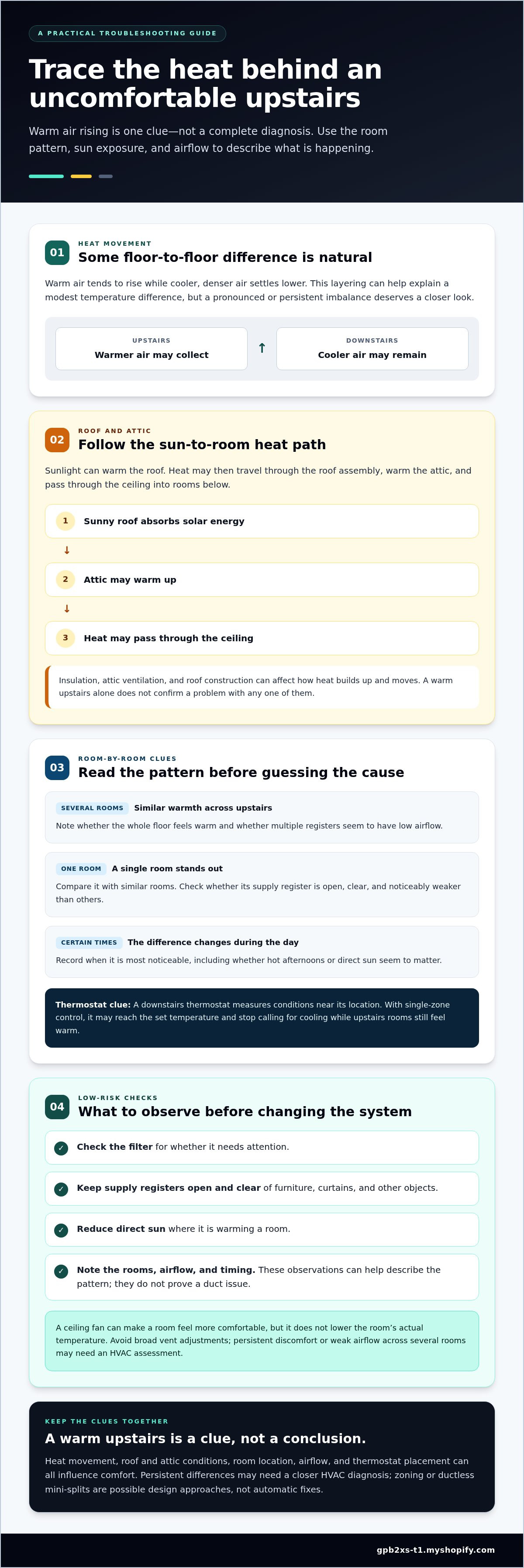
Warm air tends to rise, so upper floors can naturally run warmer while cooler, denser air settles below. But that pattern doesn’t explain every hot room, and it doesn’t show whether the HVAC system is distributing cooled air properly. Roof exposure, attic conditions, room location, and airflow can all influence comfort. Heat may move through the home in several ways, so there isn’t always a single cause.
How heat movement affects a two-story home
Temperature stratification is the natural layering of warmer air above cooler air within a space. In a two-story home, warmth from people, appliances, or cooking can move upward and collect near the second floor. At the same time, cooler air may remain lower. This helps explain a modest floor-to-floor difference, but a pronounced or persistent imbalance deserves a closer look.
Heat also moves through surfaces and materials, not only through rising air. Sunlight can warm the roof, and heat can pass through building materials toward the attic and rooms below. The basic mechanisms include conduction through materials, convection through moving air, and radiation between surfaces. These Heat Transfer Principles help explain why a sunny roof can affect upstairs comfort even when the downstairs thermostat is satisfied.
Why the attic and roof can make upstairs rooms warmer
During a sunny day, the roof absorbs solar energy. Some of that heat can travel through the roof assembly and warm the attic. From there, heat may transfer through the ceiling into rooms below. Upper rooms sit closest to this source, so they may feel the impact more than lower rooms, especially if they’re directly beneath the attic or roofline.
Attic insulation helps slow heat transfer between the attic and living space. If it’s thin, uneven, displaced, or not performing as intended, more heat may pass through the ceiling. Attic ventilation and roof construction can also affect how heat builds up and moves. These are factors to assess, not conditions that can be diagnosed just from a warm upstairs.
Southwest Florida’s heat and humidity can make an uncomfortable room feel even more oppressive. The cooling system has to contend with outdoor heat, while humid air can leave people feeling sticky even when the temperature seems close to comfortable. Still, climate alone doesn’t identify the cause. A hot upstairs may reflect normal heat movement, added attic or solar heat, an HVAC distribution issue, or several factors at once. Treat the temperature difference as a clue, not a conclusion.
How HVAC Airflow and System Design Can Leave the Second Floor Behind
Even when the cooling equipment is running, comfort depends on cooled air reaching each room and warm air returning through the system. In a two-story home, distribution can be uneven. Ducts may be leaking, restricted, or poorly balanced, but a warm room alone doesn’t confirm any of those issues. The same symptom can have different causes.
If you’re wondering “why is my upstairs so much hotter than downstairs,” pay attention to where the discomfort occurs. Do several upstairs rooms feel similarly warm, or is one bedroom noticeably worse? Does air from its supply register seem weaker than air from registers elsewhere? These observations can help describe the problem, but they don’t confirm a duct issue. A register may also be closed or obstructed, so check that it’s open and clear without making broad vent adjustments.
What ductwork and airflow clues can tell you
Compare similar rooms and note clear differences in airflow or comfort. Weak airflow at one upstairs register is a useful clue to report, not proof of a blockage or leak. Keep furniture, curtains, and other objects from covering registers. If several rooms have low airflow, or the imbalance persists despite clear registers, BulletProof Air can assess the distribution system.
Airflow is only part of the picture. A filter that needs attention or a system component that isn’t operating as intended may affect cooling, while duct conditions can influence how much air reaches particular rooms. Don’t assume replacing equipment will solve uneven temperatures. The equipment’s condition and capacity need to be assessed alongside airflow and the home’s cooling needs.
Why thermostat placement and system configuration matter
A thermostat measures conditions near its location, not the temperature in every bedroom. If it’s downstairs, it may reach the set point and stop calling for cooling while upstairs rooms still feel warm. With single-zone control, one setting serves spaces that may receive different sun exposure, airflow, and heat loads. The mismatch can be especially noticeable on hot afternoons.
Zoning and ductless mini-split systems are possible design approaches for homes with persistent differences between floors, but neither is an automatic fix. Whether an approach makes sense depends on the home, existing equipment, and source of the uneven comfort. Diagnose the problem before making system changes.
Keep a simple record before scheduling an evaluation: which rooms feel warm, whether their registers seem weak, and when the difference is most noticeable. Share those details with BulletProof Air. The company takes a diagnostic-first approach, explains its findings, and provides clear next steps. If simple observations don’t explain the imbalance, HVAC diagnostic support can help identify what needs attention without guesswork.
Is Heat Rising the Whole Story? Read the Temperature Pattern
A temperature difference is easier to investigate when you can describe exactly where and when it happens. The pattern may suggest whether sun exposure, airflow, or a broader upstairs cooling imbalance deserves attention. It won’t identify the cause by itself, but it can make an HVAC evaluation more specific.
| What you notice | What the pattern may suggest | What to record |
|---|---|---|
| The whole upstairs feels warm | A shared building or air-distribution factor may be involved. | Which rooms feel warm and whether their airflow seems similar. |
| One room stands apart | Room location, sun exposure, or airflow may differ from the rest of the floor. | Whether the room faces direct sun and how its register airflow compares. |
| A room warms later in the day | Sun exposure may be contributing, especially if the change follows the sun’s path. | When the room starts feeling warmer and whether the pattern repeats. |
| Uneven comfort continues over time | The issue may need a closer look at the home and HVAC distribution. | How long it has been happening and whether anything changed recently. |
Compare room, time, and airflow patterns
Note which rooms feel warm and whether the problem changes as the day goes on. Compare airflow by standing near upstairs supply registers while the system is running. You don’t need to remove vent covers or open ductwork. Also record the thermostat setting and how comfortable each room feels at the time.
For example, if one west-facing room becomes uncomfortable later in the day while nearby rooms stay cooler, sun exposure may be part of the pattern. If several rooms feel warm from morning onward, that’s a different pattern worth describing. Neither observation confirms a cause, but both give a technician useful context.
When the pattern deserves a closer HVAC look
Persistent discomfort during normal system operation deserves attention, particularly if it’s a change from how the home used to cool. Note any sudden drop in cooling or noticeably weak airflow, too. A temperature pattern is a clue for diagnosis, not confirmation of an HVAC fault or an undersized system. Equipment condition and capacity require professional assessment.
Keep your notes straightforward: room, time, thermostat setting, and perceived airflow. Avoid drawing conclusions from a single warm afternoon. If the unevenness continues and your observations don’t explain it, BulletProof Air offers free HVAC diagnostics and explains its findings with clear next steps. A focused HVAC diagnostic evaluation can help move the conversation from guesswork toward a clearer understanding of the issue.
What You Can Try Safely Before Changing the HVAC System
If you’re asking “why is my upstairs so much hotter than downstairs,” start with simple checks that don’t require opening equipment or altering the duct system. These steps may improve comfort and help you describe the problem clearly. They won’t correct every airflow or system issue, so treat them as a first check, not a substitute for diagnosis.
Low-risk checks to make around the home
Follow this order, starting with observations and moving to simple adjustments that don’t require specialized tools.
- Note the pattern. Record which rooms feel warm, when the discomfort begins, and whether anything has changed. This gives you a point of comparison after each household adjustment.
- Check the air filter. Look at its condition and follow the care or replacement guidance for your equipment. A dirty filter may restrict airflow, but don’t assume it explains a floor-to-floor temperature difference.
- Clear supply registers and return-air openings. Move furniture, rugs, or curtains that block airflow. Make sure registers are open, but don’t close multiple vents to force more air upstairs.
- Reduce direct sun. Use blinds or curtains in rooms that receive strong sunlight, especially during the part of the day when they become warm. Notice whether limiting sun changes how the room feels.
A ceiling fan can also help a room feel more comfortable by moving air across your skin. It doesn’t lower the room’s actual temperature, so use it for comfort rather than as proof that the cooling system has fixed the imbalance.
Changes that should not replace diagnosis
A large thermostat adjustment may make the downstairs uncomfortably cold without resolving why the upstairs isn’t cooling evenly. Avoid repeatedly lowering the setting as a workaround. Likewise, don’t close several vents or adjust dampers without qualified guidance. These changes can affect airflow through the system and may not address the cause.
Keep the checks simple. Don’t dismantle HVAC components, access refrigerant lines, or attempt electrical or equipment repairs. If the upstairs remains uncomfortable after these steps, or airflow seems unusually weak, have the system assessed instead of escalating DIY adjustments. A technician can evaluate the distribution and equipment rather than guessing from one room’s temperature.
For continued cooling problems, BulletProof Air offers free HVAC diagnostics, explains the findings, and provides clear next steps. You can also review this guide to AC repair in Southwest Florida for more context. If simple checks haven’t restored comfort, learn about help for persistent cooling concerns before making changes that could mask an unresolved system issue.
How BulletProof Air Diagnoses Upstairs Cooling Problems
When the upstairs stays uncomfortable after basic checks, guessing can lead to changes that don’t address the real issue. BulletProof Air takes a diagnostic-first approach: assess the concern, explain the findings, and outline clear next steps. Free HVAC diagnostics let you have the problem evaluated without confusing an initial assessment with a promise of a particular repair or result.
If you’re still asking, “why is my upstairs so much hotter than downstairs,” bring the pattern you’ve observed into the conversation. Which rooms feel warm? Does the problem change during the day? Do some upstairs registers seem to have weaker airflow? Those details help frame an evaluation around your home’s comfort concern rather than treating every upstairs temperature difference as the same problem.
What to expect from a clear HVAC evaluation
An evaluation may consider airflow, system operation, and how comfort varies across your home. The goal is to identify relevant concerns before discussing what to do next. BulletProof Air explains its findings in straightforward terms and provides clear next steps, so you can understand what may be contributing to the imbalance. Recommendations focus on services you need, not assumptions based on a single warm room.
The findings may point toward a repair, maintenance, or another concern that needs attention. In some homes, replacement or system design may also be relevant. That doesn’t mean a specific outcome is guaranteed or that every uneven-temperature problem requires new equipment. A careful assessment helps distinguish possible causes from what the home actually needs.
Choose a next step that fits the problem
For persistent upstairs discomfort, schedule a free HVAC diagnostic with BulletProof Air. Depending on the findings, relevant options may include Residential HVAC Repair, Maintenance, Replacement, or Service. The right next step depends on what the evaluation shows. A hot second floor alone isn’t enough to determine whether the system needs repair, adjustment, or replacement.
If system replacement or a different configuration becomes part of the discussion, the home’s layout and comfort needs matter. For an overview of that planning, see this guide to Sarasota AC installation. It’s a useful reference when considering how equipment choices relate to whole-home comfort, but it doesn’t replace an assessment of your existing system.
Start with a clear diagnosis, then decide based on the findings. Learn about scheduling a free HVAC diagnostic with BulletProof Air for clear next steps on persistent upstairs cooling problems.
Take the Next Step Toward Upstairs Comfort
If you’re still asking why is my upstairs so much hotter than downstairs, use what you’ve noticed to guide a focused next step. A clear picture of when the discomfort happens and where it’s strongest can shift the conversation from random adjustments to understanding what your home needs.
Southwest Florida’s heat and humidity put extra pressure on home comfort. BulletProof Air brings local expertise in these conditions and can help make sense of persistent cooling concerns without jumping to assumptions about equipment or repairs. The goal is to understand the issue and decide what makes sense for your home.
For clearer answers about persistent upstairs cooling concerns, schedule a free HVAC diagnostic with BulletProof Air.
Frequently Asked Questions
Is it normal for an upstairs to be warmer than downstairs?
A small difference between floors can be normal, but persistent discomfort shouldn’t be dismissed as inevitable. If you’re asking “why is my upstairs so much hotter than downstairs,” consider whether the gap is occasional or routinely disrupts sleep and daily activities. A bedroom that stays stuffy even during mild weather, for example, may deserve attention beyond the usual afternoon temperature difference. Track what feels unusual for your home rather than relying on a universal comfort threshold.
Can humidity make an upstairs room feel hotter than it is?
Yes. Humid air can make a room feel warmer and stickier because sweat evaporates less readily from your skin, reducing your body’s natural cooling. For example, a bedroom may feel uncomfortable after a shower or with the door closed, even if the thermostat reading hasn’t changed much. Temperature alone doesn’t describe the whole comfort picture. If the upstairs often feels damp or clammy, note that alongside the warmth when describing the issue.
Should I run my HVAC fan continuously to cool the upstairs?
Not necessarily. Setting the system fan to run continuously can move air between cooling cycles, but it doesn’t create additional cooling or guarantee better temperature balance. The best setting depends on your equipment and how the home is configured. Try the setting recommended in your system’s documentation, then observe whether comfort changes. If the upstairs remains warm, don’t rely on continuous fan operation to fix a persistent distribution problem.
Can a smart thermostat solve uneven temperatures between floors?
A smart thermostat may help manage schedules or respond to temperature readings from compatible remote sensors, depending on the thermostat and system. But it can’t repair restricted airflow, correct a duct problem, or make a single-zone system deliver air differently by itself. Before buying one, identify what control features your existing HVAC system supports. If the temperature gap comes from the home or equipment rather than scheduling, a new thermostat alone may not resolve it.
How often should I check or replace my HVAC air filter?
Check the filter according to the guidance for your specific HVAC equipment and filter. Replacement timing varies with filter type, household conditions, and how quickly it collects dust, so a fixed schedule may not suit every home. If it looks visibly loaded with dust, consult the equipment instructions before replacing it. Use the recommended filter size and type; an unsuitable filter can interfere with proper operation.
What should I write down before scheduling an HVAC diagnostic?
Write down which rooms feel uncomfortable, when the issue is most noticeable, and whether it began suddenly or developed gradually. Include your thermostat setting, recent filter changes, and any recent changes to the home, such as renovations or a room being repurposed. Note unusual system sounds or changes in operation, too. These details help organize the conversation and give the technician a clearer starting point without requiring you to diagnose the cause. When you’re ready, call BulletProof Air at 941-599-9999 to schedule a free HVAC diagnostic.