

Keeping Employees Comfortable and Productive: A Practical HVAC Guide
What if the thermostat isn’t the real reason employees are uncomfortable? A quick adjustment may help one area while leaving another too warm, too cool, or too humid. Keeping employees comfortable and productive takes more than chasing the thermostat setting. Start by identifying how conditions vary across the workplace and looking for patterns that may point to an HVAC concern.
Recurring complaints can be frustrating, especially when it’s unclear whether the system is involved. Comfort depends on more than air temperature, and rooms can feel different even when they share the same HVAC system. A consistent assessment helps replace guesswork with useful observations and practical next steps.
This guide explains how to evaluate workplace comfort, recognize patterns that deserve attention, and respond when problems persist. You’ll learn what to observe in different work areas, how humidity and airflow may affect comfort, and when professional diagnosis or maintenance may help. For Southwest Florida businesses, local heat, humidity, and salt air are important considerations in commercial HVAC care. BulletProof Air starts with diagnosis, explains its findings, and provides clear next steps.
Key Takeaways
- Keeping employees comfortable and productive starts with assessing what people experience throughout the workplace, not just checking the thermostat.
- Track complaints by room, time, and type of concern to spot recurring patterns rather than reacting to isolated impressions.
- Small adjustments to employee-controlled settings may help with minor concerns. Recurring complaints call for a closer look.
- Plan HVAC maintenance instead of waiting for a reported fault to prompt action.
- BulletProof Air investigates commercial HVAC concerns, explains its findings, and recommends services only when they’re needed.
Why Keeping Employees Comfortable and Productive Starts with the Indoor Environment
Keeping employees comfortable and productive begins with understanding what people experience, not just the number on a thermostat. A workplace can have one central setting and still feel different from room to room. Repeated complaints are useful signals that conditions may be uneven or an HVAC concern may need attention. They don’t, by themselves, prove that the HVAC system is the cause or that a particular adjustment will improve productivity.
Indoor comfort is shaped by temperature, humidity, airflow, and how the workspace feels to the people using it. It depends both on the building’s conditions and on individual preferences. Thermal comfort is also a building-science concept, as described in Thermal comfort and its impact on productivity.
What workplace comfort means beyond the thermostat
A thermostat measures conditions where it’s located, but employees work throughout the building. A sunny office, an interior meeting room, and an area near an entrance may feel different even with the same setting. Humidity can contribute to a stuffy or clammy feeling, while drafts or still air can change how a room feels. Clothing, activity, personal preference, and the type of work area also play a part.
Assess the whole experience, not just the setpoint. Note whether complaints recur in particular workspaces and whether people describe feeling too warm, too cool, damp, or affected by air movement. These details help distinguish a room-specific pattern from a general preference for a different temperature.
How Southwest Florida conditions shape commercial comfort
Outdoor heat and humidity are important operating conditions for commercial HVAC systems in Southwest Florida. Humid air can make indoor spaces feel less comfortable, so temperature alone may not explain employee feedback. Coastal salt air is another local consideration for HVAC equipment and system care. Consider the building and its environment when reviewing complaints instead of assuming one solution will suit every property.
Not every comfort concern comes from HVAC. Workload, workstation ergonomics, lighting, noise, and management practices can also affect how people experience the workday. An employee who reports discomfort at a desk, for example, may be reacting to a draft, an awkward setup, or both. Record the area and the specific sensation, then look for patterns that point to indoor conditions or another workplace factor. This helps avoid thermostat changes that simply shift discomfort elsewhere.
How Temperature, Humidity, and Airflow Shape the Workplace Experience
Temperature gets most of the attention, but it’s only one part of the indoor environment. A room can reach its thermostat setting and still feel uncomfortable if the air seems damp, stuffy, or unevenly distributed. When keeping employees comfortable and productive, pay attention to what people experience throughout the workday, not only to the displayed temperature.
Humidity affects how the air feels, while airflow describes how it moves through a space. A draft near a vent differs from air that feels stagnant in a crowded room. Lowering the thermostat changes the temperature setting, but it won’t necessarily address airflow or explain a persistent damp or stuffy feeling.
Recognizing humidity and airflow concerns
Noticeable signs may include rooms that repeatedly feel stuffy, a damp-feeling atmosphere, drafts in particular seats, or unusual odors. These are clues, not a diagnosis. An odor, for example, can have several possible causes, so don’t assume it identifies a specific HVAC fault. Record what employees notice and where, then use those observations to guide a closer assessment.
Patterns help make the concern more specific. If comments come from one enclosed office, the issue may be localized. If they recur across several areas, a broader assessment may be useful. Neither pattern proves the cause, but both give a technician more context than a general report that “the building feels off.”
Why comfort can vary between rooms
Rooms differ in how they’re used and occupied. A meeting space may fill quickly while a nearby office stays lightly occupied. Spaces along exterior walls can also experience different conditions from interior rooms because of their exposure to the outdoors. One thermostat reading can’t describe every occupied area.
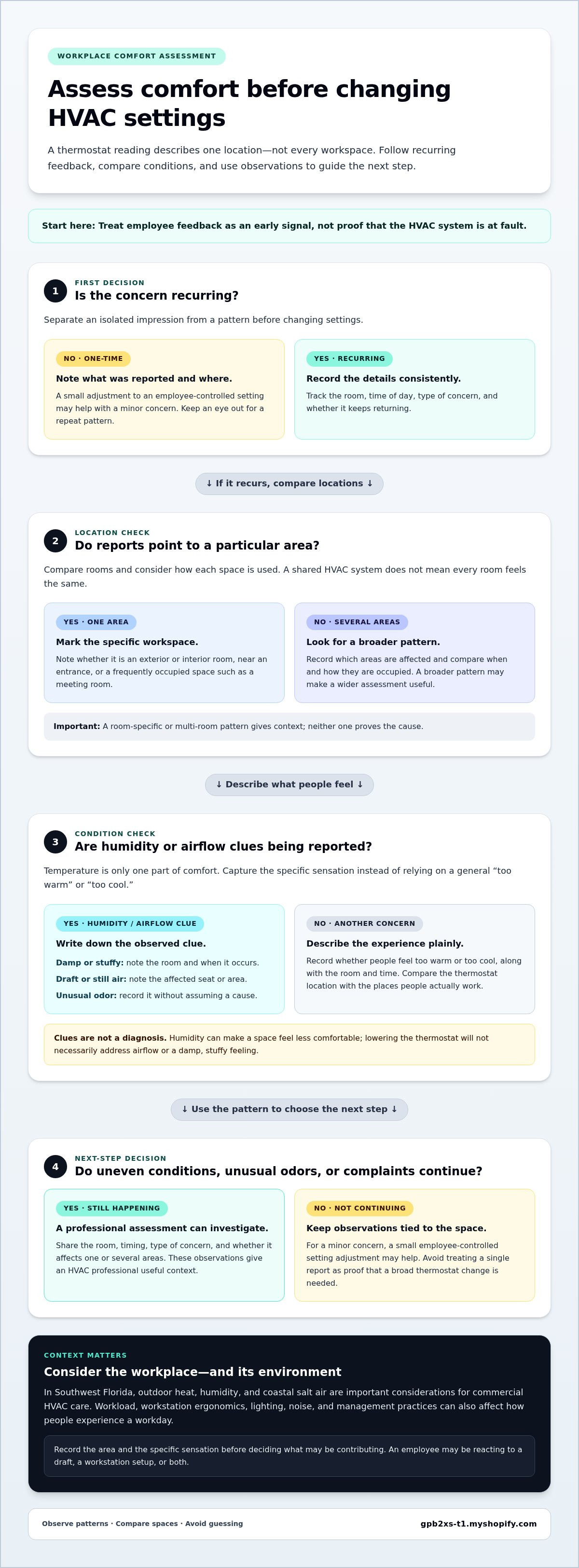
Before changing settings, note the room, time of day, type of concern, and whether it keeps returning. Compare locations and consider how each space is being used. This helps show whether complaints relate to a particular room, time, or pattern of occupancy. It also reduces the risk of a broad thermostat adjustment that leaves the original concern unexplained or makes another area less comfortable.
Use employee feedback as an early signal, not proof of a mechanical problem. If unusual odors, uneven conditions, or recurring complaints continue, a professional assessment can investigate the HVAC system. Commercial HVAC diagnosis can help clarify findings and next steps, particularly for workplaces managing Southwest Florida’s heat, humidity, and coastal salt air.
How to Assess Employee Comfort Before Changing HVAC Settings
Before adjusting a thermostat, gather enough information to understand what employees are experiencing. A brief, consistent process helps separate a one-time preference from a recurring concern and gives an HVAC professional useful context. Keeping employees comfortable and productive starts with listening, documenting patterns, and treating reported sensations as observations rather than proof of a specific system fault.
Collect useful employee feedback
Ask neutral, focused questions: Which area feels uncomfortable? What does it feel like, and when does it happen? Does the concern return, or was it a one-time experience? Avoid leading questions that suggest a cause, such as asking whether a vent is broken. Collect details relevant to the building concern without including personal information that isn’t needed to assess it.
Turn comfort patterns into practical next steps
Follow these steps in order. A simple log can reveal useful trends without turning a comfort check into a complicated survey.
- Gather feedback. Invite employees to describe the location and sensation in their own words, such as “stuffy near the conference table” or “cool by the window.”
- Identify patterns. Record the room, time, and recurring issue. Compare reports to see whether they cluster in one area, happen at a particular time, or affect multiple occupied spaces.
- Observe conditions. Note what’s happening when a complaint occurs, including how the room is being used and whether the concern seems localized or widespread. Treat these observations as context, not a technical diagnosis.
- Seek diagnosis. If the same concern continues, share the log with a commercial HVAC professional. A technician can investigate the system, explain whether the pattern points to an HVAC issue, and outline appropriate next steps.
A log shows where and when a concern recurs, giving an HVAC assessment more context than a single impression. It can also help you avoid broad thermostat changes before you know whether the issue is confined to one area or present across the building. Employee reports describe what people feel; a professional assessment can investigate whether an HVAC condition is contributing.
BulletProof Air takes a diagnostic-first approach: the team investigates, explains its findings, and provides clear next steps. It does not recommend services customers don’t need. If recurring reports suggest a system concern, commercial HVAC diagnosis can help move from observations toward a clearer understanding of the issue.
Practical HVAC Steps to Support a More Comfortable Workplace
Once you’ve gathered observations, choose a response that fits the concern. A small, temporary adjustment to an employee-controlled setting may help with an immediate preference. Repeated complaints in one room or several areas call for a closer look. Avoid repeatedly changing central settings without first checking whether the reported conditions are isolated, recurring, or widespread. Keeping employees comfortable and productive calls for deliberate HVAC care, not guesswork.
When to review maintenance, repair, or installation needs
Recurring or widespread comfort concerns are a reason to investigate system performance, not an automatic reason to replace equipment. The appropriate next step depends on the findings. These service needs are distinct:
- Preventative maintenance is planned HVAC care, rather than a response that begins only after someone reports a problem.
- Repair addresses a diagnosed issue with an existing system.
- Installation or replacement may be considered when findings and building needs point to system work.
No single service can be assumed to resolve every comfort complaint. There may be more than one contributing factor, so base decisions on the building’s conditions and system findings instead of assumptions. For guidance on evaluating commercial HVAC needs and a service partner, see this guide to commercial HVAC companies.
Account for Southwest Florida’s commercial HVAC demands
Commercial properties in Southwest Florida operate in conditions shaped by heat, humidity, and, in coastal areas, salt air. These factors make local climate knowledge useful when reviewing comfort concerns and planning HVAC care. Commercial HVAC Preventative Maintenance can be part of a planned approach, while repair or installation decisions should follow an assessment of the specific system and building.
Planned maintenance and fault response serve different purposes. A maintenance plan keeps HVAC care on the agenda; repair addresses an identified problem. Neither is a blanket promise about how every room will feel. Match the work to professional findings, and keep track of recurring concerns so the assessment reflects how the building is actually used.
BulletProof Air uses a diagnostic-first process to investigate, explain findings, and provide next steps without recommending services customers don’t need. Explore BulletProof Air’s commercial HVAC services for commercial HVAC care in Southwest Florida.
How BulletProof Air Helps Businesses Address HVAC Comfort Concerns
Recurring comfort concerns can leave business owners unsure whether to adjust settings, arrange maintenance, or investigate a system problem. BulletProof Air helps commercial properties across Southwest Florida move from concern to informed next steps with a diagnostic-first approach. The team investigates, explains its findings, and connects recommendations to the property’s needs. Keeping employees comfortable and productive starts with understanding what’s happening in the building, not assuming a particular service is the answer.
What businesses can expect from a diagnostic-first approach
BulletProof Air provides free HVAC diagnostics for commercial customers. The team investigates the concern and explains what the findings mean for your property. Recommendations are tied to the diagnosis, and BulletProof Air does not recommend services customers don’t need. You’ll receive clear next steps to help guide decisions about ongoing care or system work, without a promise that one service will resolve every comfort issue.
Employee observations can point to a concern, but they don’t confirm its cause. A professional assessment can help determine whether commercial HVAC repair, preventative maintenance, installation, or replacement fits the findings and the building’s needs. The appropriate option depends on the property, not assumptions based on a single complaint.
When to request commercial HVAC support
Arrange an assessment when comfort complaints keep returning, affect multiple areas, or coincide with a change in system operation. Share which spaces are affected and when the concern tends to occur. That context gives the diagnostic process a practical starting point. For urgent commercial needs, BulletProof Air provides 24/7 Emergency Service.
For local context, the Sarasota and Bradenton HVAC services guide offers further information about HVAC support in the area. Southwest Florida’s heat, humidity, and coastal salt air are relevant considerations for commercial properties, making locally informed diagnosis and planned system care useful parts of a building’s HVAC approach.
BulletProof Air provides commercial HVAC repair, preventative maintenance, installation, and replacement based on diagnosed needs. Clear findings help you understand the issue and choose a reasonable next step, whether that means addressing a reported fault or planning HVAC care. You don’t have to guess at the cause or commit to work without a clear reason.
Call BulletProof Air at 941-599-9999 or schedule online to discuss commercial HVAC concerns at your property. For urgent needs, 24/7 Emergency Service is available for commercial customers.
Make Workplace Comfort an Ongoing Priority
Turn comfort observations into a simple routine. Choose someone to collect recurring feedback, note changes in how spaces are used, and revisit concerns when conditions or occupancy shift. This gives your team a practical way to notice emerging patterns and decide when a professional assessment makes sense. Keeping employees comfortable and productive isn’t about finding one setting that suits everyone; it’s about responding thoughtfully to the workplace your team uses.
If a concern keeps returning, you don’t have to keep guessing at the cause. BulletProof Air can help your business understand its commercial HVAC needs and identify appropriate next steps. Free HVAC diagnostics, local knowledge of Southwest Florida’s heat, humidity, and salt air, and 24/7 Emergency Service for commercial customers support both ongoing concerns and urgent needs.
Ready to take the next step? Schedule online or call BulletProof Air at 941-599-9999 to discuss your commercial HVAC needs. A clearer understanding of your building’s conditions can help you make more informed decisions for the workplace.
Frequently Asked Questions
How does indoor temperature affect employee comfort and productivity?
Indoor temperature can shape how comfortable employees feel, but perceived comfort isn’t the same as a measured change in productivity. Someone may find a room distracting or unpleasant without that experience proving a specific effect on work output. If employees report trouble concentrating alongside temperature complaints, record both separately. This helps managers address workplace conditions without assuming an HVAC adjustment alone will improve performance.
Can humidity make an office feel uncomfortable even when the thermostat setting seems right?
Yes. Humidity describes moisture in the air and can change how a room feels even if the thermostat reading seems acceptable. Staff may describe a room as clammy or heavy rather than simply warm. Those descriptions are useful observations, not a technical diagnosis. Record when and where the sensation occurs, especially if it returns, and share the pattern during an HVAC assessment.
What should I do if employees in different rooms report different temperatures?
Write down each affected room, when the concern happens, and whether employees describe feeling too warm or too cool. Note whether reports recur during similar room use, such as in a regularly occupied meeting space. Different reports don’t necessarily mean the thermostat is faulty, and one setting may not suit every area. Room-specific notes give an HVAC professional a clearer starting point for assessing conditions.
How often should a commercial HVAC system receive preventative maintenance?
There isn’t one maintenance schedule that fits every commercial property. Planning depends on the system and the building’s needs, so don’t automatically apply another property’s schedule. Keep a record of past service, recurring operating concerns, and changes in how the space is used. A commercial HVAC professional can use that context to discuss an appropriate preventative maintenance approach.
When should a business call for commercial HVAC repair?
Arrange an assessment when a concern keeps returning or the system’s operation changes in a way that disrupts normal use of the building. Examples include cooling that no longer seems consistent or a system that stops operating as expected. For urgent commercial needs, BulletProof Air provides 24/7 Emergency Service. Share what changed and when it began to give the team useful context for diagnosis.
Does BulletProof Air offer free commercial HVAC diagnostics?
Yes. BulletProof Air offers free HVAC diagnostics. Its diagnostic-first approach is to investigate the reported concern, explain the findings, and provide clear next steps based on the property’s needs. A diagnostic helps clarify the issue; it doesn’t mean a particular repair or system change is necessary. BulletProof Air does not recommend services customers don’t need.
How can Southwest Florida’s climate affect commercial HVAC needs?
Southwest Florida’s heat and humidity are important considerations when planning commercial HVAC care, while salt air is relevant for coastal properties. Describe the building’s setting and any recurring system concerns during an assessment. A locally informed evaluation can consider those factors alongside the equipment and property instead of relying on a generic assumption about what the system needs.