

Preventing Mold in HVAC Systems: A Florida Homeowner's Guide to Clean Air
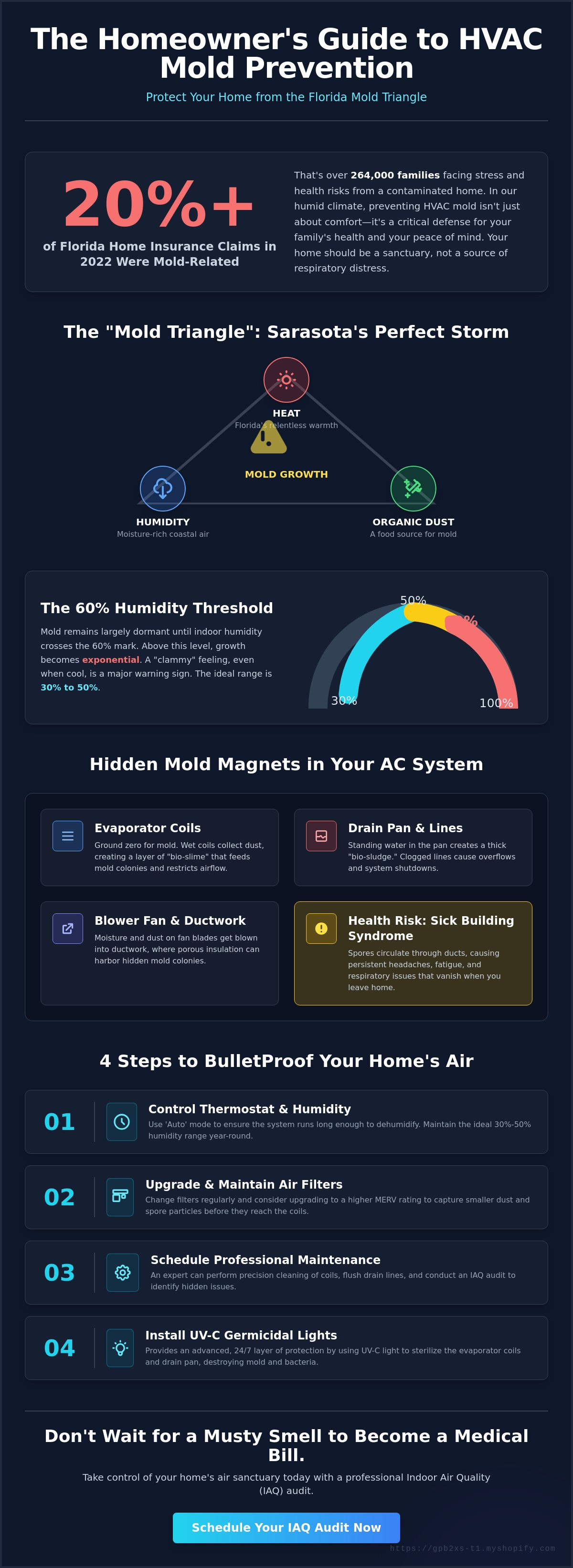
Did you know that in 2022, mold-related insurance claims accounted for over 20% of all home insurance claims in Florida? That is more than 264,000 local families facing the stress and health risks of a contaminated home. In our humid Sarasota climate, preventing mold in hvac system units isn't just a matter of comfort; it's a critical defense of your family's health and your peace of mind. Your home should be a sanctuary, not a source of respiratory distress.
It's exhausting to deal with itchy eyes or musty odors while your AC runs constantly, yet the air still feels heavy and damp. You shouldn't have to live in fear of hidden growth or expensive remediation bills. We'll show you the professional strategies used to stop fungal growth before it starts, ensuring your indoor air stays crisp and safe. This guide covers how to maintain the ideal 30% to 50% humidity range and use precision maintenance to keep your system running efficiently all year long.
Key Takeaways
- Understand the Florida "Mold Triangle" and why your home’s air sanctuary requires a 24/7 structural defense against heat and humidity.
- Identify the critical "mold magnets" in your AC, such as evaporator coils and drain pans, where moisture and dust create the perfect environment for growth.
- Learn the essential thermostat settings and filter upgrades necessary for preventing mold in hvac system components while lowering your energy bills.
- Discover how UV-C germicidal lights provide an advanced layer of protection by sterilizing your system’s internal parts around the clock.
- Find out how specialized IAQ audits and professional maintenance plans can "BulletProof" your home against expensive remediation and health risks.
Why Sarasota Homes are Breeding Grounds for HVAC Mold
Your home should be your sanctuary. It's the one place where you deserve a protected environment, free from the sweltering heat and heavy air of the Gulf Coast. Unfortunately, Florida's climate is a relentless adversary. In Sarasota, we deal with the "Mold Triangle," a perfect storm of heat, high humidity, and organic dust. When these three elements meet inside your dark, cool air handler, your system stops being a comfort provider and starts becoming a laboratory for fungal growth.
The salt air from our nearby beaches adds another layer of complexity. Salt accelerates the corrosion of your evaporator coils, creating tiny pits and rough surfaces. These imperfections trap moisture and dust more effectively than smooth, clean metal. This creates a stubborn layer of "bio-slime" that is difficult to remove and provides a steady food source for spores. As we move through 2026, climate trends show that Sarasota is experiencing longer periods of peak humidity, making the job of preventing mold in hvac system components harder than ever before. Your system is likely running longer cycles, which means more condensation is sitting in your drain pan right now.
The 60% Humidity Threshold
Mold is opportunistic. It remains largely dormant until indoor humidity levels cross the 60% threshold. Once you hit that mark, growth becomes exponential. During a typical Sarasota summer, your AC might cool the air quickly but fail to run long enough to remove the deep moisture. This leaves your home feeling "clammy." If you notice your home feels sticky even when the air is cool, professional hvac services near me can perform a precision humidity audit to find the source of the spike. We use advanced sensors to track these levels, ensuring your system doesn't just cool the air, but actually dries it out.
Health Risks of Circulating Spores
Poor indoor air quality (IAQ) is a silent threat to your family's well-being. When mold takes root, it releases microscopic spores that use your ductwork as a high-speed highway to every room in the house. This often leads to "Sick Building Syndrome," where residents experience persistent headaches, fatigue, and respiratory distress that mysteriously vanish when they leave the home. This Indoor mold overview details how these spores can trigger severe reactions in sensitive individuals. For families in Lakewood Ranch and Bradenton, the urgency is real. Preventing mold in hvac system units is the only way to ensure the air you breathe at night is actually clean. Don't wait for the musty smell to become a medical bill; take control of your home's air sanctuary today.
Identifying the Hidden Mold Magnets in Your AC System
Mold doesn't just appear; it colonizes specific damp environments within your unit. Understanding these "magnets" is the first step in preventing mold in hvac system contamination. Your air conditioner is designed to remove moisture, but if that moisture isn't managed perfectly, the system itself becomes the source of the problem. There are four primary areas where growth typically starts: the evaporator coils, the condensate drain pan, the blower fan, and porous ductwork insulation.
The Role of the Evaporator Coil
The evaporator coil is the ground zero for most mold issues. As warm air passes over the cold metal fins, moisture condenses into water droplets. This is a natural part of the cooling process. However, if your air filter allows even a small amount of dust to pass through, that dust sticks to the wet coils. This creates a layer of organic "food" that mold colonies crave. Over time, this buildup restricts airflow and forces your system to work harder, leading to higher bills and poor air quality. Professional ac repair and precision cleaning are vital to keep these coils surgically clean and efficient.
Clogged Drain Lines and Pans
Directly beneath those coils sits the condensate drain pan. Its job is to catch the dripping water and channel it outside through a PVC line. In the intense Florida heat, this standing water can quickly turn into a thick, jelly-like bio-sludge. This "algae bloom" is a common problem in Southwest Florida homes, often leading to total system shutdowns. You'll know you have a problem if you see standing water in your secondary emergency pan or if your system's float switch trips. A properly installed p-trap acts as a critical moisture barrier, preventing sewer gases and extra humidity from entering the air stream. Referencing the EPA guide to mold and moisture confirms that keeping these drainage systems clear is the most effective way to stop indoor growth.
The blower fan is another "forgotten" component that requires attention. If mold grows on the fan blades, it literally flings spores into your air every time the system kicks on. Similarly, if the porous insulation inside your ductwork or plenum gets damp, it stays damp. This provides a deep, dark home for colonies that are nearly impossible to reach without professional equipment. Don't let your system become a health hazard; schedule a professional inspection to ensure your home remains a clean air sanctuary.
4 Practical Steps to Prevent HVAC Mold Today
Building a defense against fungal growth doesn't require a degree in mechanical engineering. It requires consistency and a proactive mindset. Now that you know where the "magnets" are located, you can implement a strategy for preventing mold in hvac system units before the next Sarasota heatwave hits. These four steps focus on moisture control and starvation, removing the conditions mold needs to survive.
Thermostat Mastery: Dry Mode vs. Cool Mode
Your thermostat is your primary weapon against humidity. Many modern units in Florida feature a "Dry Mode." This setting specifically slows down the fan speed to allow the air to spend more time against the cold evaporator coil, pulling out significantly more moisture than standard "Cool Mode." If your home feels muggy but the temperature is fine, switch to Dry Mode for a few hours.
Always keep your fan setting on "Auto" rather than "On." When the fan is set to "On," it continues to blow air over the wet coils even after the cooling cycle ends. This actually evaporates the water back into your home, spiking your humidity levels. For Sarasota homeowners traveling away for the season, never set your thermostat higher than 78 degrees. Anything higher allows the indoor humidity to climb into the danger zone above 60%.
Filter Selection and Maintenance
Filters are the first line of defense in starving mold of its food source: organic dust. To maintain your home's air sanctuary, aim for the MERV 8 to MERV 13 sweet spot. These filters are dense enough to trap microscopic spores and skin cells without suffocating your system's motor. Avoid "washable" or permanent filters. In our climate, these rarely dry completely before being reinstalled, which turns the filter itself into a mold colony. Use this monthly "Sanctuary" checklist to stay ahead of the curve:
- Swap the filter: Do this every 30 days during peak summer months.
- Check the drain line: Ensure water is flowing freely to the exterior of your home.
- Inspect the plenum: Look for any damp spots or condensation on the outside of the air handler.
- Listen for clicking: A struggling system often makes noise before it fails.
Finally, look up. Many mold issues start in the attic. If your ductwork has small leaks, it acts like a vacuum, pulling in 120-degree, humid attic air. This hot air meets the cold air inside your ducts, causing immediate condensation. Sealing these leaks is a professional task, but you can visually inspect your duct connections for any peeling tape or visible gaps. Taking these small steps today ensures your HVAC remains a dependable source of clean air rather than a hidden health risk.
Advanced Defense: UV Lights and Professional Maintenance
While DIY maintenance provides a solid foundation, Sarasota's extreme humidity often requires a more robust shield. We call this the "BulletProof" approach. It's about moving beyond simple cleaning to implementing structural defenses that work 24/7. When you're serious about preventing mold in hvac system units, you need technology that actively destroys spores before they can colonize your air handler. This advanced defense turns your HVAC system from a potential hazard into a true air sanctuary.
How UV Lights Kill Mold Spores
UV-C germicidal lights are the gold standard for internal system sterilization. These lights don't just "clean" the air; they disrupt the very DNA of mold spores, rendering them unable to reproduce or survive. For maximum effectiveness, these lights must be aimed directly at the evaporator coil, which we've identified as the primary "mold magnet." A 2022 study demonstrated that a specific dosage of UV-C light could achieve a 99.99% reduction in black mold. By installing these lights, you ensure that the heart of your AC system remains sterile even during the wettest months of the Florida summer.
For homeowners facing persistent dampness, a whole-home dehumidifier is the ultimate weapon. These systems integrate directly with your existing ductwork to maintain the EPA-recommended humidity range of 30% to 50%. This is a level that standard air conditioners often struggle to reach on their own in Southwest Florida. By removing the moisture at the source, you starve mold of the environment it needs to thrive. This proactive strategy is far more cost-effective than facing a $10,000 remediation bill later.
The Value of Maintenance Plans
Maintenance is not just a "check-up"; it's a precision operation. A professional mold-prevention tune-up includes clearing the condensate lines with high-pressure air, chemically treating the drain pan to prevent bio-sludge, and inspecting the plenum for air leaks. Regular maintenance is the most effective way to prevent the #1 cause of ac repair in sarasota: moisture-related component failure. When a technician catches a clogged drain or a pitted coil early, they save you from the stress of a sudden breakdown during a heatwave.
Choosing a reputable hvac company near me ensures that these inspections are performed with the specialized knowledge our local climate demands. Our technicians look for the subtle signs of salt-air corrosion and moisture retention that generic checklists often miss. This level of precision is non-negotiable for protecting your family's health and your home's value. Protect your air sanctuary today by scheduling a professional IAQ audit.
BulletProof Your Air: Expert IAQ Solutions in SW Florida
The air you breathe inside your home should never be a source of anxiety. While the Florida climate is relentless, your defense doesn't have to be. BulletProof Air provides the definitive solution for homeowners through our specialized Indoor Air Quality (IAQ) audits. These aren't just surface-level checks. Our audits are technical deep-dives designed for preventing mold in hvac system units by identifying microscopic moisture traps before they become a health hazard. We don't just fix equipment; we restore your home’s air sanctuary.
Our technicians act as the primary first responders for Florida mold issues. We understand that a musty odor or a spike in humidity is an emergency that affects your family's safety. Because we live and work in the same climate, we know exactly how the 2026 weather patterns are impacting local systems. We arrive with the specialized tools and heavy-duty components required to withstand salt-air corrosion and extreme heat. Booking your precision maintenance visit for 2026 is the single most important step you can take to ensure your system remains a barrier against the elements.
Customized Solutions for Sarasota & Bradenton
Every community in Southwest Florida faces slightly different challenges. Whether you are in a high-wind area in Lakewood Ranch or a salt-heavy environment in Sarasota, we tailor our IAQ strategies to your specific zip code. We take pride in our rapid response times for musty odor emergencies. If you smell something "off," our team is ready to deploy immediately. We stand behind our "No-Repeat-Visit" promise. This means we use total accuracy during our precision cleaning to ensure the job is done right the first time, eliminating the common consumer anxiety of recurring growth.
Restore Your Sanctuary Today
Mold is an aggressive opponent in Florida, but it's entirely preventable with the right partner. You have worked hard to build a life here; don't let poor air quality compromise your investment or your health. By choosing a proactive maintenance strategy, you are choosing long-term durability and lower energy bills. We provide the strength and resilience your home needs to stay cool, dry, and safe all year long. Take the definitive step toward a healthier home environment right now. Secure your home’s air quality with a BulletProof Maintenance Plan and breathe easy knowing your sanctuary is protected by the best in the business.
Secure Your Sarasota Sanctuary Today
Your home deserves to be a protected environment where your family can breathe easily. We've explored how the Florida "Mold Triangle" threatens your comfort and why specific components like evaporator coils require constant vigilance. By focusing on preventing mold in hvac system units, you ensure your indoor air remains crisp and safe regardless of the intense Gulf Coast humidity. Implementing advanced defenses like UV-C lights and whole-home dehumidifiers isn't just an upgrade; it's a definitive commitment to your long-term health.
While indoor air quality is vital, protecting your property's exterior plumbing is also part of a complete maintenance plan. To learn how to safeguard your fixtures during seasonal changes, find out more about preventative care for your home's infrastructure.
This commitment to a dry, stable environment also safeguards your most cherished belongings, allowing you to proudly display custom wall art or high-end albums from Photobook Press without worrying about moisture damage.
Our expert technicians serve Sarasota and Bradenton with a focus on precision and rapid response. Whether you need an emergency AC repair or a specialized IAQ installation, we bring the authoritative skill required to "BulletProof" your home. Don't wait for a musty odor to signal a crisis. Take the proactive step toward total air security right now and eliminate the threat of fungal growth for good.
Restore your home's sanctuary with an expert IAQ audit from BulletProof Air. You can trust our team to provide the dependable, high-durability solutions your home requires for lasting peace of mind.
Frequently Asked Questions
What does HVAC mold smell like?
Mold in your air conditioner typically produces a pungent, musty, or earthy odor often described as "dirty sock syndrome." This scent is usually most intense when the system first kicks on and begins circulating air. If you notice a persistent smell of dampness that doesn't go away, it's a clear sign that organic growth is present on your coils or within your ductwork.
Can I clean mold out of my AC vents myself?
You can safely wipe down the exterior grilles of your vents, but internal cleaning requires professional equipment and expertise. Mold often takes root deep within the plenum or porous insulation where household sprays cannot reach. Disturbing these colonies without proper containment can actually fling millions of spores into your air, worsening the problem throughout your home sanctuary.
How often should I change my filters to prevent mold in Florida?
You should change your air filters every 30 days during the peak Florida cooling season. In our humid climate, filters trap organic dust that quickly becomes damp, creating a perfect breeding ground for fungi. This simple, consistent habit is the most effective DIY strategy for preventing mold in hvac system components and ensuring your unit breathes freely.
Do UV lights really stop mold in HVAC systems?
Yes, UV-C germicidal lights are highly effective at sterilizing the internal surfaces of your air handler. These lights use a specific wavelength to disrupt the DNA of mold spores, rendering them unable to reproduce or survive. By mounting these lights near the evaporator coil, you provide a 24/7 defense against the "bio-slime" that typically clogs Sarasota systems.
Is mold in my air conditioner a health emergency?
While it may not require a 911 call, mold in your air stream is a significant health issue that requires urgent professional attention. Breathing in circulating spores can lead to "Sick Building Syndrome," causing respiratory distress, fatigue, and persistent headaches. We treat these situations with high priority to quickly restore the safety and comfort of your home environment.
Why is my AC making my house feel humid and sticky?
Your system is likely failing to complete a full dehumidification cycle, often due to a dirty evaporator coil or incorrect fan settings. If the unit cools the air too quickly without removing moisture, your indoor humidity will stay above the dangerous 60% threshold. Professional preventing mold in hvac system audits can identify if your system needs a precision tune-up to restore its drying capacity.
How much does professional HVAC mold cleaning cost in Sarasota?
The cost for professional cleaning depends on the level of contamination and the complexity of your ductwork. In the Sarasota and Bradenton area, homeowners should expect pricing to align with regional industry standards for specialized labor and antimicrobial treatments. It's best to request a precision inspection to get an accurate quote for restoring your system's cleanliness.
Can a clogged drain line cause mold growth?
Yes, a clogged drain line is a leading cause of mold because it traps standing water inside your unit. This warm, stagnant water quickly turns into a thick bio-sludge in the drain pan, which then releases spores into the air handler. Keeping your condensate line clear is a non-negotiable part of a professional maintenance plan to prevent system-wide contamination.
If you would like maintenance or repair assistance with your Florida Air Conditioner, contact BulletProof Air Or call: 941.599.9999 for more information about how we can help.